“Da Island Guy”
Sounding Off Social
Well America, what just happened? A couple weeks ago the Yankees fell flat in the World Series. Over recent days in college football, we saw Georgia get beat by Ole Miss. Even soccer had its shocking result as Messi’s Inter-Miami squad got knocked out of the MLS playoffs by Atlanta United. Maybe the post-game analysts, sports radio pundits and podcast hosts are gonna make it make sense.

Then came the presidential election. It’s going to take some time to have it all make sense, but we gotta avoid being stuck. After a disappointment like happens in a big game, the commentators might run through the season from start to finish to help connect the dots. Moreover, the analysis might look at the team’s past and present to consider their future options. We need to do the same to answer the question, “how does America explain itself?” Maybe one aspect is that folks see their vote like voting for contestants on a realty tv show. Plus, with around 6 million less folks voting for president compared to 2020, and the social hierarchy from history, looks like many had more dread than hope.

But there’re lots of other factors to pull in when reviewing the reality of our current times, in terms of history and legacy. For example, during biblical days there was a pendulum swing over a 450-yr period between good Kings and bad Kings, where God at times had to step in to set things straight. But let’s make it make sense from SAIC’s ongoing deep dive in American history, the ‘Black to America’ story and #HometownStrong comebacks. We learned that throughout America’s almost 250-yr history, author Corey Brettschneider says we’ve seen a similar pendulum swing:
- We’ve flipped back-and-forth between reckoning and recovering in the journey of America.
- It was the efforts of ‘We the People’ that ensured America kept moving and growing.
Reckoning had Democracy on edge, while recovery had it on elevate. Then, add-in thoughts Dr. King shared in 1967 from assessing the civil rights movement and race relations in his book “Where Do We Go From Here: Chaos or Community?”. He once said that “darkness cannot drive out darkness only light can do that. Hate cannot drive out hate, only love can do that.” SAIC’s footnote on King’s message is that “politics cannot drive out politics, have civics help do that.” A cold hard truth is that love doesn’t spread hate, only self-hate does that. Light doesn’t spread darkness, only darkness does that. So for America to heal, how’re we gonna address the self-hate, the darkness, the hypocrisy?

Furthermore, the presidential campaign revealed some things about trying to heal election wounds. No one with a wound goes out and keeps re-injuring the wound, expecting it to heal. It’ll heal when given treatment or surgery or time, as with athletes after a hard-fought game or injury. The problem we have is that sometimes politics keeps re-harming the wound. So we’ve gotto do some analysis to help America explain itself (to itself). For starters, there’s a void/disconnect in how we see America and each other in:
1. Humanity
SAIC’s social-edge framework is built on the shift from black & white TV to color TV. Black & white TV beams a stream of ‘white light’, with varying shades of gray. Color TV beams three streams of ‘colored light’ (red, green, blue), when combined give the beautiful picture on our sets. America began with a single stream of ‘white light’. The nation’s journey towards a more perfect Union is shifting to a multi-stream ‘array of light’. The ever-present challenge in America is some mainly want to stream ‘white light’. This sadly plays out across humanity and the annals of time in a mindset of “whiteness over otherness.”
2. Democracy
Each time our democracy was on edge it was preceded by a stark ‘public debate’ or provable ‘lie’. Around the time of our founding and the subsequent abolition period, the debate was that Blacks were inferior (three-fifths clause). During the Antebellum period, a ‘debate conclusion’ led to Dred Scott being told he had no rights as a citizen (Supreme Court Ruling). More recently after the 2020 elections, things went off the rails. In each case, the wranglings led to seismic moments in American history. So, understanding modern elections and how we got here means connecting the dots across history, civics and culture.
3. Party
Political parties took shape around 1796 and more fully by the 1800 elections as Federalists and the Democratic-Republicans. Now, don’t get stuck on labels since party names have changed and ideology flipped between parties over time. The key thing to note is ideology flips between living in contradiction or living in conviction. An example of this from the early days was in slavery as a contradiction to the Declaration of Independence ideal of equality. These days the contradictions play out in election polling data and public policy info. Was the election really about the economy or other contradictory factors?

4. History
It’s said that controversy sells, sex sells, celebrity sells. This election saw ‘bigotry sells’ surface in new ways. These were demeaning moments against different racial groups which have already begun to affect college campuses and Black voters. In the early/mid 1900s there were minstrel shows which often had folks in blackface as a gesture meant to be funny but was instead demeaning. Decades later there was Archie Bunker, who played the lead role in a sitcom serving up a similar mixture. What we just experienced and have seen in history felt like it came from the ‘political supermarket’ of old.
Maybe Dr. King would take a page from scripture or ‘Uncle Sam’ take a page from history in asking, “what does it profit a nation to lie to the whole world but lose its soul?” In early America we had one group of politicians pushing the Alien and Sedition Acts of 1798 while another group of NJ citizens were crafting the Township Act of 1798. Same year, two different realities. Since today looks like this is America, we can take a page from King’s work to “do something for country, keep moving with new energy.” The civil rights movement knew that it’s ‘We the People’ that keep us on the ‘life, liberty and happiness’ path.

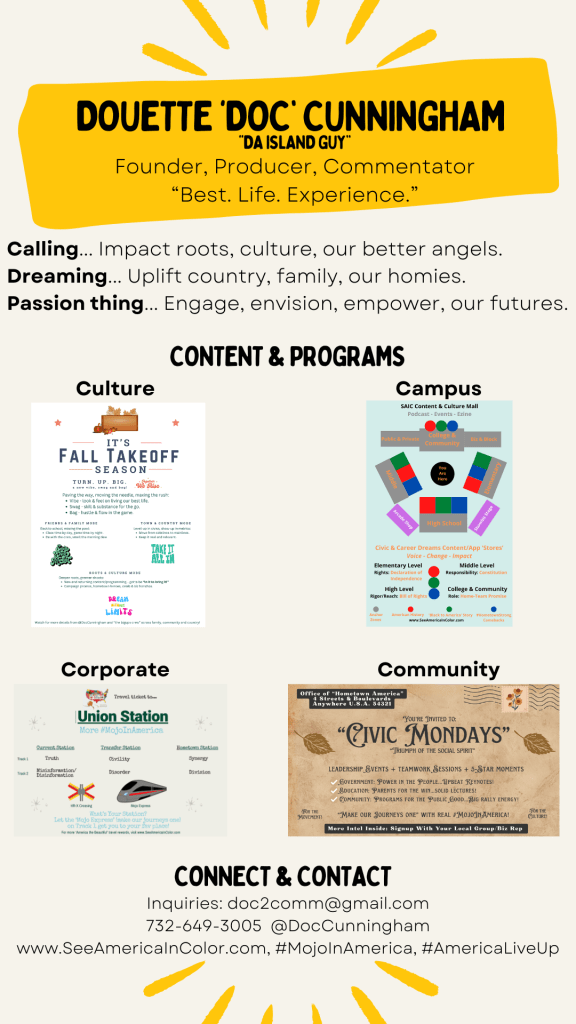
Chime-in on impacting Democracy & Public Good, Education & Community or Entrepreneurship & American Dream, ‘Civic Mondays’ events or Civics & Community forums. Plus, you can “J.A.M. With Us” (join a movement) in civic engagement, social change and community life. Checkout the Signup Center below.
Tracks: Jazmine Sullivan – Stand Up – https://youtu.be/X-6g7My_j14?si=XO1qpHiMVESZOWjr
John Mayer – Waiting on the World to Change – https://youtu.be/oBIxScJ5rlY?si=VCVIxXoKolm8Pq4z
Signup Center
 See America In Color