Featured

‘America 2K26’ and The Nation’s Fix! How the Founding Ideals Inform our Goals, While an Eye on Public Service Inspires our Game

Preview Summary –

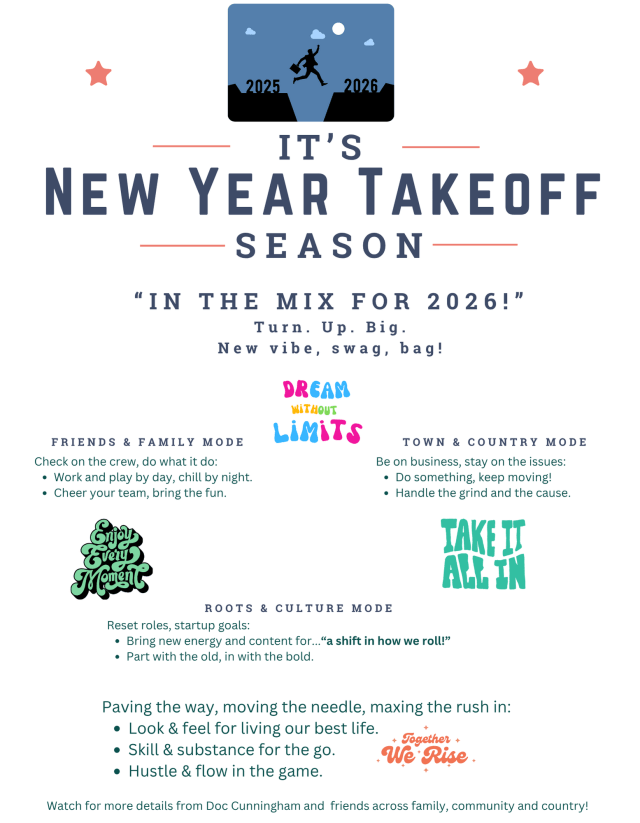
  • Looking towards the new year offers a reset and fresh mindset. Some folks will be saying, “out with the old, in with the bold”.
  • The People’s Plan is based on the first 20 years of America’s founding. The ‘Turn Up’ Agenda is about being “In the Mix for 2026” across history, civics and culture.
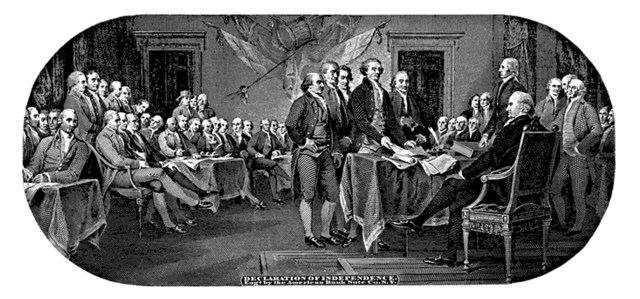
  • There’s more rational and oomph for how America’s next chapter might include the Declaration of Emergence where the nation gets to bloom in all its colors, since after winter must come spring.

Signup Center –

Mission Option #1: ‘Country Road’
Mission Option #2: ‘Community Road’

Mission Option #3: ‘Family Road’
Main Content –
Doc Cunningham
“Da Island Guy”
Sounding Off Social

Well, with 2025 just about done, the countdown has begun! Whether it’s folks hanging out at the iHeart Jingle Ball concert, office holiday party or some other social meet-up, the good times gonna be on and popping. Soon we’ll see the party revelers lined-up at the heart of Times Square. But there’s also a kinda count-up that’s happening too, as the new year offers a reset and fresh mindset. Some folks will be saying, “out with the old, in with the bold”. That’s one way to think of SAIC’s rollout of “America 2K26 and the nation’s fix”. Our overall approach is seen in key mission options across country, community and family.

The Nation’s Fix

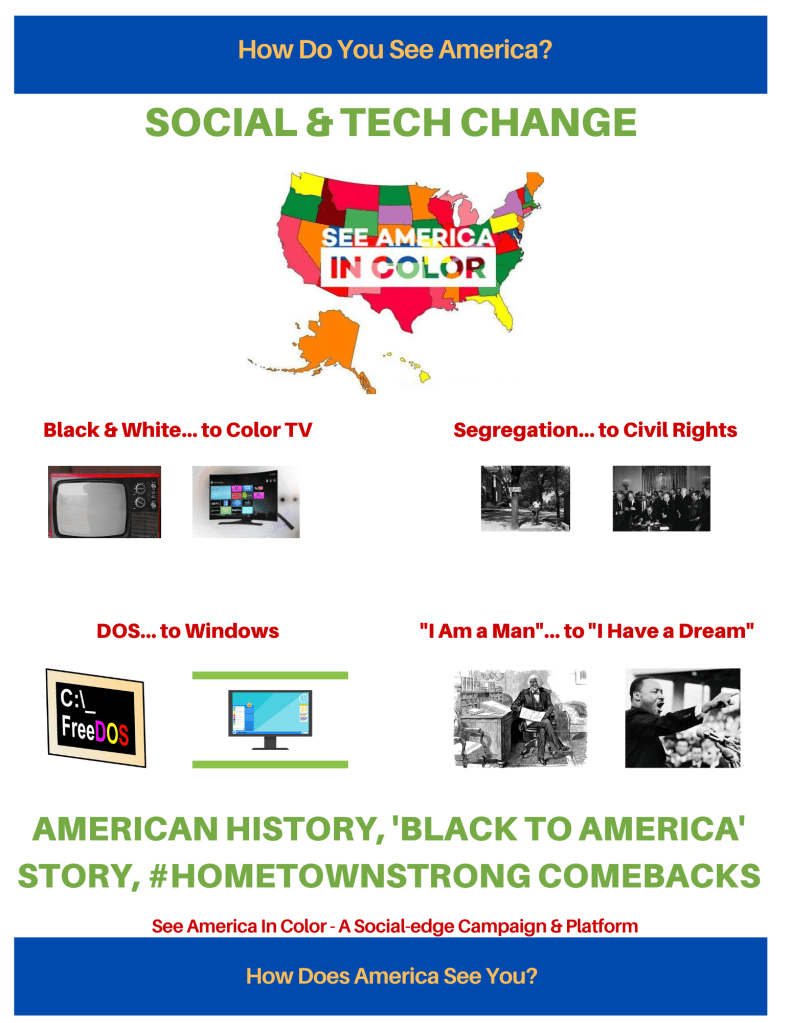
For example, the avid gardeners among us can relate during the late Fall season. As they put away the patio gear, they also cut back some of their garden plants, otherwise known as annuals. This way when spring rolls around there’ll be new ‘green shoots’ busting loose. That’s something SAIC represents in its framework. For America to have a new ‘founding’ with a reset and fresh mindset, it’ll take cutting back on some things so that there’re new ‘green shoots’. Consider that if the shift from black & white TV to color TV involved cutting back on ‘white light’ to ‘turn up’ three streams of colored light, so does the nation’s fix for some of the racial/social issues require cutting back on ‘white light’ by combining three streams of ‘colored light’ in American history, the ‘black to America’ story and #HometownStrong comebacks. So, as with color TV, how might that better picture unfold?

Well, let’s walk in the shoes of Alexander Hamilton and Dr. Martin Luther King Jr, one of America’s founders and an iconic civil right leader, respectively. By drawing on their example and the three social streams just mentioned, we’re poised to deliver market-level success tied to the ‘America 2K26’ big picture and rollout that’s defined by:

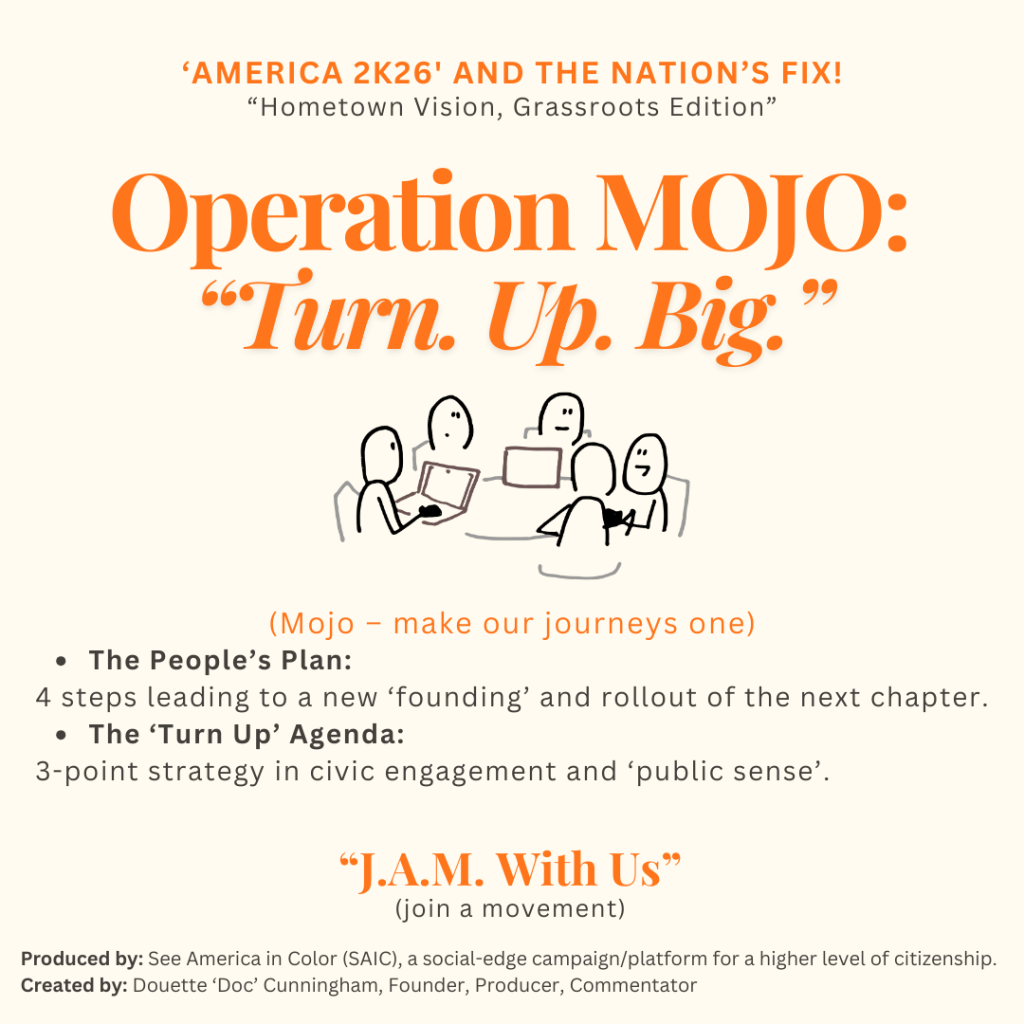
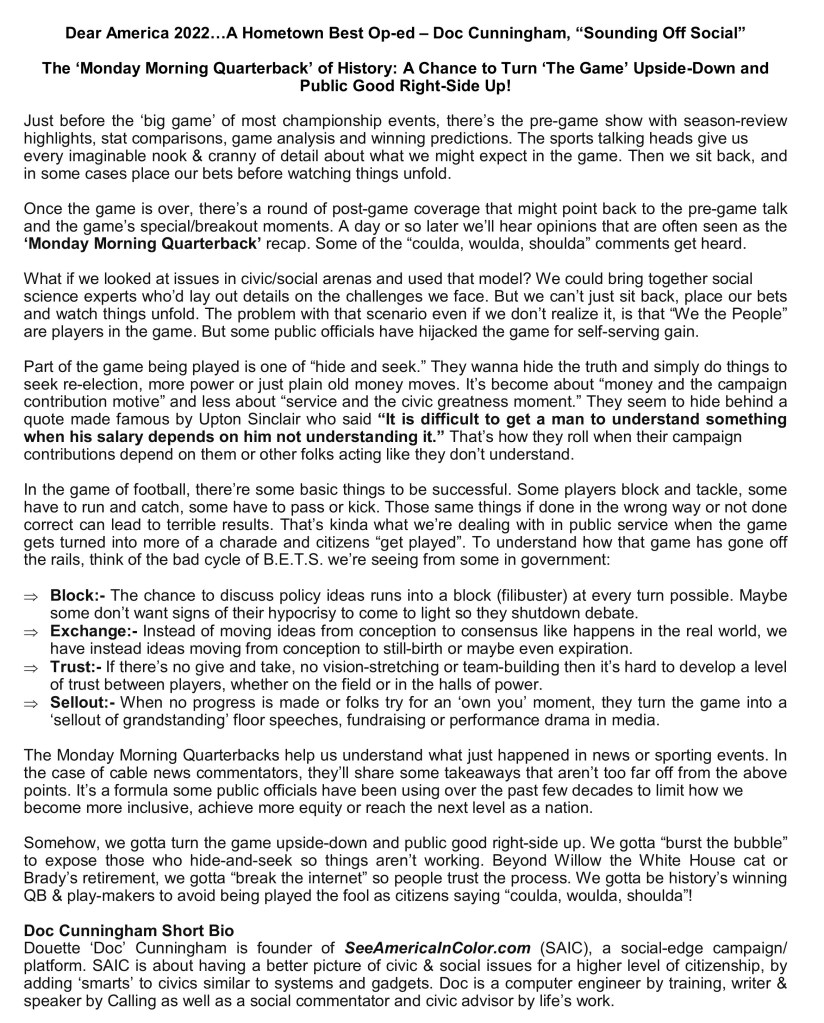
  • The People’s Plan: 4 steps leading to a new ‘founding’ and rollout of the next chapter.
  • The ‘Turn Up’ Agenda: 3-point strategy in civic engagement and ‘public sense’.

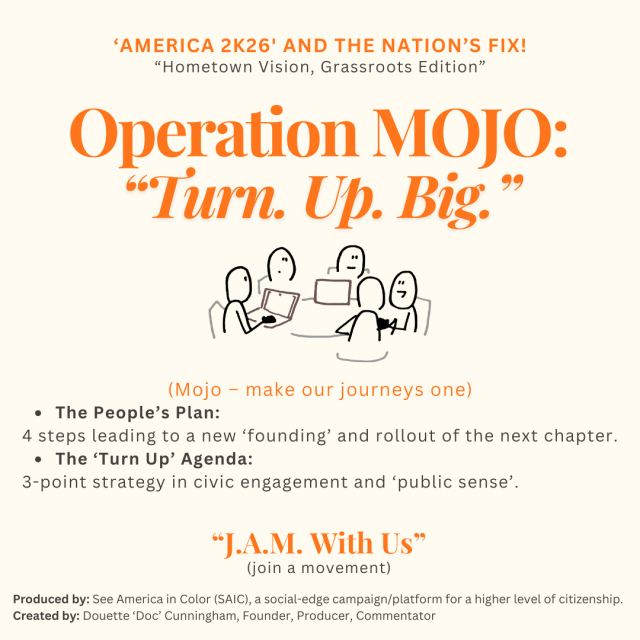
Interestingly, folks over 40 might relate to The People’s Plan based on the first 20 years of America’s founding. While folks under 40 might relate to The ‘Turn Up’ Agenda by being “In the Mix for 2026” across history, civics and culture. Think about how a DJ uses two turntables to ‘turn up’ the energy at a party. In the past, DJs would show up with two or three crates, having a collection of records across decades and genres. Nowadays the music is all digital. The key is to play the right mix of records from different albums to keep the party jumping. Well, that’s how the theme “In the Mix for 2026” came about. We wanna bring the right ‘crates’ in history, civics and culture to ‘Turn. Up. Big.’ for the nation’s fix.

College Student

In the coming month’s there’ll be more ‘inside stuff’ on what it means to ‘turn up’ around Life’s Blueprint, America’s Footprint. Moreover, there’ll be updates online and across different forums on what that means in my role as founder, producer, commentator. Sharing concepts as founder comes with having a vision for how to collaborate across ventures, whether profit or non-profit. As producer, there’ll be content, programs and events that help with having a better handle of hot-button issues by how we see America in color, not just in black & white. As commentator, you can expect heart-grabbing soundbites on daily news and current affairs (kinda like what you get on this site).

But there’s more! As famed writer/historian David McCullough reminded us, it was Thomas Jefferson who once said, “If a nation expects to be ignorant and free, it expects what never was and never will be.” Told another way for those who wanna flashback to their college days, you know that first semester set the tone. It all depended on whether you chose to party all the time, or got some studying in. You don’t need to have a college degree on your resume to know that if you party all the time, you’ll have a dumb life. But if you study all the time, you’ll have a dull life. The key is to balance how you party and how you study. Sometimes you might even party to study (if you get what I mean). So, how we rollout ‘America 2K26’ will have us “In the Mix for 2026” to party and study as a:

1. Market/Member

    Early Settlers

    When early settlers first landed on America’s shores they came in waves across two regions. The first group landed in Virginia, many looking for new markets to trade their goods. The other group landed in New England, many looking to be new members of a just society, as they fled a sense of religious persecution. One region became the cradle of enterprise, the other became the cradle of change. That’s a way to look at how we plan to formalize, monetize and institutionalize our efforts. One aspect is about advancing a more perfect union, the other about social capital partners in America and the diaspora.     

    2. Hotspot

    When you hear ‘hotspot’ you might think of two ideas: (i) in a social sense it’s a place where folks show up to have a good time or be among good energy; (ii) in a tech sense it’s a digital connection for your phone or laptop to a public or private Wi-Fi space. Basically, a hotspot connects you with a social space that opens a whole new world in work & play. But also, as an online space that opens a whole new world in news and games. Well, our ‘America 2K26’ gameplan will include ‘Civic Life Hotspots’ that connect to a multi-purpose space to open a whole new world in work & play as well as roots & culture.  

    3. Social

    Holiday Lights

    The holidays can be a time of great social appeal. The array of lights and other festive displays help to spark a sense of optimism and good spirits. That’s an aspect of ‘social’ we plan to draw on for how we spark interest in what See America In Color represents. But there’s also another part to ‘social’ that you see when you look back to the early days spent at taverns. There was a shift in social consciousness as America went through its ‘labor pains’. Some folks were there to discuss strategy on how to organize and engage. Others were there to develop a path to a new America by how they’d educate and empower.      

    4. Network

    During the founding there was a sequence of events and season of pronouncements. This led to forming a new nation and forging a oneness in purpose. That was captured in the Latin words E Pluribus Unum – Out of Many, One. This helped bind the 13 colonies into the United States of America. How might we take a page from that to help bind us these days as diverse citizens with a oneness in purpose? Well, we’re about ‘Operation MOJO’ and the Strong Citizens Association of America, with ‘5 iDeals’ to help make our journeys one. So “J.A.M. With Us” to join not simply a social network but movement network.

    Movement Network

    The People’s Plan builds on America’s founding across a 4-step rollout as the ‘civic strong’. The ‘Turn Up’ Agenda builds on a 3-point strategy in civic engagement and ‘public sense’. Back in 1776 before the Declaration of Independence became final, Thomas Paine wrote a pamphlet called ‘Common Sense’ with the rational and oomph for forming a new nation. Well, in the coming weeks and months SAIC will lay-out the rational and oomph for why and how America’s next chapter might include the Declaration of Emergence where the nation gets to bloom in all its colors, since after winter must come spring.

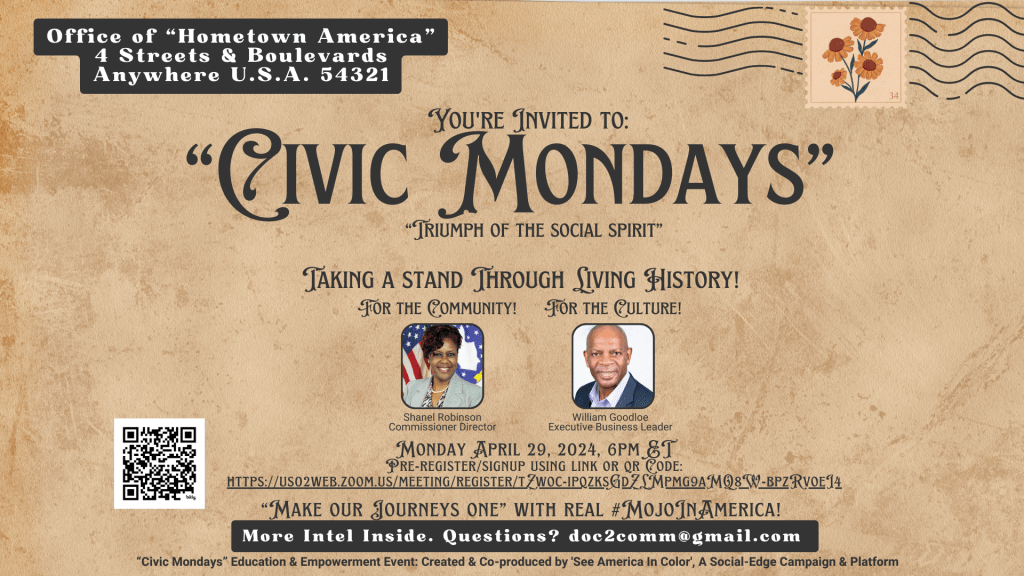
    Chime-in on impacting Democracy & Public Good, Education & Community or Entrepreneurship & American Dream, ‘Civic Mondays’ events or Civics & Community forums. Plus, you can “J.A.M. With Us” (join a movement) in civic engagement, social change and community life. Checkout the Signup Center below.

    Tracks: Eddie Murphy – Party All The Time – https://youtu.be/iWa-6g-TbgI?si=pUhxNO1ybNfPcMUT

    Lauren Hill – Everything is Everything – https://youtu.be/i3_dOWYHS7I?si=vYZkgcMqe-qbF6wZ

    Featured

    America Votes and Cries for Change: How are We Gonna Get Past ‘The Politics of Things’ That We’re Told, and Closer to the ‘Civics of Things’ in Truths We Hold?

    Preview Summary –

    • The Shutdown reached a winddown! So how are we gonna get past ‘the politics of things’ that we’re told, and move closer to ‘the civics of things’ in truths we hold?
    • A further challenge we have is that civics get put in second-class status and politics viewed as first-class. Guess where that got us…bad politics used to turn DEI into an IED.
    • With ‘America250’ already in motion, we can look back and begin to chart new steps forward. It’ll take some ‘civic dosing’ as well as a ‘mojo movement’ towards a more perfect union.

    Signup Center –

    Follow @SeeAmericaInColor on FB & IG for podcast episodes and events!

    Main Content –

    Doc Cunningham
    “Da Island Guy”
    Sounding Off Social

    The Shutdown has reached a winddown! That was the initial breaking news hitting airwaves and social media feeds. As word started spreading, some were still saying it wasn’t a done deal. The concern was if some officials caved while others thought it important to fight for everyday people. The results of recent local and statewide elections which had national implications showed that America votes and cries for change. So how are we gonna get past ‘the politics of things’ that we’re told, and move closer to the ‘civics of things’ in truths we hold?

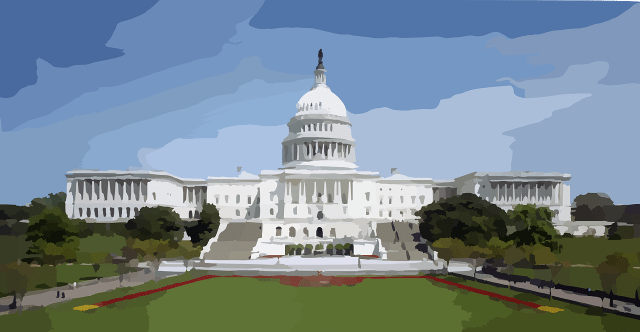
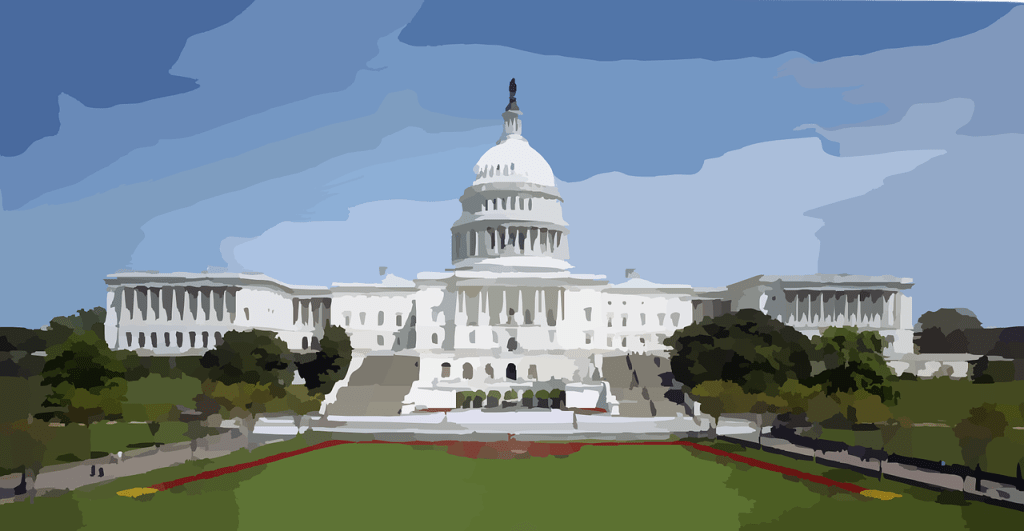
    Capitol Building

    It seems every few years we keep getting in a government shutdown cycle. Maybe we need a 28th Amendment that lists who’d still get paid during a shutdown and who would not. If members of congress along with others were on the ‘not list’, then that might change the calculation. But let’s also consider basics, like the difference between civics and politics. We understand civics to mean how you represent as elected official, citizen or community member to make government service and ‘public good’ matter. Meanwhile, politics is a means to an end for public good through government programs and policies. When you read social media comments, here’s what’s baffling to some people about our politics today:

    • One side sees government as a key, to unlock the service benefits for the people. The other side sees government like candy, to keep the service benefits to themselves and their enjoyment.
    • It took those who’re not up for re-election to push a deal to end the shutdown and be seen as the ‘bad guys’. While those who’re up for re-election oppose the deal but are seen as the ‘good guys’.

    A further challenge we have is that civics get put in second-class status and politics viewed as first-class. We see it repeatedly where it’s as if politics tend to choke civics, sometimes to the point of near suffocation. Guess where that got us…bad politics used to turn DEI into an IED. Plus, continued culture-war battles might have led to the shutdown drama too. So, can we fix politics with politics, as America votes and cries for a different response and higher purpose? There’re times you must fight fire with fire. We see that when fighting forest fires where folks try to contain the spread. But most times when putting out fires, the experts use a fire-dosing strategy for tamping down the flames.

    Maybe that’s somewhat where we find ourselves as a nation. There’s frustration to go around for different reasons, especially due to political whiplash over the past twenty years. But in this next phase of public policy and collective urgency, we gotta rally as the ‘civic strong’, not just as the politically well-connected. That requires intention. What should be driving our local and national actions? Well, consider these three factors from America’s past compared to our current social standing:

    • Back then folks were less advanced but more committed. These days folks are more advanced but less committed.
    • Back then the Black Church was a ‘fuel station’ for people’s vibrancy and advocacy. These days it’s in the process of re-imagining and re-grouping.
    • Back then we had public figures/venues operating like a ‘hometown dealership’ in civic content. These days some public figures are more about gaining status than leading people.
    Media Soundbites

    America wasn’t built on just soundbites. It was about crafting solutions for sticky situations. Then as various suffrage groups came along, there was a concerted effort around things like voter registration, civic engagement and voter education. These days we seem to need a new solution strategy as seen in how tech heads delivered change in consumer products like personal computers and smart phones. Those changes produced a shift in marketing and consumer consciousness. Similarly, SAIC’s approach involves a kinda ‘Hometown IOS’ as a new solution strategy to produce a shift in civic engagement and social consciousness. While the town square is influenced more by memes & misinformation, clicks & clout, noise & nonsense, than ideals, we can do better in how we respond to life’s MEME of the:

    1. Moment

      A focus on civic engagement seems to come up strong around elections/voting or a crisis/tragedy. Then after that, life and TV news/ads return to their regular scheduled programming. Imagine if players and owners in pro sports only got excited in the moment when it’s time for signing contracts but after that, things return to shoddy performance? Since elections results are like ‘contract signings’ with the winners, the electorate should expect top-billing not just in the lead-up to elections, but season after season too. Otherwise, we’ll keep finding ourselves in situations where America votes and cries for things to change.                  

      2. Element

      On November 6th, 1967, Dr. King gave a speech to students in Philly that might be a wake-up call for us today. His message around four key points can be summed up as “Life’s Blueprint, America’s Footprint”. His speech was like a ‘halftime look-back’ on the movement’s achievements. He was also preparing students for the next phase of civic engagement. There’s an element to King’s speech that will help us in being more advanced and more committed. That will help us embrace a new solution strategy. Let’s shape America’s next chapter like a ‘hometown dealership’ in civic content at a Black Friday sale.                  

      Black Friday Sale

      3. Movement

      Over the past few months there’ve been many protests and rallying events. Some even described our current moment as hearkening back to the original Boston Tea Party, which itself was one of America’s early movements. Is that message getting through? Recent election results might say yea, but maybe there’s something else needed that Dr. King hinted at in his speech. These days we’re at a moment where we need to go from being ‘in protest’ to being ‘in mojo’ as in ‘hometown mojo’. That’s gonna require a new strategy in how we organize & engage, educate & empower.       

      4. Empowerment

      We’ll build on the lead-up to and roll-out from America’s founding, with lessons from suffrage movements and sports leagues. On November 6th, 1869, the first college football game was played in Central New Jersey. Soon, the game got so dangerous, even brutal where players died. The then U.S. president and public figures issued a call to action, creating the NCAA to help rein things in. These days our political/social climate has gotten dangerous/brutal too. We need a new empowerment strategy to rein things in. You’ve heard of POTUS, FLOTUS, SCOTUS. It’s time for CLOTUS (Civic Leaders of the United States)!

      A championship coach and team will tell you that the secret to their success took more than just rah-rah moments and fire-brand speeches. It took real intention like in past movements of civic engagement. Furthermore, with ‘America250’ already in motion, we can look back and begin to chart new steps forward. It’ll take some ‘civic dosing’ and a ‘mojo movement’ to get us moving towards a more perfect union. In the past when consumers cried out for change in technology, the response was something user-friendly. As America votes and cries, we can do for citizen-friendly dreams like seen in tech and sports.

      Citizen-Friendly Dreams

      Chime-in on impacting Democracy & Public Good, Education & Community or Entrepreneurship & American Dream, ‘Civic Mondays’ events or Civics & Community forums. Plus, you can “J.A.M. With Us” (join a movement) in civic engagement, social change and community life. Checkout the Signup Center below.

      Tracks: Jon Baptiste – Big Money – https://youtu.be/PkS2xydpLIg?si=icn9NXOGu71l5rZm

      H.E.R. – Hold Us Together – https://youtu.be/peiZgUda4dY?si=SB1YHMF7by4CbALF

      Featured

      A Path for Shake-up or Breakout (Part 2 of 2): Joining the Trailblazers from Our Nation’s Past with the Changemakers of our Present Day

      Preview Summary –

      • Flashback to the past and we’ve got two music history moments in songs ‘Imagine’ and ‘Born to Run’ that led to a cultural breakout for both artists who dropped an empowering message.
      • A ‘new & improved’ gameplan in civic fanfare will involve managing hometown frustrations as seen in the lead-up to Independence and rallying civic engagement as seen after the Convention.
      • We can raise our mojo around impact and public good not by the old school approach of ‘racism agitation’ by some new school techniques for how we ‘make our journeys one!’

      Signup Center –

      Follow @SeeAmericaInColor on FB & IG for podcast episodes and events!

      Main Content –

      Doc Cunningham
      “Da Island Guy”
      Sounding Off Social

      There’re two music history moments from 50+ years ago that helped shape advocacy and activism in America. First, on September 9th, 1971, John Lennon released the album with title track ‘Imagine’. The message pointed to a better future in daily life on earth as well as the here-after. Roughly four years later, on August 25th, 1975, Bruce Springsteen released the album with title track “Born to Run”. These music projects were breakout moments for both artists in how they dropped an empowering message.

      Music History

      With the recent 50-year anniversary celebration at Monmouth University in NJ for Springsteen’s album, folks might wonder whether their artistry offers a potential breakout moment in today’s social environment. Lennon’s take on ‘Imagine’ in some ways reflects what our days past as well as life-skills experts today suggest; begin with the end-results in mind. Remember that during our nation’s founding, two social impact tracks were front and center (the lead-up to Independence, rollout from the Convention). Over the years, those impact tracks have influenced abolitionists, civil rights and other suffrage movements. In a sense, they were in-line with a ‘Crusade for Civics, Anthem for Action’.

      Furthermore, as mentioned previously, there was Paul Revere whose life’s work led to forging a new nation through the exchange of ideas and ideals, one community at a time. When you think about SAIC’s backstory and framework, it represents a similar mindset too, built around how we see America in color, not just in black & white. Pull that all together as happened in ‘imagine and run’. A path will emerge for shake-up or breakout by joining the trailblazers of our nation’s past with the changemakers of our present day. Why would taking a page from ‘old days’ make sense today?

      Well, think about a time with a wayward child at home, teenager in school or young adult in the community. Parents, administrators and authorities might try different things to get them on track. Some might go with an ‘old school’ approach while others might employ ‘new school’ techniques. In some cases, both aspects might make sense. In the long run, that person will look back and probably see a moment that helped to create a shift in their attitude. As the saying goes, “its attitude that determines your altitude.” Maybe America needs an old-school attitude shift as well.

      Dominoes Dots

      But what about a ‘new school’ approach for America? With SAIC, it’s about how we connect the dots in a fun way like dominoes, across history, civics and culture. This also means having a new & improved version of a ‘Crusade for Civics, Anthem for Action’ that engages Gen X, Millennials and Gen Z since they represent the future of our republic. Plus, the gameplan requires having ‘boots on the ground’ not for warfare but for civic fanfare by:

      1. Managing hometown frustrations like seen during the lead-up to the Declaration of Independence.
      2. Rallying civic engagement like seen during the rollout after the Constitutional Convention.

      The objective is to foster a mindset about being the ‘Civics Capital of the World’ starting in Central Jersey, by how we level-up our nation’s focus in:   

      1. Education

        Did you know before the Constitution was in place or political parties were in a race, the first 25 colleges were already founded? Harvard was founded in 1636 and others that followed were founded in the New England and Mid-Atlantic regions. There were some in the south too since that’s how the population centers spread. Those areas were the birthplace of settlements in America after the White Lion ship landed in Virginia with 20+ Africans, and pilgrims on the Mayflower landed in Plymouth Massachusetts. It’s also where Paul Revere had lonely-road horseback rides to exchange notes and spread civic ideals.                

        2. Awareness

        Revere’s trips were important with shaping the emerging nation. This involved building awareness around sovereignty, hope, excellence and goodwill. While that worked in the lead-up to Independence and the rollout after the Constitution, the 21st century needs a new level of awareness in response to the issues of today. There’s an opportunity we have between Constitution Day, National Civics Day and America’s 250th birthday in July 2026, to raise a new level of awareness around those ‘old school’ ideals as well as some next-gen aspects of 21st century education in academics, athletics, arts and advocacy.         

        3. Consciousness

        Whenever America made moves in fulfilling its ideals, there was a shift in consciousness, one community at a time. Psychology experts will tell you that consciousness works in tandem with the subconscious. It’s like in sports there’s practice to develop muscle memory. You’re not always thinking specifically about how you’re gonna make the play. It just happens in the moment based on having practiced the skill over time. Well America, maybe there’re some civic skills for which we’ve lost our mojo that need practice. We need to work on having ‘civic muscle memory’ and not be fooled by ‘slick talk’.   

        4. Purpose

        Football Tricks

        What makes change hard to come by in the civic/social space? In part, it’s because some folks have more to lose than others. Plus, as the saying goes, “it’s hard to teach an old dog new tricks.” That’s why they’re trained in the early stages. Similarly in life, younger folks have less to lose when it comes to rallying around change. They have less pride, money, ego, etc, to lose than adults. So how do you make up for that dilemma? You build change around a unifying sense of purpose. This way you’ll attract young people looking to define a sense of purpose and older folks looking to live with a higher sense of purpose.

        Is there a consciousness missing in culture, based on ‘clicks and clout’? Take the internet out the picture and go old school, you’ll see that the nation’s founding was influenced by the Enlightenment Age. So, who are the civic soothsayers today like back in the early days (as opposed to the smooth sayers now)?  For those like Lennon who did it through music in the 60s & 70s, you find these lyrics from ‘Imagine’: “you may say I’m a dreamer; but I’m not the only one; Hope some day you’ll join us; And the world will be as one.”  We’ll raise our mojo not by ‘racism agitation’ but by a conscious effort to ‘make our journeys one!’

        Smart Device

        Chime-in on impacting Democracy & Public Good, Education & Community or Entrepreneurship & American Dream, ‘Civic Mondays’ events or Civics & Community forums. Plus,you can “J.A.M. With Us” (join a movement) in civic engagement, social change and community life. Checkout the Signup Center below.

        Tracks: Third World – Sense of Purpose – https://youtu.be/4z4yuSvQPa8?si=94h25eU1UqlnctSV

        Mary J Blige & Busta Rhymes – You will Never Find Another Me – https://youtu.be/XKwmuRT2VOI?si=zoXy0kCtKPcCYV3P

        Featured

        A Path for Shake-up or Breakout (Part 1 of 2): Joining the Trailblazers from Our Nation’s Past with the Changemakers of our Present Day

        Preview Summary –

        • Flash flood warnings are meant to get our attention, so we can make a note and take heed. Is America in such a moment in our history that requires a new level of awareness?
        • As our new nation was unfolding in 1775 there wasn’t time for pomp and pageantry as folks were focused not only on winning the battle but also creating a shift in consciousness.
        • While politics of the day might raise concerns about warfare now, it’s gonna take boots on the ground in civics, enlightenment and healing for a shift in consciousness in our present day.

        Signup Center –

        Main Content –

        Doc Cunningham
        “Da Island Guy”
        Sounding Off Social

        This summer saw flash flood warnings get our attention and cause tragedy from Texas to New Jersey. Normally folks would make a note but not really be concerned. But after being taken by storm from recent downpours, it requires a new level of awareness from getting those alerts. In a sense, America might find itself in a similar place. Things are happening by storm, as there’s a new battle brewing in the nation with less than a year going into the 250th anniversary of America’s independence, otherwise known as the Semiquincentennial. Maybe we need a new level of awareness to make a note or take heed.

        Flash Flood

        Travel back in time to the days of our founding and there were aspects at play then as we see now. Many had become exhausted by British Monarchy rule. This included frustration with numerous taxes. Things got so bad that some started to look for a path for shake-up or breakout to move beyond the madness. Interestingly, concerned citizens then were deeply influenced by the Enlightenment period, which helped to forge a shift in consciousness with ideas like ‘natural rights’, or what the founders eventually called unalienable (inalienable) rights. Meantime, a little over a year ago we learned from a Pew Research poll that 65% of folks are exhausted when they think of politics. Plus, in terms of our social climate, who’s bringing the enlightenment, since many are more focused on clicks & clout.  

        Knowing the thread that runs through the cloth of America helps us with joining the trailblazers from our nation’s past with changemakers of our present day. The battle/divide during our founding was between loyalist vs patriots. During the civil war it was between confederates and unionists. Now it seems things have evolved to a battle between ‘Mecca States’ vs ‘Massa States’ (like those that initially seceded). We see this playing out in the recent push around redistricting. But the common thread whether during revolution, civil war or current times, is in those who seem/feel celebrated (viewed as insiders) vs the other side who seem/feel slighted (viewed as outsiders). You can also tell the different sides based on whether they’re about ‘we the people’ or mostly about money and power.

        Thread Thru America

        In the coming months there’ll be events of pomp and pageantry in the lead-up to July 2026. But as our new nation was unfolding in 1775 there wasn’t time for that as folks were focused not only on winning the battle but also creating a shift in consciousness. That happened through efforts like:

        • Committees of Correspondence with hometown voices in unity of purpose and other civic ends.
        • Paul Revere’s work in New England and Mid-Atlantic regions to spread awareness.
        •  Rallying around a ‘big standing’ with the Declaration of Independence as a new nation.

        One of the benefits of the Enlightenment period was that it brough a new language for describing the issues around life, liberty and the pursuit of happiness. This helped to shape a new structure for governing, as well as focus for going from colonies to the United States of America. These days it seems the structure (Constitution) is under attack, and the focus is less communal and more confrontational. The period after the Revolution gave root to the American experiment. The period after the civil war gave root to what’s known as America’s second founding. Some hoped the period after the civil rights movement would be a kinda post-racial era. But here we are knocking on the door of our 250th birthday, asking ourselves what’s it gonna take to create a new shift in consciousness as a nation. Maybe folks like Paul Revere, Samuel Adams and John Hancock can help us with a word or strategy around:    

        1. Leadership

          Back in the early days, leadership wasn’t dependent on political parties. It came out of hometown voices focused on unity of purpose and other civic ends. In 1772, Samual Adams and John Hancock were key players in forming Boston’s Committee of Correspondence. Long before the New York Times or cable news networks, these committees began to spring up locally and across the colonies. It was their way of breaking news and providing leadership as the colonies asserted new democratic willpower. Of course, we now know those names are among the signers of the Declaration of Independence.               

          2. Mission-ship

          Horseback Rider

          Many remember the story of Paul Revere’s horseback ride into Lexington to warn the patriots that “the British are coming.” But there’re other aspects to his life that give context for mission-ship. Long before there was Fedex, there was the ‘pony express’. Revere would take long rides to the New England and Mid-Atlantic regions to share updates on what was happening across the colonies. The ‘mission packages’ didn’t get there overnight, as Revere had lonely-road travels through backwoods. But it’s the sharing of insights and stories from regular folks that helped to fuel his sense of purpose and mission.           

          3. Allyship

          As a teenager, Revere was a bell ringer. In those days, bell ringing was how they shared birth, wedding, death and other announcements. He was among a small group of young boys who took that responsibility seriously which eventually led to shaping their life’s work. As an adult, Revere became a silversmith with part of his work done in making bells. It’s as if he was the Mark Zuckerberg of his time, providing the community with ways to ‘post’ messages via bell ringing. Some of those he worked with as a young bell ringer in his hometown became confidantes and strong allies in his life’s work as a regular citizen.      

          4. Citizenship

          When it comes to impacting, serving and servicing the marketplace, many industry leaders know about B2B (business to business) and B2C (business to consumer) for having strong earnings/value. These marketing strategies help open lanes of commerce and streams of income. What’s needed in the 21st century on our journey to a more perfect union is the concept of B2CE (business to civic ends). That new model will help open lanes of engagement and streams of public good. It will provide a framework to guide efforts on impacting, serving and servicing the marketplace for having ‘strong citizens.’

          Stream of Income

          The Revolution battle was over taxes and self-determination, the civil war over slavery and the cotton enterprise. The civil rights battle came out of exhaustion with segregation and discrimination. Today’s slow-boil battle seems to be with redistricting. It took boots on the ground in warfare to fight some previous battles. But there was more involved in creating a shift in consciousness as a nation, one community at a time. While politics of the day might raise concerns about warfare, it’ll take boots on the ground in civics, enlightenment and healing if we’re gonna ‘take a walk’ towards a shift in consciousness.   

          Chime-in on impacting Democracy & Public Good, Education & Community or Entrepreneurship & American Dream, ‘Civic Mondays’ events or Civics & Community forums. Plus,you can “J.A.M. With Us” (join a movement) in civic engagement, social change and community life. Checkout the Signup Center below.

          Tracks: Jamal Roberts – Heal – https://youtu.be/6rccyIFqIPI?si=lizFb2NIwVcRVk-W

          Passion Pit – Take a Walk – https://youtu.be/dZX6Q-Bj_xg?si=DpfMviNirPL2Vthc

          Featured

          Independence Day, 249th Anniversary and Counting! The Big Reveal on What We’ve Learned About America from the Old Days to Present Times

          Preview Summary –

          • America’s national anthem isn’t just a patriotic melody, while Independence Day isn’t just about parades, cookouts and music festivals.
          • When the anthem reaches its crescendo or the nation rises to the occasion, there’s a shift in consciousness that happens in lyrics and legacy.
          • For the 65% of Americans who feel exhausted when they think about politics, there’s a combo of civics and empowerment (like an ‘Empowerade’ booster) to raise the consciousness of the nation.

          Signup Center –

          Main Content:

          Doc Cunningham
          “Da Island Guy”
          Sounding Off Social

          America’s national anthem, aka the “Star-Spangled Banner”, has become a fixture at sporting events, including Olympic medal or other championship ceremonies. It’s also an obvious go-to at patriotic occasions like those celebrated around Independence Day. The full anthem isn’t sung or played on most occasions. But the last sentence is repeated in all the four verses. Those words appear as a question at the end of the first verse. Then a shift occurs when those same words appear as a statement in the remaining verses, as in “O’er the land of the free and the home of the brave.”

          Fireworks Show

          The significance of Independence Day for any nation represents a time when freedom became more real in a legal, political and civic sense. It’s when residents began to have a greater role in self-determination and public affairs. There’s a much deeper meaning though as for some groups the milestone fell short. Their freedoms came as a later struggle towards a more perfect Union. In other words, Independence Day is more than just parades, cookouts and music festivals. It also symbolizes an ‘awakening’ in the consciousness of a nation.  

          What if the consciousness of the nation, based on awareness of oneself in the civic/social space and broader world was approached with the same passion as we do with AI in the tech space? These days AI is playing an increasing role in society. But before there was social media, the consciousness of the nation took shape around social impact and public-good factors. In one sense, that’s a big reveal on what we’ve learned about America from the old days to present times. Our nation’s journey had a shift in consciousness from asking the question, “O’er the land of the free and the home of the brave?”, to stating it as an affirmation.

          Package Delivery Driver

          In business, Fred Smith, the late founder of FedEx comes to mind. His journey was of getting past questions folks had on whether his company would be profitable. Some industry players thought his idea, while understandable, wasn’t doable. At times he had to ask staff to wait a week to cash their checks. His story of revisiting a college term paper and turning questions into a commercial enterprise is a business version of what others have achieved through social movements. Beyond Dr. King as figurehead for the civil rights movement, there’s Gregory Watson who led the charge for the 27th Amendment; Stevie Wonder who fought for the MLK Holiday; and Dr. Opal Lee who advocated for the Juneteenth holiday.

          Here we are at another moment in time where we can add to history and legacy. Based on the current social climate and crosswinds in public policy, maybe we’re at a similar point, as folks question the next phase of America’s journey. With Independence Day, 249th anniversary and counting, we gotta look at the things we question that are ‘out-of-pocket’ or unacceptable or unequal or represent an injustice. Let’s figure out how we turn those questions into action statements. To make that happen we gotta rollout a Civic Revolution that isn’t about sticks & stones or cannons and bombs, but instead about:          

          1. An Upshift in Consciousness

            If you follow the story from 1776 to present, on the road to a more perfect Union, our nation’s journey has advanced based on Independence that came through a shift in consciousness. Folks no longer wanted to be ruled by a king but preferred a route of self-determination. Unfortunately, blacks and others were left out of that formula so there were missing elements to those newfound freedoms. Other more inclusive opportunities came about later through what might be called an upshift in consciousness. Folks had to kick-in the ‘turbo’ factor to help America understand why the racial status quo wasn’t acceptable.             

            2. A Boost in Hope

            An important ingredient to survival is hope. When hope isn’t lost, there’s a chance of rising again. One of the legacy aspects of Independence was in the hope folks had for a new nation. They began to see new possibilities and explore new frontiers. But a related ingredient to survival is change. It’s been said that the only constant in life is change. The seasons change year in, year out. There’s the constant in what we expect from the seasons and there’s the change that comes with each season. In America, there’s the constant that comes with daily life. But there’s change required for each round of making progress.      

            3. A Jolt in Passion

            Passion at Work

            While it’s important to keep hope alive, that hasn’t been enough to get America to level up. That comes with a jolt in passion. The passion of a nation feeds off the consciousness of a nation, in the same way that passion in business might feed-off market awareness. Maybe what kept Fred Smith and FedEx going through those early years was the glimmer of hope that kept the lights on and the jolt of passion that kept the delivery truck wheels turning. That passion isn’t always about how much noise one makes in the marketplace or social space, but more about how much positive movement one creates through actions. 

            4. A Mark in History

            Some holidays provide one-size-fits-all meaning behind the occasion, while others might be more specific to certain groups. Independence Day has a more universal message. It represents a mark in history like a before-and-after view in weight loss, or a black & white then, but color picture now in tv technology. A high mark in history helps us savor the moment in time. But some low marks occurred when there was less conscience or consciousness in the nation. In other words, some marks in history show up as turning back the hands of time and others as moving the nation forward for the ages.

            Poll Question

            Are we progressing as a nation, or regressing in our politics? A Pew Research Poll from 2024 revealed that 65% of Americans feel exhausted when they think about politics. As with sports, work or other activities, when we’re exhausted, we’re likely to pull back or step away. Athletes often go to the sidelines and refresh with Gatorade or similar energy boosters. To provide the same relief for residents in the civic/social space, like those who’ve check-out from the issues or are wearing blinders, we need a combo of civics and empowerment (like an ‘Empowerade’ booster) to raise the consciousness of the nation.

            Chime-in on impacting Democracy & Public Good, Education & Community or Entrepreneurship & American Dream, ‘Civic Mondays’ events or Civics & Community forums. Plus,you can “J.A.M. With Us” (join a movement) in civic engagement, social change and community life. Checkout the Signup Center below.

            Tracks: Alicia Keys – Underdog – https://youtu.be/izyZLKIWGiA?si=z06J9zfo986CGFbj

            Jon Baptiste – Freedom – https://youtu.be/3YHVC1DcHmo?si=Q7mZLGgh6VsyvQJu

            Featured

            Hometown Chronicles Cover Story: How We Got Here in this Moment as a Nation and Forging our Next Chapter in Civic Engagement

            Preview Summary –

            • Some wonder if America is going through bouts of hiccups in our public space or are we about to choke on something that’s gonna require the Heimlich maneuver to free the flow of hopes & dreams.
            • There’s something that’s been brewing in the south regarding ‘boots on the ground’. In a pop culture context, it’s a new line dance. In public affairs it might help us level up our social impact.
            • The problem we have these days is emotions of grievance, hate and divisiveness have been turned into personal animus as opposed to frustrations being turned into purposeful action.

            Signup Center –

            Main Content:

            Doc Cunningham
            “Da Island Guy”
            Sounding Off Social

            If there’s anything we know about showbiz, there’re certain events that sellout out quicky or are like must-see TV. Just this month alone, folks have the NBA, celebrating Broadway and music awards in LA. Take your pick, or for those who’re fans across the spectrum, then one or more of the above works for you. There’s sure to be a cover story or viral moment that has people talking and brand-attention rising. But these days some wonder if America is going through bouts of hiccups in our public space or are we about to choke on something that’s gonna require the Heimlich maneuver to free the flow of hopes & dreams.

            Hopes & Dreams

            What if we had to write the next hometown chronicles cover story to explain how we got here in this moment as a nation? What might be the theme in the chapter on civic engagement? On the west coast there’re clashes between immigration agents and residents. On the east coast there’s discussion around legislation that could set the path of America. We need elected officials to show leadership and deliver policies that showcase our nation as ‘light on a hill’, not ‘ash on a heap’. Meantime, there’s something that’s been brewing in the south regarding ‘boots on the ground’. In a pop culture context, it’s a new line dance. In public affairs it might help us level up our social impact.

            These days we need a fresh approach for how we respond to the frustrations of ‘we the people’. If we take a step back in time we can walk in the shoes of history. As our nation was coming into fruition, there were 70 delegates who were invited to attend the Constitutional Convention. Of the 70, there were 55 who made it to Philadelphia. Of the 55, there were 39 who signed the document. Of the 39 there were three who kept telling the story of America’s founding and future promise (that’s what we find in the Federalist Papers). Then, 10+ years or so into the young life of our republic, two stood tall in response to attacks on our democracy (they became future presidents). Since then, we’ve gone from 4 million to 325 million. How things played out at the national level gives clues for our next chapter in civic engagement.

            There was also action taken at the local level to forge more ‘boots on the ground’. Those steps involved newly incorporated municipalities as many were focused on life, liberty and happiness objectives. But in another sense, ever wondered why New York is considered the media/financial capital of the world, or why Los Angeles is considered the showbiz capital of the world? When it comes to government or biz, the capital has a sizable number of public servants or industry personnel, e.g. Washington DC as the nation’s capital. So, what would it mean to have the title of the “civics capital of the world?” We’d have more ‘boots on the ground’ with content to rally folks around civic engagement, and pop culture to rally folks around hometown empowerment.

            Press Conference & Rally

            The capital is often about location and how folks leverage resources at their fingertips. Let’s then connect the dots across history, civics and culture where the power of the people and the people in power come together in a major way. Our response must take into consideration that we got here because of grievance, hate and divisiveness. The problem we have is those emotions have been turned into personal animus as opposed to purposeful action. If we’re gonna move past animus and deploy action, we’ve gotta be operating as:

            1. Advocate

            There’s been a push across NJ and a couple of other States to allow students as young as 16 to vote in school board elections. The idea known as ‘Vote16NJ’ is that the earlier we get young folks involved in voting the better it will be for voter participation at all levels. There’re mixed feelings as to whether the public school system is the only avenue for civics education, since some fear the ‘politics of things’ might get in the way. There’s also a sense that while public education provides the initial facts and keyword-learning of civics, there’s a void in providing a broader mindset or fuller meaning of civic matters.            

            2. Syndicate

            If we wanted stronger citizens, we’d probably need to focus on building understanding about government, having them be more informed, engaged, inspired on issues as well as making gains in voter turnout and civic participation. Sometimes in showbiz, you’ll see a local personality move on to a national role on a network or syndicate. This allows for a wider reach as a group of individuals or companies pursue more commerce or promote some common interest. Civics can also help advance America as a syndicate across education, biz, government and community for more in commerce and common interest.    

            3. Administration

            Girls Soccer

            Consider how organized sports play a big part in student development. At an early age, students get to participate in P.E. for their mental and physical well-being. Some go on to other extracurricular or competitive formats. Based on the value of sports and artistic expression in culture, what would happen if there were an anti-talent vibe? The activity would lose its excitement and excellence. Similarly, when administrations consider our nation’s well-being if there’s an anti-knowledge or anti-civics vibe in some sectors then the importance to our culture will lose its excitement, excellence and essence.  

            4. Innovation

            How did we function before without a microwave in our kitchens? How did we find our way before without having GPS in our vehicles? How did we research a topic before without having the Internet? These innovations have changed the way we cook our meals, drive our cars and challenge our minds. Similarly, we need new innovations in how we make our way as a nation across family, culture, community and dreams. SAIC represents a campaign/platform for having a better handle of hot-button issues by how we see America in color, not just in black & white. As with that shift in TV, it’s about delivering smart civics.

            America’s going through a ‘microwave moment’ that might not be the best use of public affairs. It’s like putting foil in a microwave which causes sparks to fly. Lots of sparks are flying in our social space. After each use for heating, the microwave will beep to get our attention that the cycle is done. Well, we’re getting beeps too in our nation that should be getting our attention. Let’s open the door as advocate and syndicate in civic engagement. Let’s make new strides in administration and innovation for empowerment. Let’s not lose excitement, excellence and essence in an ordinary day to turn out some extraordinary play.  

            ‘Microwave Moment’

            Chime-in on impacting Democracy & Public Good, Education & Community or Entrepreneurship & American Dream, ‘Civic Mondays’ events or Civics & Community forums. Plus,you can “J.A.M. With Us” (join a movement) in civic engagement, social change and community life. Checkout the Signup Center below.

            Tracks: Alex Warren – Ordinary – https://youtu.be/u2ah9tWTkmk?si=0WV0TRqUTLiPgUwA

            Beyoncé – Be Alive – https://youtu.be/4aeDlZOD-B0?si=RpTXMUUnPasyjc4Z

            Featured

            The Civic Revolution Gonna Be Televised! Or At Least Impact Culture Like Color TVs Did Back in the Day

            Preview Summary –

            • There’s been an outpouring of frustration at Townhalls across the country. Folks are upset with how things have unfolded over the past 100 days of public affairs.
            • These days we can’t just get caught up with the emotions of things. We gotta understand the evolution of things.
            • What if U.S.A. now stood for the United States of Authenticity? It might give us a new way of looking at how we address the issues with clarity.

            Signup Center –

            Main Content:

            Doc Cunningham
            “Da Island Guy”
            Sounding Off Social

            It was one of the most anticipated NFL Drafts in recent memory. Folks showed up in droves at the Packers stadium. Others tuned-in for the multi-day, hours-long coverage on cable and broadcast. The big question was, “would Shedeur Sanders get picked in the first round?” Well, he ended up being selected in the fifth round as the 144th pick overall. The experience of ‘dream delay, detour and disappointment’ is one that I can relate to in my own life’s work, as Sanders had in this process. Every sports analyst had their take on what went down or why he got picked so far down. Some wondered, “what kinda impact will he have in the league?”

            Packed Townhalls

            The answer to that question is gonna take some time to unwind, but we’ve got other issues at hand. Over the past few months there’s been an outpouring of frustration at Townhalls across the country. Folks are upset with how things have unfolded in public affairs over the past 100 days. So, we gotta respond correctly to the cries of the America people over the next 100 days. Those cries might be because, as Fannie Lou Hamer once said, some folks are “sick and tired of being sick and tired.” Some cries are because we keep going through the same cycles, where things need to change. Others cry out because they’re hungry for real information, not the misinformation and disinformation in some media spaces.

            These days we can’t just get caught up with the emotions of things. We gotta understand the evolution of things. Think about how we went from black & white TV to color TV back when. This shift happened because technology no longer relied on just projecting ‘white light’. Instead, it combined three streams of colored light, (red, green, blue). It’s those three streams that give us the beautiful picture on our color TV set. Furthermore, with B&W TV, if you turn up the brightness (whiteness) too high, it’s hard to enjoy watching. With color, if you take away red, green or blue, that’s sure gonna be a terrible picture.

            Maybe that’s some of what we’re dealing with, which is deeper than just what we see in the politics of the day. When folks wanna take away Black history from the American story, that makes the picture worse. When folks just want to turn up the brightness (whiteness) of the American movie trailer, then it’s hard to enjoy living in America or to advance the American Dream. We can use the campaign/platform of See America In Color (SAIC) for how we get a better picture of civic/social issues for a higher level of citizenship. This way we’ll impact culture, like color TVs did back in the day.

            Civic Revolution Televised (to your smartphone)

            That’s why the Civic Revolution gonna be televised. It’s time to ‘set it off’! Let’s break down the issues to breakout a shift in town and country. Folks will understand how we got here as a nation by looking at the U.S. presidencies of John Adams, Andrew Jackson and James Buchanan. Then, what if the power of the people and the people in power came together in a major way to shore up our democracy? We can take a page from 1798 and regular citizens at the local level, public officials across State Legislatures, as well as Thomas Jefferson and James Madison at the federal level. When we model these actions, our Civic Revolution will be on a fresh path of:

            1. Life

            The nation’s founders were influenced by the Enlightenment era. They brought that to life in the Declaration of Independence which says, “all men are created equal and are endowed by the Creator with certain inalienable rights”. What they might not have fully shared is that we’re also born to fulfill certain inner assets around mind, body and spirit. Living a full life isn’t just tied to those God-endowed rights, but also to how we make life ‘pop’, like music does for the culture. When we express these inalienable rights and inner assets, we live like an impact player that’s seen as a rock star.    

            2. Liberty

            For those inner assets to be fully expressed, we gotta have the liberty to think, do and act in ways that reveal our authentic self. It’s the real you that shines through. Otherwise, you’re living out of the ego self which is the made up you. America seems to be wrestling with that too. There’s the real America based on true liberty, and the made-up America based on grievance, hate and divisiveness. Living our best life is like listening to music. Those tracks are built around beats, hooks and bars which create flow. Our inalienable rights and hidden assets (e.g. calling, purpose, passion) can create flow too, a beautiful thing.        

            3. Happiness

            Unaware or Out-of-Touch?

            Why is it that some Americans seem so wound up about any and everything? Is it that they’re unaware or out of touch? Our happiness often comes from experiences we have around the good things in life. But there’s also an extended happiness of inner approval and outer awareness. When those carry over to our life’s work, we might find ways to stand on civics the same way we stand on business or stand on sports for our dollars or enjoyment. If that sounds like a stretch, just consider that the founders included happiness in the nation’s Declaration, which they used as a tool of enlightenment to lead with civics.  

            4. Witness

            The thousands who showed up at the NFL Draft can say, “they were there.” They were able to witness events in real time. In the Constitution there’re five objectives for guiding us in real time as a nation. One of them is found in these words: “secure the blessings of liberty to ourselves and our posterity.” That’s another way of saying we can be a ‘witness’ by being there as things happen and we can be a ‘witness’ in how we leave a legacy. It’s about walking in the shoes of history, connecting the dots across history, civics and culture to secure the blessings of liberty to ourselves and our posterity.

            What if U.S.A. now stood for the United States of Authenticity? It might give us a new way of looking at how we address the issues with clarity. There’re times we want politics to be a solution for things that are better solved through civics. With civics, we can build a crossover coalition in the spirit of what Dr. King called the ‘beloved community.’ It’s time for a new rising that reflects true enlightenment and puts us on a fresh path in life, liberty, the pursuit of happiness. We can be a witness in shoring-up our democracy. That’s the kind of impact we’ll make in securing the blessing of liberty, prosperity and posterity.

            Great Seal of New Jersey

            Chime-in on impacting Democracy & Public Good, Education & Community or Entrepreneurship & American Dream, ‘Civic Mondays’ events or Civics & Community forums. Plus, you can “J.A.M. With Us” (join a movement) in civic engagement, social change and community life. Checkout the Signup Center below.

            Tracks: Jac Ross – A Change is Gonna Come – https://youtu.be/ik1_D0Z0qv4?si=HsRuoo_3yef-cbdb

            Bruce Springsteen – The Rising – https://youtu.be/P5pNqBhz8uI?si=-YQsmDoZd-KxIadZ

            Featured

            Do it ‘Boom’ for the Public Good! The Road to a Better America That’s Of, By and For the People

            Preview Summary –

            • Some pundits believe what Senator Booker did recently, beyond making history, might also be a game-changer in our social tempo.
            • Since history speaks for itself, the nation’s founding saw people coming together based on two social streams: civics & politics.
            • Making history isn’t so much about trying to break records but trying to make a difference. However, some in public service have lost their moral/political will to be decent human beings.

            Signup Center –

            Main Content:

            Doc Cunningham
            “Da Island Guy”
            Sounding Off Social

            Another NCAA March Madness is in the books! Three weeks of intense competition led to the Final Four playoffs on the men’s and women’s sides. The UConn woman took the crown through the rounds as the big three of Sarah Strong, Azzi Fudd and Paige Bueckers racked up points like an April showers downpour. On the men’s side Florida came out on top against Houston, after a gutsy rally from 12 points down. The last time all four #1 men’s seeds made it to the Final Four was in 2008. Even though that happened again this year like basketball heaven, fans still had busted brackets.

            Basketball Heaven

            These days we’ve got a different kinda busted brackets to deal with in public affairs. As economic policy gets rolled out, the stock market and many biz leaders have gotten roiled-up. Things have taken a nosedive with investor fears setting in about the global economy. Meanwhile, in Washington we saw something bold happen on Capitol Hill recently. NJ’s senior Senator Cory Booker, spoke on the Senate floor for 25 hours and 5 mins, breaking the previous record held by noted segregationist Senator Strom Thurmond. That 68-year-old record is no more, but making history is more than breaking records.

            It seems Senator Booker decided to do it ‘boom’ for the public good. He realized that by the end of April, we’ll have lived through 100 days of a new Administration in Washington. It has been a rollout driven by politics, politics, politics. Now, politics is an aspect of public service that involves carrying out the policies of governing. As Abraham Lincoln once said, “government of, by and for the people shall not perish from the earth”. But what if the government is being run by factions of self-interest? Maybe it’s because some folks have lost sight of the purpose of public service as seen in:

            • The five objectives of the republic: social justice, domestic tranquility, common defense, general welfare, liberty & posterity.
            • The five pillars of democracy: voting access/safeguards, shared power, human freedoms, social equality, rule of law.
            • The five perspectives for making #HometownStrong comebacks: faith, fear, firsts, fight, face.

            Some pundits think what Senator Booker did, beyond making history, might also be a game-changer in our social tempo. He said these first 100 days haven’t been normal and shouldn’t be seen as such. He challenged his colleagues to do better. He used John Lewis as inspiration, like many used Fannie Lou Hamer’s Boston speech in 1968 as inspiration, imploring Americans to wake-up for “good trouble”. That’s like SAIC’s ‘Operation Mojo’ to make our journeys one by how we empower many as one. It’s a chance to rekindle our ideals and virtues. One concern is some have lost the moral/political will to be decent human beings. In the past, when civics got lost or leaders lost their decency (e.g. slavery), politics did too. As we’re seeing now, some folks then make bias, bigotry and bombastic views, fashionable.

            Road of America’s Founding

            One author said the road of America’s founding wasn’t necessarily an ‘immaculate conception’. Plus, since then there’ve been times of contradictions, complications and complicity. But even with those past moments, the road to a better America can be one that rallies around a quote Senator Booker shared in his speech: “The power of the people is greater than the people in power.” History shows that ‘money as power’ has played a role in public policy decisions than put self-interest over public good. While there’s nothing wrong with wealth, there’re some wealthy folks who see themselves among ‘we the people’ and others who see themselves above ‘we the people’. So, what if the power of the people and the people in power came together in a major way? It might lead to a new sense of civic engagement in our:  

            1. Mindset

              UConn player Azzi Fudd was asked at half-time of the game against UCLA, “How is it that you started the game so strong?” Paraphrasing, she said when you get to this level, it’s about having a ‘breakout mindset’ as a team. Everybody’s got to be locked in. Similarly, as things unfold today, we gotta be aware of the stakes. When players are locked in it raises their performance as individuals and as a team. Moreover, it helps raise fan engagement which can impact the outcome of the game. These days in our nation call for a ‘breakout mindset’ that raises our awareness and civic engagement.

              2. Mojo

              Social Change Movements

              During the civil rights movement local marches got folks’ juices flowing. They’d often gather in black churches to strategize, synchronize and galvanize their mojo. In the 21st century, what’s it gonna take to bring fresh mojo to the movement? Last time we mentioned that when consumers complained about the early PCs, tech heads came up with an innovative solution. This gave us Windows with a ‘point & click’ interface. SAIC uses that model for doing the same in our social discourse, by how we ‘point’ to the more perfect union we seek, and connect the dots across history, civics and culture to make things click.

              3. Mission

              Some of the nation’s founders and bold citizens back in the day might relate to SAIC’s “mission to educate, vision to empower”. Consider this sequence: Independence declared, 1776; E Pluribus Unum adopted, 1782; Constitution ratified, 1788; NJ’s ‘Township Act’ incorporated 100+ municipalities of citizens governing their public affairs, 1798; national political parties in elections, 1800. Folks led with civics before politics, in life, liberty and pursuit of happiness. That’s why SAIC’s civic rollout includes introducing a Resolution that helps folks rally around answering the question, “What’s America Missing?”

              4. Millennials

              The U.S. Bureau of Labor reveals that millennials will become the largest population block in the workforce by 2029. Folks in their late 20s to mid-40s will hold key positions of influence and authority in the foreseeable future. We’ve gotta make sure they’re on-board as we influence family, impact culture, invite community and inspire dreams. They’ll bring ‘#MojoOfMillennials energy’ that connects with these words Senator Booker said in his marathon speech: “Moments like these require us to be more creative, more imaginative or just more persistent and dogged and determined.”

              Boom Deck

              So, how do we ‘point & click’ for a better America? How might we do it ‘boom’ for the public good? Our nation’s early days had people come together around two social streams: civics & politics. Civics spoke to our common good and shared humanity. They evolved with politics by outlining citizen concerns (grievances) and developing a template for governing as a democracy. We can use those examples for how we do the same towards life, liberty and the pursuit of happiness in 21st century America. Folks, this is your invitation to our ‘conscious party’ as “J.A.M. Sessions with the People”. Let’s push to start!

              Chime-in on impacting Democracy & Public Good, Education & Community or Entrepreneurship & American Dream, ‘Civic Mondays’ events or Civics & Community forums. Plus,you can “J.A.M. With Us” (join a movement) in civic engagement, social change and community life. Checkout the Signup Center below.

              Tracks: Ziggy Marley – Conscious Party – https://youtu.be/RSfQ4oE9W9I?si=6Mzfe4xqFLruGEvP

              Tyla – Push to Start – https://youtu.be/2WU5pK3ZIQI?si=ws-l4ORUa3SuLZnM

              Featured

              Stop the Press and the Madness! Are Folks Ready to Meet the Moment Across ‘Three Lanes of Activism’ in America?

              By now we know that twice a year we get to make time change. Each year those moments seem to just pop up on us even though we know they happen like clockwork. In the Spring, we move the time forward by an hour, which means we lose an hour of sleep. In the Fall, we move the time back an hour which means we gain an hour’s sleep. Some folks have mixed feelings about the time change, while others have strong feelings about our current times.

              Change the Times!

              What if we not just make time change but also make the current times change? Well first, let’s go back to when America was trying to do that by getting its footing. After the Declaration of Independence and the American Revolution, folks were trying to figure out whether they wanted to be a ‘collaboration of colonies or a confederation of States’. To meet the moment, they drafted Articles of Confederation. But after a couple of years things weren’t working as they wished, so they had to figure out whether they wanted to be a ‘confederation of States or union of States.’ They revamped the Articles of Confederation to create a U.S. Constitution as a democratic republic. That document has stood the test of time.

              These days some folks want to turn things upside down, by hinting at suspending the Constitution. It’s as if they’re pushing for the rebirth of the Confederacy or coming at DEI like a new Revolution. Furthermore, some companies want to use DEI to flaunt their street cred in ‘name, image and likeness’ but chose to drop DEI from their ‘name, image and likeness’ of in-house programs. They seem to forget that the first ‘call to action’ of the Constitution is ‘to form a more perfect Union’, not a more white or more racist or more divisive union. Maybe we gotta stop the press and the madness and ask who’s ready to meet the moment? History shows that when we arrived at a similar crossroads, we deployed ‘three lanes of activism’ as is happening now:

              • Blockade: Using our dollars as economic leverage through boycott and buy-in.
              • Broadcast: Rallying/mobilizing around black voices in mainstream media or independent black media.
              • Best Life: Charting a course to overcome the struggle, get a breakthrough and build excellence through education.

              The Montgomery Bus Boycott was an early catalyst in the civil rights movement. In addition, black media played a key role in keeping the community informed and on point. Back then, folks like Rev. James Farmer were key with training the masses on non-violent protest. Those efforts have always been about how we upgrade America. Instead, some want to keep repeating the cycle of America of ‘advancement, reversal, reconstruction, resistance’. This self-defeating, self-sabotaging cycle might remind us of those times when personal computers first arrived on the product scene. It was somewhat cumbersome to use in having to remember direct commands and wait for the response. Then things were upgraded to what we have nowadays in ‘point & click’. The tech heads heard the frustrations/complaints of consumers and came up with a better way to address those feelings.

              Point & Click

              While blockade and broadcast are important areas of activism, SAIC also realized that we could take a page from the tech heads and develop a strategy around a platform with content, programs and events that run on top of the platform like apps. This is like the OS model that tech devices use today. This way the three lanes of activism don’t end up building ‘loose cannons’ as idols & imposters in as much as building ‘civic strong’ people… ‘we the people’. Then, a bonus is that SAIC brings AI capabilities (automatic intelligence as opposed to automatic ignorance) by connecting data points across history, civics and culture. With all that said, if we’re gonna have #AmericaLiveUp to its ideals and best life, as we saw with the founders and tech heads, we gotta breakout a shift in:

              1. Sword & Shield

                Humanity has always produced change, and tech heads have always delivered upgrades by how things went from primitive to innovative. There was a time when the weapons of choice were swords & shields in combat. But the fight cannot go on forever. So, for every next-level solution, a shift occurs that involves diplomacy or innovation. Think of the days of the American Revolution to our current point, we went from collaboration to confederation to constitution. Folks then asked the question, What’s America missing? The answer led them to the motto “Out of Many, One” as well as legislation in American ideals/values.

                2. Hearts & Homes

                Hearts & Homes for America

                At first, political parties didn’t exist. Efforts in citizenship and leadership were guided by civic virtue of ‘hearts & homes for America’. Even James Madison in Federalist Paper #14 seems to confirm that by saying, “Hearken not to the unnatural voice which tells you that the people of America, knit together as they are by so many cords of affection, can no longer live together as members of the same family; can no longer continue the mutual guardians of their mutual happiness; can no longer be fellow citizens of one great respectable and flourishing empire.” But what we see much of today is mere virtue signaling.

                3. Campus & Community

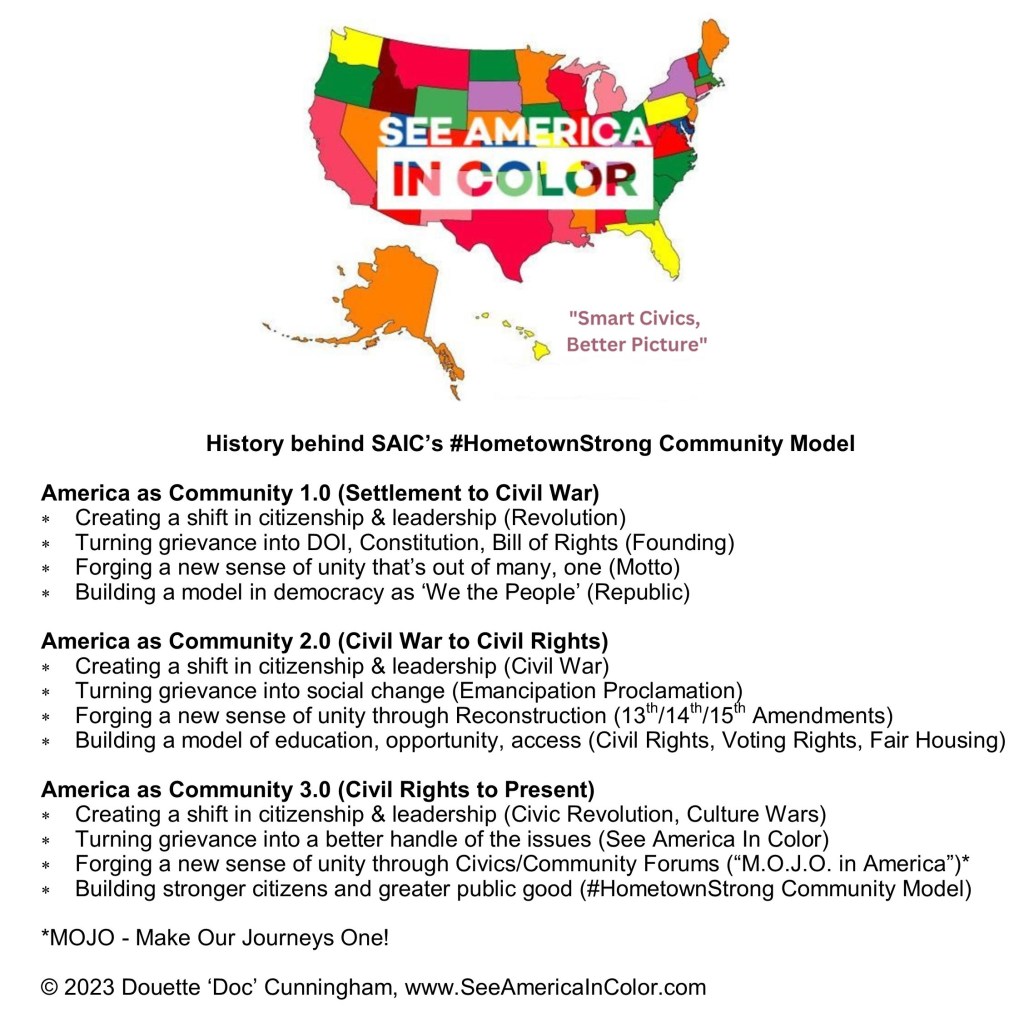
                Our journey to a more perfect union has gone through upgrades in representation. Think of us starting out as ‘Community 1.0’ with education institutions training a new nation in self-government, while abolitionists focused on ending slavery. After the civil war more institutions came on board, including HBCUs. A shift to ‘Community 2.0’ occurred with industrialization training, while activists sounded the alarm on lynchings. As segregation took hold, a shift to ‘Community 3.0’ saw citizens trained in non-violent protest, and there was a rise in information-tech. Now there’s STEAM in education as we ask, “What’s America missing?”

                4. Town & Country

                With the initial Articles of Confederation, the founders soon realized some gaps. There was a problem with handling ‘common defense’ of the colonies. After the words “We the people in order to form a more perfect union”, you’ll see five areas they felt the new U.S. Constitution would address: establish justice, ensure domestic tranquility, provide for the common defense, promote the general welfare, and secure the blessings of liberty to ourselves and our posterity. SAIC sees an opportunity to begin answering the question “what’s America missing” like the founders did in their approach to those five areas.

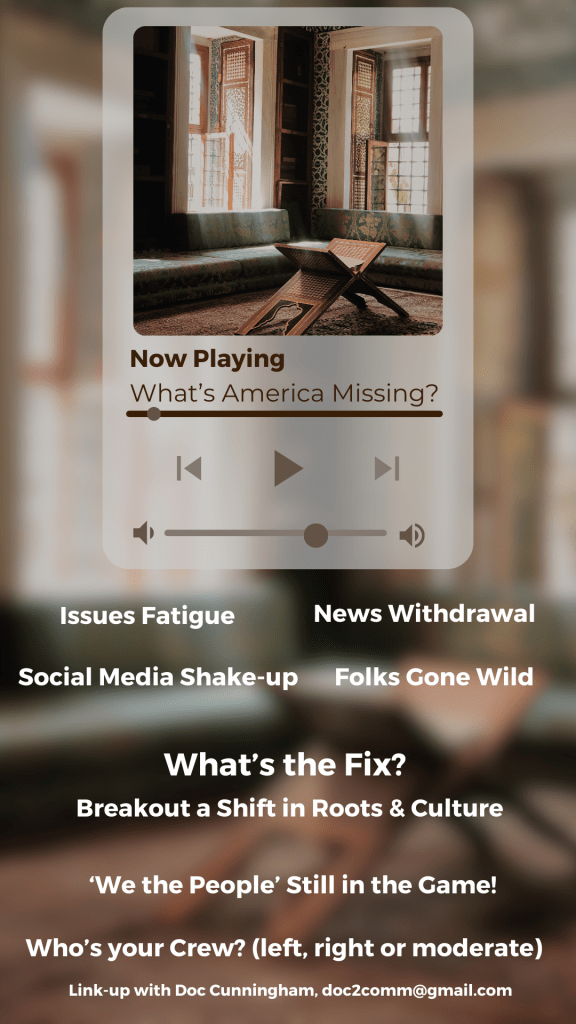
                What’s America Missing?

                So, let’s go from primitive to innovative in America’s next chapter, as opposed to the reverse or just being about lining your pocket while the market tumbles. Join us in answering the question, “what’s America missing?” Plus, SAIC is looking at new ways to deliver content, programs and events where folks have a better handle of hot-button issues, by how they see America in color, not just in black & white. What do you do when you want a rebirth of the Confederacy? Maybe you go to the dark ages. What do you do for an upgrade to America’s story? Change the times and make our journeys one with more #MojoInAmerica!     

                Chime-in on impacting Democracy & Public Good, Education & Community or Entrepreneurship & American Dream, ‘Civic Mondays’ events or Civics & Community forums. Plus,you can “J.A.M. With Us” (join a movement) in civic engagement, social change and community life. Checkout the Signup Center below.

                Tracks: Armin Van Buuren – Turn It Up – https://youtu.be/kivuDS-6HbQ?si=6CKI5wTMklTe1IFy

                Dwayne Wiggins – What’s Really Going On – https://youtu.be/0GIFY7NI-OI?si=VnzYEF97vDeVkHel

                Signup Center

                Featured

                The Repeating Cycle of America: It’s Time for Us to Grow-up as a Nation and Stop Being Stuck in The Past of Our Old Ways

                Doc Cunningham
                “Da Island Guy”
                Sounding Off Social

                Artistic genius at its best! That’s how many have been describing the Superbowl halftime performance by Kendrick Lamar. As one friend wrote on social media, “he used hip-hop bars to deliver symbolism and messaging over entertainment.” There’re a bunch of clips about the subtext and subliminal lessons in the performance. Not everybody saw it that way though as some felt the show didn’t have enough razzmatazz. But maybe the current social climate called for a different way to view the rhymes. Ever wondered how folks made it through crazy times of the past? Well, we’re living in such a moment.

                Social Media Options

                To understand where we are in time, let’s look back to the period of Reconstruction. This ties-in with the phase of America’s story after the civil war that saw a ‘rollback’ (sorry biz leaders) in civil rights gains. Back then, when blacks were promised 40 acres and a mule, there was a rollback. When black folks started to win elected office, there was a rollback in ballot access. After voting rights and citizenship laws were passed, there was a rollback to what became known as Segregation. In our current season of backlash to Black History Month and anti-DEI sentiment there’s basically a rollback in fulfilling America’s ideals.

                The problem is that Black history has always been a catalyst for change against the bogeyman, sometimes known as a ‘white supremacy’ mindset. Said another way, whenever America makes headway towards a more perfect Union, there’re forces that operate around:

                • Denial of truth: Self-evident truths turn into ‘social truth’ like sometimes happens at a bar.
                • Withdrawal of trust: As America withdraws from neighbors/agreements, denial is to autocracy as withdrawal is to hypocrisy.
                • Tyrannical in task: There’s so much angst due to knee-jerk decisions and faulty explanations.

                In the past, this has led to citizens getting bamboozled by a skewed reality as leaders chose to unwind progress under the pretense of trying to upgrade policy. Plus, in some circles these days, patriotism seems to be more about a ‘race to riches’ than a service to the common good as a nation. It’s interesting, last time we talked about the words ‘establish justice’ appearing in the Constitution. Well, another objective listed after the preamble of ‘We the people in order to form a more perfect Union,’ is found in ‘general welfare’. Some in America have lost their way on ‘general welfare’ and handling of grievances.

                Headline Rapper

                Well, like Lamar’s halftime show, SAIC’s efforts as a social-edge campaign/platform bring symbolism and messaging with uplift entertainment. A new phase of our rollout (as opposed to rollback) is in ‘Operation Mojo’ where community partners join forces to ‘make our journeys one’. Not enough time to get into how this relates to history, but moments in our past have had wake-up calls. Those times in history were followed by two scenarios: (1) Boycotts, (2) ‘Social Moonshots’. In other words, there were upshift steps in civic engagement, social consciousness and programs to level-up our game. An important note is that America seems to have a repeating cycle. So, it’s time we choose to grow up and stop being stuck in the past of our old ways. We’ve got to learn from those past moments by how we:    

                1. Influence Family

                  People often say Black history is American history. One way to understand this is when white folks can take to social media and read between the lines of Lamar’s symbolism and messaging. This means his performance wasn’t just a ‘black history’ performance. There’re some ‘common good’ aspects to black history that have significance beyond black people. We know that’s true from Dr. King’s message about building a ‘beloved community’. Yea, he was rooted in Black America based on genealogy. But his message was the ultimate example of diversity, equity and inclusion as a family line or American family.    

                  2. Impact Culture

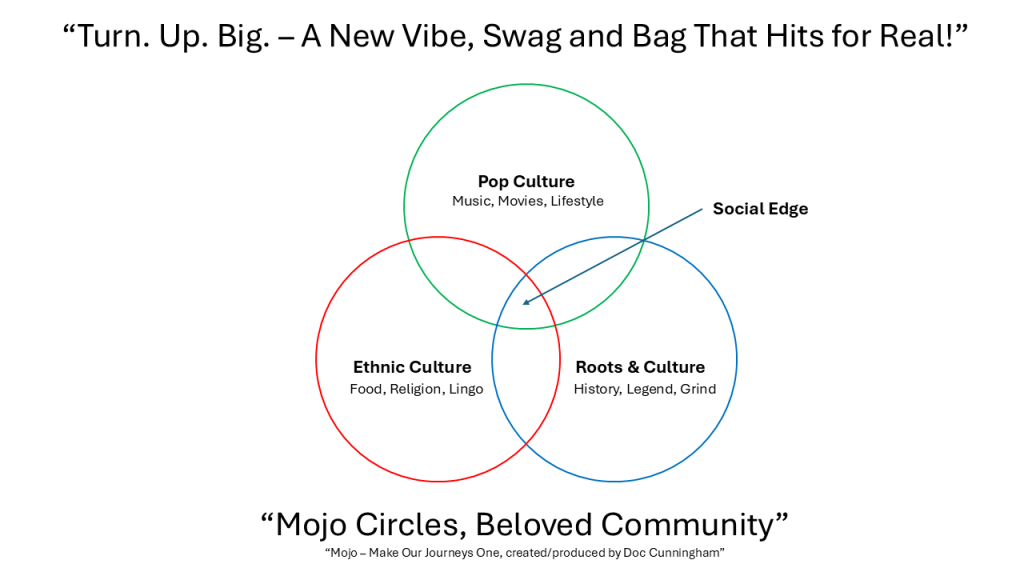
                  One of the ways folks tried to impact culture back in the day was through intimidation. The KKK became a thing after Reconstruction because folks wanted to reset the narrative about the civil war. They also did that through ‘denial of truth’ by saying the civil war was about ‘State’s Rights’ when it really was about trying to hold on to slavery. We can impact culture today by how we relate King’s ‘beloved community’ with SAIC’s ‘mojo circles’. What if we could show folks another way to ‘slice & dice’ the craziness of our times through civics, the way Lamar gave us a new way to get the message across through his lyrics?     

                  “Operation Mojo”

                  3. Invite Community

                  Think about how smart TV’s have made streaming apps and multi-media features possible? We can watch Internet broadcasts on our TV sets and ‘mirror’ content from our phones to our family room big screen. Well, think about what ‘smart civics’ might do to raise our civic engagement and social consciousness. SAIC’s expertise in this area is about connecting the dots across history, civics and culture. This way we’ll achieve ‘informed living, homeland rising’ with EASE: Educational, Aspirational, Social, Entrepreneurial. Ready to get on board our Friday Night Flights to a higher destiny of community?

                  4. Inspire Dreams

                  It’s hard to believe that next year will be 40 years since we’ve been honoring the MLK Holiday. It was signed into law on November 2,1983 and first observed as a holiday on January 20, 1986. That should be enough for us to see it’s time we grow up as a nation. Also, next year we’ll have the 250th anniversary of America’s Independence. Let’s put it this way…America’s independence inspired dreams of a new nation built around democracy as a republic. Moreover, Dr. King’s dream was built around the idea of making diversity, equity and inclusion meaningful in our journey. How are those dreams looking these days?      

                  Life Dreams

                  At a civil rights movement transition point in April 1968, Dr King said these words: “The nation is sick. Trouble is in the land. Confusion all around.” By Summer ‘68, Fannie Lou Hamer at a Boston speech said America must “wake up.” Are we at a similar point now? Well, Dr. King outlined two high-level steps: (1) Fierce urgency of now, (2) Do something for country, keep moving with new energy. So, does ‘Operation Mojo’ interest you or your group? Let’s get through the rumble & tumble moments by how we influence family, impact culture, invite community and inspire dreams in the next chapter of America’s story.    

                  Chime-in on impacting Democracy & Public Good, Education & Community or Entrepreneurship & American Dream, ‘Civic Mondays’ events or Civics & Community forums. Plus,you can “J.A.M. With Us” (join a movement) in civic engagement, social change and community life. Checkout the Signup Center below.

                  Tracks: P!nk – What About Us – https://youtu.be/ClU3fctbGls?si=kF83Dml6T4Z4yh0x

                  Chaka Khan – Keep Your Head Up – https://youtu.be/88DS-T7Ypa4?si=V5Art2MWV-7zFbLb

                  Signup Center

                  Featured

                  Roll Call 2025 For Here and Now: What Presidential Inauguration, Civics and American Values Should Mean During This Season of Makeover

                  Not since 2005 had Christmas and the start of Hanukkah fallen on the same day. The significance of that coincidence happening this past holiday was not lost on many faith observers. Normally after Christmas the usual ‘small talk’ children have with others is “what did Santa get you?” While that question has been long answered by now, there’re some bigger questions that America needs to have front and center. There’s also the coincidence of Inauguration falling on MLK Day.

                  What’s America Not Seeing?

                  Since it’s the start of a new year to build on vision, there’re probably some action items you’re turning into goals. To make them a reality will take steady effort and maybe even probing insight. That’s where we find ourselves as a nation too as we ponder what presidential inauguration, civics and American values should mean during this season of D.C. makeover. There’s probably a steady effort underway to get folks in place. But what about the probing insight needed to make sure America rises to the occasion of the Constitution and its goals? Meanwhile, there’s a shake-up happening in social media and traditional media. Not enough time to get into it here, but for clues we gotta go back to America’s second President John Adams.

                  Following the pre-amble’s first few words of “We the people in order to form a more perfect Union”, comes these two words: “establish justice”. As SAIC is known for, we’ve done a deep dive in American history, the ‘Black to America’ story, and #HometownStrong comebacks for some probing insight. The founders wanted to establish justice as a nation because there was a sense of unfairness from the British throne. But America’s history has also seen a focus on ‘social justice’ in response to those experiencing the feeling of denial. There’s been equality denial, voting rights denial, opportunity denial, climate change denial, and more recently, election denial as well as DEI & truth denial. Dr. King understood this social justice element when he said, “injustice anywhere is a threat to justice everywhere.”

                  Just to recap, those ‘threads of denial’ led to different moments in history. They’ve played a role in America’s tug-of-war between two sides: life, liberty and happiness vs hate, grievance and divisiveness. Plus, throughout history we’ve had moments of major ‘public lies’ that caused Americans to make decisions based on deception and not destiny. These ‘lies’ included the three-fifths clause, Supreme Court decision on Dred Scott as well as Plessy vs Ferguson ruling on ‘separate but equal’, and more recently, disinformation about the 2020 election results. It’s important to share these not simply to cry foul, but to remind us that history is like a ‘civics bible’, the more we apply it the better we’ll handle life’s issues.

                  “Civics Bible”

                  Dr. King encouraged us as a nation to choose the path that led to a higher destiny of community in the same way that SAIC offers a path for a higher level of citizenship. When King wrote the book “Where Do We Go from Here: Chaos or Community?” there was a stretch between 1963 and 1968 that holds some relevance to the past five years. What could have caused him to go from his ‘I Have a Dream’ speech to his ‘Mountaintop’ speech five years later where he said, “The nation is sick. Trouble is in the land. Confusion all around.” Well, we might add a new subtext to King’s book title with the words “What’s America Missing?” If we had to interpret King’s dream and make it relevant to here and now, what might our 2025 goals (and beyond) as a nation look like? Maybe we should first revisit “Out of Many, One” and reset around how we “Empower Many, as One” to: 

                  1. Build your Quad/Squad

                    In the ‘here & now’ Dr. King could rattle off some quick points of concern. He might suggest that some parts of ‘The Church’ has lost their high ground. He might emphasize that we need a new social consciousness mindset with education and civic action as two sides of the coin of economic/social impact. His dream might point to a newer sense of urgency for how we build our quad/squad so that America’s unresolved trauma, unresolved truths and unresolved trust don’t spread even further like wildfire. As with computers, when truth is lost, we end up in an error condition or major system failure.    

                    2. Build your Brand

                    In the new year as companies announce that they’re rolling back certain initiatives, many are wondering, what does that mean for the ‘pace of change’? In civic life W.E.B. Dubois talked about us having a double consciousness of how we see America and how America sees us. Well in business there’s the idea of having a ‘double bottom line’ in how you make money and make a difference. Those in biz know that as you build your brand and attract customers, you’ve gotta do things even when it’s not ‘popular’. Similarly, to build success you gotta do some things that aren’t always convenient or ‘trending’ at the time.  

                    Attracting Customers

                    3. Build Your Block

                    When “Out of Many, One” was adopted in the early days it served as a mantra in going from 13 colonies to become the United States of America. Back then there weren’t any political parties, just folks operating with the idea of “hearts & homes for America.” If we’re gonna “empower many, as one” we gotta empower many families as one, many communities as one, even ‘We the People’ as one. To get there, we’ve gotta put civics in the driver’s seat. With politics we tend to see a push/pull between money and power. With civics we get to be inspired by a push/pull between people and progress, between ideals and innovations.

                    4. Build Your Cred

                    What’s it gonna take to build more cred as a nation and level-up our Union? To begin answering the question “what’s America missing”? we need a model to connect the dots across history, civics and culture. Plus, maybe America needs a new mojo in our game, culture needs a new lingo to explain things and families need a new go-to for not repeating same-old-same. In sports, momentum rules the day. Teams can have similar records and somewhat equal talent, but it’s in how they bring juice, magic and charm that things click as mojo. Similarly, we can build our cred by how we deliver more #MojoInAmerica.      

                    Mo-men-tum Building Efforts

                    At Franklin Delano Roosevelt’s inauguration he said, “the only thing we have to fear is fear itself”. There’s a certain kinda fear that’s hovering over the nation in this season of political makeover. Dr. King as a Baptist preacher might use scripture to remind us that “God didn’t give us a spirit of fear. But of power, love and a sound mind”. In this new period of civic engagement, let’s build King’s dreams and our purpose in speaking truth to power, operating in love with one another and maintaining a sound mind. Every kinda people make the world go ‘round and ‘We the People’ keep America moving towards destiny.  

                    Chime-in on impacting Democracy & Public Good, Education & Community or Entrepreneurship & American Dream, ‘Civic Mondays’ events or Civics & Community forums. Plus,you can “J.A.M. With Us” (join a movement) in civic engagement, social change and community life. Checkout the Signup Center below.

                    Tracks: One Republic – Better Days – https://youtu.be/dbUI7JfHxLc?si=2BvAy-E-pbIILi7i

                    NF – Hope – https://youtu.be/YUdkYx9WH9k?si=eHvA_Zf1LeENndCg

                    Signup Center

                    Featured

                    How Does America Explain Itself? (Part 2 of 2): A Wake-up Moment on the Reality of Our Times

                    Doc Cunningham
                    “Da Island Guy”
                    Sounding Off Social

                    The holiday line-up is in full swing! Things started to roll out before Thanksgiving with promos for Black Friday. It seems we’ve already shattered shopping records with more cash registers left to ring. Online sales continue to skyrocket as folks do more clicks than trips to the mall. Even in sports the line-up is set with twelve teams named for the new College Football Playoff (CFP) series. And of course, holiday lights are twinkling everywhere.

                    Holiday Lights

                    Meanwhile, others are gearing-up for a changing of the guard in Washington. With the final count of election results being just about done, some wanna regroup. As with sports, it helps to ‘review the film’ to see what led to the loss at the party level. But another way to understanding the ‘L’ is in whether we’ve lost or way as a nation. For starters, we get to see the full picture by comparing America over the past 20 years, with the first 20 years of America’s founding and rollout.

                    Interestingly, the first line in the Constitution is a statement of civics (“We the people in order to form a more perfect Union”). The rest of the Constitution comes with statements of politics. Similarly, the most quoted line at the beginning of the Declaration of Independence is a statement of civics (“We hold these truths…). The 27 grievances listed afterwards help us see how things can get caught up in politics. Maybe it’s not an accident that the motto E Pluribus Unum (Out of Many, One) happened in the first 20 years, when compared to America’s recent journey of ‘election whiplash’ over the last 20 years.

                    You’ve heard it said that we live life forward but understand it backward. From our ongoing deep dive in American history, the ‘Black to America’ story and #HometownStrong comebacks, we’ve made the following notes that might serve as a wake-up call on the reality of our times, based on the last 20 years of presidential campaigns:

                    • When politics get put in the driver’s seat, civics get put in the backseat (or even the trunk).
                    • History and its lessons are often overlooked or dismissed, so unproductive things repeat themselves like a memory-loss patient.
                    • There’re times when roots & culture get the side-eye from those in politics, biz/admin or pop culture, which can leave regular folks in the dark.
                    • When people or public officials miss the mark, it takes a ‘We the People’ view to bounce back. When politics is used as a wedge, those folks are working with a ‘We the Privileged’ view.

                    What you’ll see from looking at the first 20 years is that America has two ideological threads rooted in its political DNA: one based on enlightenment, the other tied to disenfranchisement. Taken a step further (or deeper), America’s journey has followed two threads: “Life Liberty & Happiness; Grievance, Hate and Divisiveness”. Moreover, whatever thread a campaign runs on, that’s likely how it will govern. With a closer look, you’ll discover three aspects in American history that help explain how these threads came to be. So as America tries to explain itself (to itself and the world), these threads shed light on who we say we are (ideals) versus who we show we are (identity).

                    Connecting Ideas & Ideals

                    In the next chapter in America’s story it’s important to connect the dots across history, civics and culture. Why? Well, we’d never allow in school, biz, sports or even family what we let happen in politics/civics. With the former arenas there’s some department that will sanction folks when they step out of line. In public affairs ‘We the People’ are the oversight body by how we vote. But we can’t sanction when we don’t understand the ideological threads of contradictions versus convictions. Like we saw in the first 20 years of America’s existence, it’s gonna take putting civics in the driver’s seat. This way we’ll know when the media finds its legs between reporting vs marketing, informing vs idolizing, and better understand the:  

                    1. Stakes

                      Our body does hundreds of operations each day to stay alive. We make lots of decisions to keep our lives on track. Not all decisions are high stakes. Some are just run-of-the-mill. Every so often, we get an alert or info that requires a high stakes decision. The first 20 years of America’s existence had high stakes decisions producing our founding documents. The last 20 years of our existence have been on a razor’s edge. We gotta pay attention to social alerts and historical info for better high stakes decision making. We gotta better balance screen time and learn time, not just making decisions as ‘reality entertainment’.    

                      2. Stars

                      Every industry has stars recognized at various awards. In culture, star-factor shifts and evolves with the times. What we’ve seen throughout history are folks who only want to celebrate others whose light shines white, versus folks who wanna celebrate others whose light shines in a multi-colored, multi-cultural way. In other words, there’re those who see ‘Whiteness as their wokeness, and otherness as your weakness”. The light folks shine on the inside, is the light they project on the outside. A black & white TV projects white light, but a smart TV’s beautiful picture projects colored light. That’s what SAIC brings to the party.

                      3. Stats

                      Stats Manager

                      Every sport has its stats where analytics has become its own commodity. But so has happened in politics where lies, disinformation and distrust have become their own commodity that gets sold to the public. But Dr. King wanted us to avoid being sidetracked by bad stats. His hope during the civil rights movement was that it would help our nation achieve a higher destiny of citizenship. It’s not about one side trying to fool the other side or control the other side or turning culture wars into battles that fool the public. It’s about how we fulfill the ideals of America’s spirit and get back our ‘civic mojo’ to make our journeys one.

                      4. Story

                      Sometimes elections are like ‘baptism’. We get preached the ‘gospel of the parties’ then are all-in with the policy/programming. However, whether at graduation, a wedding day or baptism, that’s not a one-time thing but a lifetime journey of learning and growing. America, we got to do a better job after elections where it’s not just a one-time thing, but a lifetime journey of being informed, engaged and inspired citizens. After graduation we get to grow in skillset. After the wedding day we get to grow in marriage. After baptism we get to grow in faith. After elections, we gotta grow in the story of perfecting America.     

                      World View

                      Throughout history ‘We the People’ used civics to become more informed, engaged and empowered around the stakes, stars, stats and story. We’re at that moment where we need to not just be about ‘the show’ but also about ‘the know’. We must remind ourselves of what it means to be a democratic constitutional republic, not just a hodgepodge tribe of citizens. We’ve got to deploy a new world view, with history as a mirror to help us see who we are; civics as a map to see our way around; and culture as a motor to drive our way through to an America we desire and expect in our hearts and homes.  

                      Chime-in on impacting Democracy & Public Good, Education & Community or Entrepreneurship & American Dream, ‘Civic Mondays’ events or Civics & Community forums. Plus,you can “J.A.M. With Us” (join a movement) in civic engagement, social change and community life. Checkout the Signup Center below.

                      Tracks: Bob Marley – Wake Up and Live – https://youtu.be/dq-_js08tU0?si=911h24tdDvfUQI6t

                      John Legend – Wake Up Everybody – https://youtu.be/iJgxJ6JrPkc?si=Rr7Y7mIFeXKzs9zn

                      Signup Center

                      Featured

                      How Does America Explain Itself? (Part 1 of 2): A Wake-up Moment on the Reality of Our Times

                      Doc Cunningham
                      “Da Island Guy”
                      Sounding Off Social

                      Well America, what just happened? A couple weeks ago the Yankees fell flat in the World Series. Over recent days in college football, we saw Georgia get beat by Ole Miss. Even soccer had its shocking result as Messi’s Inter-Miami squad got knocked out of the MLS playoffs by Atlanta United. Maybe the post-game analysts, sports radio pundits and podcast hosts are gonna make it make sense.

                      Podcast Host

                      Then came the presidential election. It’s going to take some time to have it all make sense, but we gotta avoid being stuck. After a disappointment like happens in a big game, the commentators might run through the season from start to finish to help connect the dots. Moreover, the analysis might look at the team’s past and present to consider their future options. We need to do the same to answer the question, “how does America explain itself?” Maybe one aspect is that folks see their vote like voting for contestants on a realty tv show. Plus, with around 6 million less folks voting for president compared to 2020, and the social hierarchy from history, looks like many had more dread than hope.

                      Pendulum Swing

                      But there’re lots of other factors to pull in when reviewing the reality of our current times, in terms of history and legacy. For example, during biblical days there was a pendulum swing over a 450-yr period between good Kings and bad Kings, where God at times had to step in to set things straight. But let’s make it make sense from SAIC’s ongoing deep dive in American history, the ‘Black to America’ story and #HometownStrong comebacks. We learned that throughout America’s almost 250-yr history, author Corey Brettschneider says we’ve seen a similar pendulum swing:

                      • We’ve flipped back-and-forth between reckoning and recovering in the journey of America.
                      • It was the efforts of ‘We the People’ that ensured America kept moving and growing.

                      Reckoning had Democracy on edge, while recovery had it on elevate. Then, add-in thoughts Dr. King shared in 1967 from assessing the civil rights movement and race relations in his book “Where Do We Go From Here: Chaos or Community?”. He once said that “darkness cannot drive out darkness only light can do that. Hate cannot drive out hate, only love can do that.” SAIC’s footnote on King’s message is that “politics cannot drive out politics, have civics help do that.”  A cold hard truth is that love doesn’t spread hate, only self-hate does that. Light doesn’t spread darkness, only darkness does that. So for America to heal, how’re we gonna address the self-hate, the darkness, the hypocrisy?

                      Bible History

                      Furthermore, the presidential campaign revealed some things about trying to heal election wounds. No one with a wound goes out and keeps re-injuring the wound, expecting it to heal. It’ll heal when given treatment or surgery or time, as with athletes after a hard-fought game or injury. The problem we have is that sometimes politics keeps re-harming the wound. So we’ve gotto do some analysis to help America explain itself (to itself). For starters, there’s a void/disconnect in how we see America and each other in:    

                      1. Humanity

                      SAIC’s social-edge framework is built on the shift from black & white TV to color TV. Black & white TV beams a stream of ‘white light’, with varying shades of gray. Color TV beams three streams of ‘colored light’ (red, green, blue), when combined give the beautiful picture on our sets. America began with a single stream of ‘white light’. The nation’s journey towards a more perfect Union is shifting to a multi-stream ‘array of light’. The ever-present challenge in America is some mainly want to stream ‘white light’. This sadly plays out across humanity and the annals of time in a mindset of “whiteness over otherness.”

                      2. Democracy

                      Each time our democracy was on edge it was preceded by a stark ‘public debate’ or provable ‘lie’. Around the time of our founding and the subsequent abolition period, the debate was that Blacks were inferior (three-fifths clause). During the Antebellum period, a ‘debate conclusion’ led to Dred Scott being told he had no rights as a citizen (Supreme Court Ruling). More recently after the 2020 elections, things went off the rails. In each case, the wranglings led to seismic moments in American history. So, understanding modern elections and how we got here means connecting the dots across history, civics and culture.

                      3. Party

                      Political parties took shape around 1796 and more fully by the 1800 elections as Federalists and the Democratic-Republicans. Now, don’t get stuck on labels since party names have changed and ideology flipped between parties over time. The key thing to note is ideology flips between living in contradiction or living in conviction. An example of this from the early days was in slavery as a contradiction to the Declaration of Independence ideal of equality. These days the contradictions play out in election polling data and public policy info. Was the election really about the economy or other contradictory factors?

                      Ideology Flip

                      4. History

                      It’s said that controversy sells, sex sells, celebrity sells. This election saw ‘bigotry sells’ surface in new ways. These were demeaning moments against different racial groups which have already begun to affect college campuses and Black voters. In the early/mid 1900s there were minstrel shows which often had folks in blackface as a gesture meant to be funny but was instead demeaning. Decades later there was Archie Bunker, who played the lead role in a sitcom serving up a similar mixture. What we just experienced and have seen in history felt like it came from the ‘political supermarket’ of old.   

                      Maybe Dr. King would take a page from scripture or ‘Uncle Sam’ take a page from history in asking, “what does it profit a nation to lie to the whole world but lose its soul?” In early America we had one group of politicians pushing the Alien and Sedition Acts of 1798 while another group of NJ citizens were crafting the Township Act of 1798. Same year, two different realities. Since today looks like this is America, we can take a page from King’s work to “do something for country, keep moving with new energy.” The civil rights movement knew that it’s ‘We the People’ that keep us on the ‘life, liberty and happiness’ path.

                      ‘Uncle Sam’

                      Chime-in on impacting Democracy & Public Good, Education & Community or Entrepreneurship & American Dream, ‘Civic Mondays’ events or Civics & Community forums. Plus, you can “J.A.M. With Us” (join a movement) in civic engagement, social change and community life. Checkout the Signup Center below.

                      Tracks: Jazmine Sullivan – Stand Up – https://youtu.be/X-6g7My_j14?si=XO1qpHiMVESZOWjr

                      John Mayer – Waiting on the World to Change – https://youtu.be/oBIxScJ5rlY?si=VCVIxXoKolm8Pq4z

                      Signup Center

                      Featured

                      The Original Founders Playbook: How Their Novel Gameplan Helped Roll Out the Red Carpet for America

                      Doc Cunningham
                      Da Island Guy
                      Sounding Off Social

                      “Blue States are getting bluer and Red States are getting redder!” That was the jarring headline from a recent USA Today analysis of where we are as a nation. Their team of journalists did an extensive look-back on the evolution of politics and voting patterns over the past four decades. What they found sends warning flags about things that contribute to the partisan discord and social divides. What does that mean for the future of America? (hold that thought).

                      Peace Out

                      As Israel marked the one-year anniversary of the attack on its citizens, we see ongoing instability and rising tensions. There’s increasing concern that things could get out of hand and become a regional mess. But even closer to home, as the presidential campaign season rounds the corner towards the homestretch, some are wondering if we’ll have similar post-election drama as happened in 2020. It seems both situations need a new language to describe things, while walking in the shoes of history.

                      In the case of the Middle East, U.S. policy supports a two-state solution. With the situation as horrific as it is, maybe that new language for moving things along might include as a mantra, “Shared Peace Lifestyle”. Furthermore, with the U.S. social/civic climate, a similar step might apply. That’s the inspiration behind SAIC, as a novel concept around civic/social issues for a higher level of citizenship, having coined the term, #MojoInAmerica (MOJO – Make Our Journeys One).

                      Pivot Points

                      Remember, SAIC was born out of a deep dive in American history, the ‘Black to America’ story and #HometownStrong comebacks. From those lessons, we found some key ‘pivot points’ along the way. There was the Declaration of Independence in 1776; the adoption of E Pluribus Unum (Out of Many, One) in 1782. The release of the Constitution to the States for review in 1787. Then there was the Federalist Papers being published on October 27, 1787. It’s why Oct 27th is observed as National Civics Day. Of course, there’s that moment between Benjamin Franklin and a female bystander who posed the question, “What do we have, a monarchy or republic?”

                      While that question lands loudly within the current political climate, there’s a subtext that resounds even louder, kinda connecting from back then to now. Think of it in the ‘What do we have’ terms today:

                      • Is it just about politics or also civics?
                      • It is just protecting turf or uniting people?
                      • Is it just the ‘horse race’ of running for a constituency or the ‘voice race’ of empowering citizenry?
                      • Is it just promoting the policy or perfecting the Union?

                      With the choice at hand in the upcoming election, we can take a page from the founders’ playbook in rolling out the red carpet for America. The model left by them is one of turning the Constitutional Convention into civic mobilization that appealed to ‘hearts & homes for America’, otherwise known as ‘We the People’. Political parties didn’t arrive on the scene initially until 1796, and more established in 1800. What made the red carpet rollout special is that it was:        

                      1. News Breaking

                        Newspaper Stories

                        The three main writers of the Federalist Papers were James Madison, Alexander Hamilton and John Jay. According to the online History Channel, when the first essay appeared in the Independent Journal, Hamilton argued that the debate facing the nation was not only over ratification of the proposed Constitution, but over the question of “whether societies of men are really capable or not of establishing good government from reflection and choice, or whether they are forever destined to depend for their political constitutions on accident and force.” These days, what’s news breaking is more ‘shock & awe’.

                        2. Crowd Sourcing

                        As the founders returned to their States, they had the chance to share ‘meeting notes from the Convention, release notes from the Constitution.’ There was that bystander question that got the ball rolling, as Franklin left the Convention Hall. When they arrived home, their focus was to engage residents in the benefits of being part of the Union. In other words, independence was the first step in democracy and republic, but to get to Union they did ‘crowd sourcing’ instead of ‘crown sourcing’. It’s like when a potential candidate announces a listening tour, they’re trying to fine-tune and maybe foretell their plans.

                        3. Mojo Building

                        National Civics Day

                        The founders and citizens knew the stakes of ratifying the Constitution. Clearly, there was some ‘mojo building’ at play. The National Anthem hadn’t yet been written so ‘E Pluribus Unum’ and the Federalist Papers were the tools. One helped to rally the social climate, the other was paramount for forging the civic climate. But something else happened, like what immigrants get to experience in becoming naturalized citizens. As with public officials, we take an oath to “support and defend the Constitution against all enemies foreign and domestic.” That’s tied to some ‘life, liberty and happiness’ patriotism.  

                        4. Shift Making

                        The first three States to ratify the Constitution were Delaware, Pennsylvania and New Jersey, with ‘shift making’ across the land. SAIC as a social-edge campaign works to embrace civics and bridge divides. Example, in consumer tech we went from black & white to color TV; same box, different technology. With civic/social issues, SAIC helps highlight that we’re “same box (flesh & blood), but different cultures”. With TV, we went from same source (channels) to different streams/smarts. Similarly, with the issues we go from the same ‘isms & schisms’ then and now to viewing things through SAIC’s ‘smart prism’ as a nation.    

                        Before there was ‘we the democrats’ or ‘we the republicans’ there simply was ‘we the people’. With red States becoming redder and Blue State becoming bluer, we can deploy ‘See America In Color’ to bridge the civics gap and partisan divides. As the red carpet got rolled out in the early days, all the founders had to work with was appealing to ‘hearts & homes for America’. In part, that’s the inspiration behind SAIC’s latest efforts to rally around civic engagement, civics education and social impact. This means taking a page from the founders, built around news breaking, crowd sourcing, mojo building and shift making.  

                        Bridging the Civics Gap

                        Chime-in on impacting Democracy & Public Good, Education & Community or Entrepreneurship & American Dream, ‘Civic Mondays’ events or Civics & Community forums. Plus,you can “J.A.M. With Us” (join a movement) in civic engagement, social change and community life. Checkout the Signup Center below.

                        Tracks: Rag’n’Bone Man – Human – https://youtu.be/L3wKzyIN1yk?si=rT6qK9HaifvTkN-d

                        Tems – Higher – https://youtu.be/Qa1IaUywiO8?si=DQ5eUwgqMk-D-bd4

                        Signup Center

                        Featured

                        Turning the Corner on Constitution Avenue: How America’s Story Might Get a Course Correction Through Social Capital Reinvention

                        Doc Cunningham
                        “Da Island Guy”
                        Sounding Off Social

                        Folks are excited about ‘opening season’ kickoff time of year! With Fall temps getting a little cooler, here’s hoping that the same can be said about our political discourse. As the campaign season hits the road after Labor Day, with candidate debates and television ads on tap, there’s something eye-opening that’s sure to go down.

                        Eye-Opening World View

                        This time of year might be seen in two ways: a ‘roots & culture’ takeoff and a ‘back to school’ jump-off. There’s a new season of returning programs and new specials to hit the small screen. We also have the hustle & bustle of daily life returning to regular programming. But there’s also the fact that cooler temps mean deeper ‘roots development’ with grass and trees. That’s what landscaping experts say. But what if this were also a great metaphor for the deeper ‘roots & culture’ development we might do as a nation?

                        SAIC spent the past few months during the lead-up to the Conventions season, making observations around two groups: those excited about the ‘politics of things’ and others excited about ‘the civics of things’. One of the ‘aha moments’ is that it’s much easier to monetize around politics than to mobilize around civics (let that sink in a bit). Said another way, it’s much easier to monetize candy than it is to monetize broccoli, but that doesn’t mean broccoli is less important.

                        Candy vs Broccoli?

                        With the Conventions over, some wonder what next? One of the takeaways from the 2024 presidential campaign trail is the idea that the next chapter of America’s story will be tied to matters of heart & home. In one sense, there’s a direct tie-in to family. But in a larger sense it’s about how we the human family operate with the same zeal for public good as folks do for elective office. Moreover, as everyday citizens, it’s about how we might “do something for country, keep moving for victory.” History reveals that victory is in how we “guard democracy, affirm the republic and save the Union.”

                        The next few months will likely be fast & furious in the political world. In addition, depending on our civic engagement, the next few years might be a chance for turning the corner on Constitution Ave through social capital reinvention, leading-up to the 250th anniversary of America’s independence in 2026. We’ve got a shot at making a course correction, like planes do while flying on auto pilot. Sometimes it drifts a bit off the desired path but gets back on track due to the ‘smarts’ tied to airplane technology. Similarly, the ‘smarts’ in SAIC’s ‘social technology’, made possible by a deep dive in American history, the ‘black to America’ story and #HometownStrong comebacks, offers a similar course correction to Union Station for:

                        Union Station

                        1. People (hopes & hurts)

                          America’s Declaration of Independence is a forward-looking statement based on self-evident truths around life, liberty and the pursuit of happiness. That’s the ‘hopes’ part of America. But it also shares a list of grievances (hurts) that led to the spin-off from the British empire. What the Constitution then tries to do is forge our collective interests as ‘we the people’ to form a more perfect Union. It seems for our social capital reinvention, we gotta look at what matters most for the hopes of the nation and the hurts of the next generation to reach new heights and move past senseless tragedies.

                          2. Family (hearts & homes)

                          When the nation was founded, there weren’t any political parties. It was just a group of regular citizens committed to governing their affairs. All they had was their ability to appeal to hearts & homes. That’s why a group of ‘friends of SAIC’ got together under the umbrella of ‘Hearts & Homes for America’. We’ve gotta do more around civics education to help break the hate in hearts. We’ve gotta do more around civic engagement to build more hope in homes. We’ve gotta do better around family to deal with possible pockets of pain and shortfall of purpose. We’ve gotta do more as a human family for the public good.

                          Hearts & Homes for America

                          3. Community (towns & teams)

                          The upcoming season-opener for ‘Dancing with the Stars’ was announced. Some of the celebs who’ll be strutting their stuff include familiar names and those who recently made a name for themselves. There’re athletes from the recent Olympics to name a few. In Hollywood we get to see ‘showbiz as the star’ with all the celebs that go with it. At the recent Conventions we got to see ‘politics as the star’ with all the public officials that go with it. What would happen if we’d make ‘civics as the stars’ with all the regular citizens to go with it? Well reality check… there’re more regular citizens than celebs and public officials combined.

                          4. Country (democracy & diplomacy) 

                          America as a constitutional republic, tries to balance the people aspect of democracy and the power aspect of diplomacy. We’re a democracy that’s for the people, of the people and by the people. We’re a republic through voting for those who’ll represent our wishes in Congress, made up of a House and Senate. We model diplomacy by how we allow freedoms to prevail inside our country and beyond our shores. It’s that delicate balance of democracy and diplomacy that signals who we are as a country amongst ourselves and who we are as a nation beyond ourselves.    

                          Social Capital Network

                          So SAIC delivers content and programming to engage and empower. It’s got new ‘social technology’ to deal with hate, hurt and depleted hope, by how we ‘see America in color’, not just in black & white. There’s a Bob Marley song with the words, “Lively up yourself and don’t be no drag; lively up yourself, ‘cause reggae is another bag”. Well, as we look to “Turn. Up. Big.” in roots & culture, let’s shake-off the things that are a drag in family, community and country. And, whether you live on MLK Blvd or work on Constitution Ave, we’re ready to level-up civics and social capital like a new ‘bag’ (as young folks say).    

                          Chime-in on impacting Democracy & Public Good, Education & Community or Entrepreneurship & American Dream, ‘Civic Mondays’ events or Civics & Community forums. Plus,you can “J.A.M. With Us” (join a movement) in civic engagement, social change and community life. Checkout the Signup Center below.

                          Tracks: H.E.R. – Journey – https://youtu.be/bTWftRNdU3w?si=NCc2SnNRSZKg61Ro

                          Protoje (Ft Jesse Royal) – Family – https://youtu.be/258_PV8K634?si=P-WeaAsefowElVno

                          Signup Center

                          Featured

                          The Hottest Convention Season of Modern Times: What Democracy, Republic, Union Mean for America’s Great Expectations

                          Doc Cunningham
                          “Da Island Guy”
                          Sounding Off Social

                          It was one of the hottest stories in sports and media circles at the Olympics. The women gymnasts led by Simone Biles took home the team gold. It was a kinda redemption story after winning silver in Tokyo. There’s even been some after-effect with the drama around Jordan Chiles’ bronze medal. But in between that, was the Adidas brand’s new ad campaign that stirred-up bad memories from the 1972 Munich Olympics where members of the Israeli delegation were killed. The ad featured runway model Bella Hadid who is of Palestinian descent. She issued a statement condemning violence and apologized for being caught-up in this unfortunate promo.

                          Olympic Rings

                          That was some of the talk in pop culture, but there were other stories where the sense was things were feeling ‘hot hot hot.’ This past July has gone down as the hottest day on record, both literally and figuratively. It was reported by European Climate Services that global earth temperature, based on the averages of land and sea, hit a new high. On a Sunday in July a new record was set, then broken the next day.  

                          Now, when it comes to the presidential campaign, the recent earth-shattering announcement and events during this Convention season left many folks stunned. A different candidate at the top of the ticket has brought new life politically and buzz socially. With this series of stories dominating news coverage, it leaves open the chance that we can have the summer of 2024 mirror the summer of 1787. Back then, the founders met to take initial steps of crafting a roadmap that would be tied to perfecting the nation.

                          Founding Fathers

                          Meanwhile, it feels like this might be the hottest convention season of modern times. Since the days of our founding and the journey of our making, we’ve had moments of crisis and crossroads, where we had to guard democracy, affirm the republic and save the union. On those occasions, George Washington, Benjamin Franklin and Abraham Lincoln left us with examples that were as meaningful then as they are now. You might remember these from:

                          • Washington’s declaration in his farewell speech to watch-out for political factions and despotic leaders that might wanna veer from the founding ideals.
                          • Franklin’s warning at the end of the Constitutional Convention that “we have a republic, if we can keep it”.
                          • Lincoln’s courage during the civil war of issuing the Emancipation Proclamation to save the union.

                          In the current climate we can build on their example while taking a page from business circles. There’s this idea called SWOT (strengths, weaknesses, opportunities, threats) that’s used as a strategy for staying on the cutting edge in the marketplace. Well, in civic & social issues we might use that mindset to rally around a gameplan to get us through the election season and the make-or-break times in America’s story. One thing we might do is make ‘civics as the star’ by how we walk in the shoes of history. We the people can engage a Civics Convention as an updated template of what the founders had in mind. This’ll help set the stage as folks consider the:

                          1. Choice

                            Mirror Image Madness

                            It seems some are bored/mad with the founders’ design on things, in wanting a ‘divorce’ from democracy towards a Christian Nationalist image. That’s one track being offered for America. The other track builds on the founding ideals in a more inclusive way. It’s like SAIC’s model of social/civic reinvention, which mirrors the shift from ‘black & white TV’ to ‘color TV’. It’s a more inclusive framework that’s not just about projecting ‘white light’ but combines elements of ‘colored light’ through American history, the ‘Black to America’ story and #HometownStrong comebacks. This mirrors who we are and want to be as a nation.     

                            2. Course

                            As the founders met in the summer of 1787, their efforts charted a course for the new nation. The guiding purpose has always been about perfecting the union. What might that look like in the 21st century? When World War II ended, the NATO alliance was formed to bolster solidarity and synergy of European nations around democracy. We need a similar strategy now to foster synergy and solidarity on making ‘civics as the star’. During the Harlem Renaissance, Ralph Waldo Emerson believed that “intellect and artistic production could help overcome prejudice”. A public/private alliance having a similar role is needed today.   

                            3. Courage

                            Lincoln issued the Emancipation Proclamation to free the slaves during the Civil War. The push for freedom by abolitionists was heard in social and political circles. But there was the dilemma of blacks joining the Union Army without further inflaming border states that hadn’t yet joined the Confederacy. The courage it took to form the union in 1776 and to save the union in 1865, might be understood in words from Thomas Jefferson: “Whenever the people are informed, they can be trusted with their own government.” A public/private alliance and informed nation gives rise to more courage, less distrust.

                            French Theologian and Philosopher

                            4. Common Good 

                            You’ve heard SAIC’s message before that “civics is to country as hygiene is to humanity. Without it things can get funky”. There’s no law to manage hygiene, it’s just something we do as self-care during life’s ins & outs, and as a common good for human interactions. That’s what this public/private alliance would mean in terms of nation-care. The founders gave us a roadmap for working and growing as a nation. It’s been updated over the years to better reflect the times. But it’s important to not lose sight of the common good so that social/civic interactions don’t devolve into a situation where things get funky.   

                            Party Conventions have become a way to make ‘politics as the star’. But back in the day when parties didn’t exist, the founders were about making ‘civics as the star’. In a few months we’ll be choosing the direction for our country, which will drive the course we take. With that in mind, noted philosopher Reinold Niebuhr one said, “man’s capacity for justice makes democracy possible, but man’s inclination to injustice makes democracy necessary.” We gotta have the courage to guard democracy, affirm the republic and save the union. To continue as a beacon of hope, land of the free, home of the brave, we gotta be on the worthy side of history. So, let’s meet the moment of America’s great expectations.  

                            The Great Seal of the U.S.A.

                            Chime-in on impacting Democracy & Public Good, Education & Community or Entrepreneurship & American Dream, ‘Civic Mondays’ events or Civics & Community forums. Plus,you can “J.A.M. With Us” (join a movement) in civic engagement, social change and community life. Checkout the Signup Center below.

                            Tracks: Pharrell Williams – Freedom – https://youtu.be/LlY90lG_Fuw?si=60X3tOqB4FVISmYc

                            Sara Bareilles – Brave – https://youtu.be/QUQsqBqxoR4?si=Bqs0TenSajKxVaab

                            Signup Center

                            Featured

                            The Story of New Beginnings: Hey America, Who Are We as a People, and What Are We Made of as a Nation?

                            Doc Cunningham
                            “Da Island Guy”
                            Sounding Off Social

                            Did you catch recent news stories that hit like fireworks? In the sports world, we learned Lebron James opted out of his contract, but then signed a new contract not long after with a no-trade clause. Seems like he’s gonna be a Laker for the rest of his playing days. Add to that, word of his son (Junior) getting drafted by the Lakers, and then signed in a matter of days. This news was all over in pop culture.

                            Shark Sighting

                            Politics is right up there too, especially after the uproar and unease following the last presidential debate. There’re those who’re like sharks going for blood or like citizens wanting to see new blood in higher office. The life & times we see today in the summer of 2024 might take us back to the summer of 1787. As the founders met during the Constitutional Convention, they had to choose a leader at the proceedings. Then following that, they had to vote who would become the nation’s first president.

                            Be a fly on the wall then, a cricket on the floor now and a diviner of public sentiment, you’ll soon get some of what’s causing all this angst. These days America is trying to write the story of new beginnings, as well as to answer the question, “who are we as a people, what are we made of as a nation?” Some of the struggles among voters point to the fact that America still has a leaning to having two white men as the nominees from each party running for president. There’s also the factor of telling other countries when their leaders need to step aside to usher in new leadership, but we’re having a tough time doing that here as it relates to both candidates.

                            George Washington, who became the first President had some other concerns then that might even apply today. He was worried about factions driving policy and law. He was chosen during a time when the struggle was around the battlefield of war and democracy. These days, we’re on the battlefield of democracy as well as law/social order, especially with recent Supreme Court rulings. The person we choose to lead us in this next phase of America should have those points top-of-mind or close to heart. Back in 1787 they chose Washington based on four key criteria:

                            • Little/no embarrassment to country.
                            • Greater competence for duty.
                            • Stronger character for synergy.
                            • Better vision for democracy.
                            Civic Duty

                            In sports, great athletes are often seen as making the right play at the right time. They’re good at ‘making the right read’ at pivotal moments in the game. Can that idea or the above 4-pronged criteria be helpful today with paving the way for the next chapter in America’s story? With all things being equal, one might choose a candidate based on party loyalty, personal liking or media savvy. But this time is different. Plus, the struggles seem to also be between regular voters vs big-money donors, left-wing vs right-wing, hope vs hubris, age vs autocratic-leaning. So, we gotta look at what else the founders had in mind when they rolled out the red carpet to America’s Independence. They wanted life, liberty and the pursuit of happiness through the inner workings of:

                            1. People

                            A key phrase in the Constitution reminds us that the nation was founded around new beginnings in self-determination as ‘we the people’. The challenge in America is making sure the will of the many isn’t trampled on by the wishes of the fewer or the civil rights of the fewer isn’t squashed by the many. The challenge we have is that politics and sports play a significant role in culture, with civics having a smaller lane. In the same way that the founders came together and laid out plans for our democratic republic, we gotta revisit that period to highlight ideals that will get us through this moment of Civic Revolution.      

                            ‘Civic Revolution: Issues Soup’

                            2. Power

                            As States came on-board in the Union, folks did more to have ‘we the people’ be a bedrock at other levels of government. Across the country there was the founding of local municipalities/townships that officially recognized everyday citizens who were committed to handling their civic affairs. We know them today as legislatures, mayors, council members, etc. It wasn’t just about serving in high office but also formalizing other parts of self-government. These days we need a kinda regeneration in civic engagement and public good, where folks aren’t in it just for public grandstanding, but for better policy making.   

                            3. Promise

                            What might regeneration look like? Consider injuries to the body and how it’s designed to heal itself by growing new cells, new flesh, new skin. We even see this in nature when branches get pruned and shaped, there’s a regrowth that occurs. The promise of America can serve as that regenerative force. But we gotta cut back from our body politic the things that are like dead weight that serve as a resource drain in the system. We gotta prune and shape some leaves/branches to give birth to new ideas. We gotta ‘set off’ the ideal of turning promise into dreams, like canisters into fireworks.    

                            4. Process 

                            Metamorphosis in Progress

                            America has gone through 7 phases in its history: Settlement, Slavery, Independence, Civil War, Reconstruction, Segregation, Civil Rights. Now we’re in the throes of a new phase, let’s call it Reinvention. When seen like the caterpillar/butterfly metamorphosis, we can move forward and become a butterfly of our better angels or revert to a cold nature and become ‘dead shell’ as a country. Metamorphosis is a transition from an immature form to an adult form. So, for this next phase, SAIC has crafted a Public Interest Proposal across country, community and culture as a public/private initiative.  

                            Whoever is chosen at the Conventions will be one step closer to pulling the levers of America’s power. Right now, a battle for the soul of America is among gatekeepers, content producers, culture makers and power brokers. In getting to ‘Union Station’, there’s track 1 based on alliance in truth & civility. Then there’s track 2 based on alliance in grim and grievance. But we can’t wait for ‘Project 2025’ as roadmap. We gotta set-it-off now with ‘Project 2024’. The path we take to Reinvention will depend on the degree of ‘esprit de corps’ (good vibes, swag & bag) we muster for a more perfect union, to level-up as a nation.

                            Chime-in on impacting Democracy & Public Good, Education & Community or Entrepreneurship & American Dream, ‘Civic Mondays’ events or Civics & Community forums. Plus,you can “J.A.M. With Us” (join a movement) in civic engagement, social change and community life. Checkout the Signup Center below.

                            Tracks: Mickey Guyton – All American – https://youtu.be/0AtnvO2_Ijc?si=1y0O3gHbQ8UND3Bb

                            YG Marley – Praise Jah in the Moonlight – https://youtu.be/Kgh9TVm4X8s?si=69ztLk9Azt6zv3rh

                            Signup Center

                            Featured

                            The New Social Puzzle in America: How an Updated Version of the Lost Cause Wants to Take Us from Jim Crow to Joe Tribe

                            Doc Cunningham
                            “Da Island Guy”
                            Sounding Off Social

                            The summer season is here with lots of ways to get out and enjoy the outdoors. For many, it’s a time for beach life, family reunions, group conventions and vacation travel. With the happenings on the beach or the block, there’re events that bring us together around good times, good life or social impact.

                            Summer Season

                            Meantime, the NBA season’s gonna wrap with the naming of a champion after a hard-fought series and long season. As the baseball pastime settles in, the WNBA season finds its groove around rookies and veterans. Whether Caitlin Clark buzz dies-down or not, the lead-up to the summer Olympics in Paris is already having stories of triumph and heartbreak. Ever wondered with all these sports events, you never hear athletes saying they’ll protest if they lose or that they’re being set up to fail by league/sports officials?

                            Well, the same can’t be said about some in the political world. Since the last presidential election, there’s been a puzzling aspect to how things played out. One way to help solve this puzzle which has become the new social enigma in America, is to take a step back and review the record. As many folks know, that’s how See America In Color (SAIC) came to be. After a series of national news story, a deep dive began into American history, the ‘Black to America’ story, and #HometownStrong comebacks. This led to creating a social-edge campaign/platform that’s about having a better handle of hot-button issues, by how we see America in color, not just black & white.

                            What’s happening today is an updated version of the Lost Cause trying to take us back. Remember after the civil war, the Lost Cause mindset tried to explain-away why the Confederates lost to the Union. That message grew into a force that contributed to the Reconstruction backlash, since some weren’t happy as Blacks made headway. The disruptive Lost Cause voice grew louder into what later became known as Jim Crow, a period of restrictive and destructive policies/laws. So, when some (who should know better) say that the Jim Crow period was a boom for Blacks, they’re clearly lost or loose with the facts because of what they overlook. It’s as if they wanna take us back, by going from Jim Crow to Joe Tribe.

                            Civil War

                            History reveals many were caught-up in the Lost Cause as a response to losing the civil war’s fight over slavery. In a sense, they wanted to re-insert practices of white supremacy. Furthermore, there were splinter efforts that might be thought of as ‘loose cause’, which like a loose tooth, weren’t fully rooted in substance, but were often conspiracy-based. The enigma we see today mirrors that period. In today’s version, the context involves a switch from slave plantation to duped-tribe plantation. But for SAIC, what we’re trying to do during this period is go from ‘beloved community’ (as Dr. King often described the civil rights movement), to ‘mojo posse’ in efforts to make our journeys one (mojo). To do that we gotta understand current times with the backdrop of:    

                            1. Hate

                              Nine years ago, a South Carolina community was rocked by tragedy at the Mother Emanuel AME Church. The victims were all church members at Bible Study. The person who carried out this heinous act was someone consumed by hate. This corrosive mindset has different degrees of victimhood, sometimes due to lack of self-love. But it also shows up in those who’re indoctrinated and radicalized by messages that sell ‘whiteness in the context of darkness’, thus being duped. That happened after the civil war as the Lost Cause mindset infected others who got caught up in KKK-thinking, like seen with the church shooter.         

                              2. Harm

                              The Lost Cause wasn’t the only form of victimhood and hate. As Blacks made gains in public service and personal achievement, there was a backlash which led to a growing acceptance of and occurrences in lynchings. This intimidation became a kinda spectator sport as ‘loose cause’ not rooted in substance, but in conspiracies about Blacks. We’ve heard about the Imposter Syndrome where folks feel like they don’t belong. Well, what we see in ‘duped-tribe circles’ across some sectors of society is the ‘Nobody Syndrome’, where due to poor sense of self, folks offer their less-self instead of their best self.   

                              3. Stigma

                              Hate and harm during Jim Crow caused social stigma, like signs that said, ‘whites only’. Even in Hollywood back then, some black artists couldn’t stay in the same hotel after performing in the hotel’s ballroom. Think about the days of black & white tv, sometimes the picture would be a bit fuzzy. You couldn’t enjoy the program as much. These days some argue the fuzziness will be made better by being colorblind, by not seeing others in color. SAIC is less about colorblind and more about having a color-mind by not being stuck on black & white tv. But to see things better in color of ‘no hate’ for a fuller life.  

                              Stomp Hate

                              4. Dogma 

                              The Civil Rights Movement helped bring an end to Jim Crow. Folks were tired of the hate, harm and stigma that prevailed. A major turning point was the Montgomery Bus Boycott which was inspired by Rosa Park’s courage to no longer ride at the back of the bus. She and others had had enough of the dogma tied to second-class status. Being told you don’t belong or that you gotta take a backseat could have caused some to experience low/lost hope. But instead of those emotions being turned into ‘lost cause’, the people rallied and turned them into one of the greatest modern-day movements in social change.   

                              To close, the Lost Cause was about explaining away the Confederates losing the civil war. These days folks try to explain away a candidate having lost the 2020 Presidential elections. The ‘loose cause’ back then led to a backlash due to conspiracy theories around Blacks. The ‘loose cause’ today is seen in a backlash to DEI and other efforts in social progress. We’ve gone from fighting to protest and eliminate the slave plantation to fighting to inform and elucidate the ‘duped-tribe plantation’. There’s even a ‘loose cause’ in how some rap artists and public figures explain their political views. So, making social change happen means scrapping the ‘fake stage show’, if folks only wanna sell their less-self, not their best self.

                              Debate Forum

                              Chime-in on impacting Democracy & Public Good, Education & Community or Entrepreneurship & American Dream, ‘Civic Mondays’ events or Civics & Community forums. Plus, you can “J.A.M. With Us” (join a movement) in civic engagement, social change and community life. Checkout the Signup Center below.

                              Tracks: Lil Duval – Smile (Living My Best Life) – https://youtu.be/BekGQqRJfWo?si=qXesN9McYv73l6Ej

                              Alicia Keys & Maleah Joi Moon – Kaleidoscope – https://youtu.be/uOaMqC8ymig?si=RJR5GTxa8yWRsDUa

                              Signup Center

                              Summer Takeoff Season
                              Featured

                              The American Project on Impacting Change: A People’s History of Calling-out What is and Calling-in What Can Be

                              Doc Cunningham
                              Da Island Guy
                              Sounding Off Social

                              A debate has been brewing in America on two battle fronts. While not everyone has the same level of interest or intensity, the battles have caught the attention of die-hard fans and rabble-rousers. Some have been following the ‘diss track battle’ between Drake and Kendrick. The rap feud has got raw overtones with some fans scratching their heads while others treat it like solving a puzzle.

                              Puzzle Solvers

                              Then there’s a battle on the other front that has dominated the evening news. It’s been a tense few weeks across college campuses at home and abroad. The ongoing middle east turmoil between Israel and Hamas has the ‘now generation’ in a tizzy. Some wanna know why one side seems ‘favored’ over the other side, when famine and unnecessary destruction are the stories of disaster. The other side is fed-up about feeling as if they shouldn’t exist. For either side it’s kinda the same message, just different context.

                              In a sense, current social protests are like what happened in the 60s and 70s. Back then folks were fighting to dismantle ‘Jim Crow’, advocating for civil rights and warning about nuclear war and the dragged-out Vietnam war. These days the burning consequential issues revolve around the culture wars and the ‘isms and schisms’ that have plagued us throughout history. Back then we dealt with sit-ins at lunch counters. Nowadays it’s encampments on college plazas. Are we missing something?

                              As SAIC draws-on its research in American history, the ‘Black to America’ story and #HometownStrong comebacks, you’ll find some common elements to the success of efforts that moved us from protest towards perfecting our Union. They include:

                              • “Calling-out what is, calling-in what can be”.
                              • Change as part of a social framework within an intellectual setting or with spiritual fervor.
                              • People finding their voice and taking a stand.
                              • A new ‘order of things’ from having rattled the conscience of America.

                              Folks would call out what’s wrong, or not working or weakening our values or just plain old wicked. The movements that helped bring change did so within an enlightenment push. Plus, a key lesson for today’s activists and agitators is in knowing that a ’poverty of vision’ results in making noise without making moves. Moreover, remember that “an overdone steak is burnt, while a well-done steak is flavorful”. In other words, we’ve gotta go from encampment to empowerment and ensure that the energy and passion displayed doesn’t dissipate like smoke after a fire.

                              Campus Encampment

                              If we look back to events of the past that made a difference with living in America, you’ll find a shift occurred in the culture. For example, a shift from spreading racial animosity to pursuing racial equity, from political maneuvering to vision building, from being limited to seeing America in black & white to seeing America in color. So, if we’re gonna go from encampment to empowerment, here’s what might help turn the mess into a message across campus, main street and country with the help of:  

                              1. Administration (upset or explain)

                                There’re times when a child misses the mark. How we handle the situation might vary on a case-by-case basis. Off-the-charts behavior might call for some serious punishment. A few choice words or slap might even show up out of nowhere. But sometimes, the situation requires that we do less to be upset by how we holla and scream and instead do more to explain how they live and learn. We’ve all had our own growing pains but eventually made a shift for the better. As the saying goes, “you live life forward and understand it backward”. At the end of the day, it’s about turning the situation into a teachable moment.   

                                2. Media (inflame or inform)

                                Consumer Eyeballs

                                For media outlets, it’s often about ratings. What’s the number of eyeballs they can attract/keep with their programming. But there’re other forces at work since the shift from free-tv to pay-tv. With free-tv the competition was based on how well they informed the public. The more in-touch folks felt about the happenings at home and abroad, the more loyalty to a station. Plus, there were fewer channels then. Since pay-tv, the competition seems to be about how some inflame the public. It doesn’t take much to inflame (doesn’t take much to cause upset). But SAIC’s vision to inform and explain helps impact change.

                                3. Business (tune-out or level-up)

                                They say what happens in Vegas, stays in Vegas. For some when it comes to social issues, the sense is “what happens out there, stays out there”. That mindset bleeds into disinformation or decisions that lack foresight. After events of the past few years, some businesses made a shift to help employees level-up in civic engagement and social impact. Recent protests are reminders that issues hit close to home. Sports leagues have gone on record about doing more with players and fans so that it’s not just about the game but also about us as a nation. SAIC’s take is that it’s gotta be about bringing more #MojoInAmerica.

                                4. Community (exhale or engage) 

                                There’s a time to complain and be upset. But we can’t simply exhale without thinking about how we engage. That’s one reason for SAIC’s efforts at developing Campus Solidarity Day (aka Breakout Day). It takes a page from what we see in sports where Draft Day for athletes and execs is an exciting time for the brand and love of the game as an athlete/league (breakout the champagne, breakout the dreams). Well, Breakout Day for students and administrators will be an exciting time for social impact and love of the culture as a citizen/country (breakout the fun, breakout the teams).  

                                Campus Crew

                                Throughout history, the American project of impacting change has been about how we “call-out what is and call-in what can be.” That’s no different in these days of street protests and college encampments. It can ruffle feathers to call out what’s wrong or not working or weakening our values or just wicked. But to make shifts happen we’ve gotta look at how we explain vs exclaim, inform vs inflame, level-up vs tune-out and engage vs exhale. In the words of James Brown on ‘Living in America’, we gotta work “hand in hand, across the nation…yeah we got to have a celebration.” It’s a matter of truth or dare.

                                Chime-in on impacting Democracy & Public Good, Education & Community or Entrepreneurship & American Dream, ‘Civic Mondays’ events or Civics & Community forums. Plus, you can “J.A.M. With Us” (join a movement) in civic engagement, social change and community life. Checkout the Signup Center below.

                                Tracks: James Brown – Living in America – https://youtu.be/c5BL4RNFr58?si=CRKp1i5pno1HF9UV

                                Tyla – Truth or Dare – https://youtu.be/boOWyGnGYxs?si=_iO9CKygHUIyo0ZC

                                Signup Center

                                Featured

                                A ‘Stroke of Genius’ in Civic Life: What America’s Story says About the ‘Movement of a People’ in Advancing our Nation’s Standing

                                Doc Cunningham
                                “Da Island Guy”
                                Sounding Off Social

                                If you’ve been watching the March Madness championships, there’ve been a bunch of exciting games. The finals results are in, not just in overall winners, but also in TV viewership. Outside of politics, it’s clear that sports events get lots of attention in the grand scheme of things as a nation. We all like to feel like winners in some aspect of daily life.

                                Spring Break Fun

                                While that’s been a Spring Break activity feeding our fun, we reached the six-month mark since the start of the Israeli-Hamas conflict. Efforts at tamping down violence and freeing hostages have been ongoing. Folks are frustrated about the recent loss of life with food workers, and how things are playing out. On the homeland, it’s been just about two months since the tragedy at the Chiefs’ Superbowl Parade. Equally so are those who’re saddened by how a fun post-Superbowl event ended with loss of life too.

                                In an interview with USA Today, Kansas City Chiefs head coach Andy Reid says the organization and the nation gotta do better, “Which has nothing to do with chasing a threepeat, but so much to do with a deeper purpose: the children”. In a sense, it’s as if our nation needs to experience a ‘Stroke of Genius in Civic Life’. We might start with a lookback in history for some clues on what America’s story says about the ‘movement of a people’ in advancing our nation’s standing. Think on how America’s founding got its footing and later free enterprise goodness. The nation came to be through movements of:

                                • Merchants seeking expanded profit in commerce (quantity of life).
                                • Pilgrims seeking greater purpose in community (quality of life).
                                • Citizens seeking deeper patriotism in country (solidarity of life).

                                These aspects continue to influence, inspire and sometimes inflame the issues of our time. What we see from March Madness is there’re more folks riding on the fun of sports. But it seems the recent World Happiness Report suggests that even with high numbers in sports viewership, more younger generation folks aren’t quite feeling America’s life situations. Clearly, there’s a difference between fun and happiness.

                                Eclipse Day Surfing

                                Closer to home, many residents made plans to view the solar eclipse. Some folks travelled long distances by air and highway to get the best view. Retail and restaurant venues offered ‘Eclipse Day’ specials to attract customers who’d be looking to the sky. Not to rain on anyone’s parade, but what if we could put a similar level of energy and dollars into civic life as we did with the eclipse? If we consider that America’s story is the combination of quantity of life, quality of life as well as solidarity of life, the common thread across all three is getting to the point of taking a stand for:

                                1. Self

                                An age-old question in human interest terms is ‘WIIFM – what’s in it for me’. With any effort for profit, purpose or patriotism, it’s an underlying question, oftentimes silently kept. There’s usually a ‘self’ aspect that gets our attention and motivates participation. In the case of the Chiefs, their ‘WIIFM’ focus is gonna be on a possible threepeat. But what coach Reid was also saying is the importance of a higher purpose as an organization. In other words, not only to ‘party with a purpose’ with a parade in the community, but also ‘live with higher purpose’ as a collective. That’s when self gets to tag-team with solidarity.

                                Selfie Shot

                                2. Education

                                Dr. King and the Civil Rights Movement tapped into something that folks hung-up on grievances seem to miss. The movement was focused on opening the doors of commerce, strengthening community and advancing country through policies that respect the value of all people. What we have nowadays are some who’re focused on devaluing people. Moreover, one way the movement got its boost was built around education. The Brown vs Board of Education ruling was a landmark decision and bookmark to the movement. Civics education can play a similar role today for taking a stand.     

                                3. American Dream

                                The American Dream is sometimes seen as turning opportunity into capability, a good job into a good life. There’s also the part of invention through innovation. Either way, things might lead to greater market value and social capital. One way we see this play-out in sports is where players/teams turn energy into chemistry and build marketability through synergy. Similarly, America is at its best when it builds its standing around creating synergy across quantity of life, quality of life and solidarity of life. Maybe that’s what the effort in E Pluribus Unum was about during the early days, as well as civil rights in later years.       

                                Out of Many, One

                                4. Country/Family 

                                The challenge these days is of double-speak from those who push policies in division but offer rhetoric in patriotism. This feeds the culture wars and a toxic kind of synergy. SAIC brings a different approach, like back in the day when music was released as a ’45’ vinyl record. There was the main track as well as what was known as the B-side. One side was the lead single, the other was an instrumental or different song. A good ‘45’ was one where it was a ‘double hit’, lead single and B-side. Well, we can do the same by bringing new energy to our civic life and human spirit. It’ll make for a double hit in country and family.

                                America looked to the sky in unity for one reason, the eclipse. So to coach Reid and those who wanna forge a ‘Stroke of Genius’ in civic life, let’s take a stand in unity for the culture. This will help impact self, education, American Dream and country/family. Our ‘Civic Mondays’ program to triumph in social spirit is like planting a seed and watching it sprout roots, then branches and leaves in civic engagement. The program and SAIC are for all ages, like water for a potted plant. As civics gets poured in, April showers bring May flowers. So ‘JAM With Us’ on the method to our madness, turn up big for fun and happiness.

                                ’45’ Vinyl Record

                                Chime-in on impacting Democracy & Public Good, Education & Community or Entrepreneurship & American Dream, ‘Civic Mondays’ events or Civics & Community forums. Plus, you can “J.A.M. With Us” (join a movement) in civic engagement, social change and community life. Checkout the Signup Center below.

                                Tracks: Chris Brown – Turn Up the Music – https://youtu.be/eQWG8BVeryU?si=JKn9fNnIoKlqPoIK

                                Nupah – Self Love – https://youtu.be/uveBMpCfgAU?si=2S2GqCNk8EXKGIkL

                                Featured

                                Brainstorming for America: Turning Lows to Highs, Step-back to Comeback and Downtime to Primetime in Civic Engagement

                                Doc Cunningham
                                “Da Island Guy”
                                Sounding Off Social

                                It was the scrolling alert on the TV screen and smart phone. Lebron James crossed the 40,000 points scoring mark. It’s a first for a pro basketball athlete. But even before that hit the wire, there was the NFL scouting combine with a new record in the 40-yard dash. While the NFL season is in its downtime, the next crop of players gear-up for primetime.

                                But that’s often easier said than done when it comes to the issues of our time. From Supreme Court rulings to surges in border crossings to shrinkflation pricing, it sometimes feels like too much to handle. That’s why SAIC’s efforts involve helping us with brainstorming for America. Our Civics & Community forum series is focused on making our voices heard from the block to the Capitol.

                                Capitol Building

                                Take for example how there’s a growing effort to deny DEI as a biz/social value program. There’re those who want to play the ‘reverse race card’ to suggest that they’re being disadvantaged. Then, when you add-in the furor around immigration issues, you realize it’s all connected to the Immigration and Naturalization Act of 1965 (INA). During the civil rights movement, much of the focus was around equality. This period saw some major legislation passed to solidify those efforts.

                                The INA included provisions for boosting immigration from predominantly non-white regions. So, countries in the Caribbean and Africa received an increase in numbers of immigration slots. This shift was an example of valuing diversity in public policy. Now, imagine if that chance wasn’t possible. There wouldn’t be an SAIC that came out of a deep dive in American history, the ‘Black to America’ story and #HometownStrong comebacks. There wouldn’t be an SAIC that invites folks to “JAM With Us” in community empowerment. That would have been my loss, and maybe even America’s loss too?

                                Millennial Generation

                                With the 250th anniversary of America’s independence in a couple years, we have the chance to explore local resolutions and state/federal legislation that writes the next chapter of America’s story. Plus, as the presidential campaign season ramps-up, folks are looking to be informed and involved. There are moments when it feels overwhelming from poll results and media reports. While not always top-of-mind for some millennials and Gen Zers, the issues are a way for us to come together and inspire the next generation of Super Citizens around:

                                1. Democracy – New Light

                                The American experiment of a democratic constitutional republic came out of the Enlightenment period. Folks were tired of being tied to a King or tied down by colonial strings. Democracy was ‘new light’ in public affairs and civic engagement. SAIC brings a social-edge campaign/platform that sheds new light on the hot button issues of our time. In a sense, it’s like knowing the difference between a bird feeder and a scarecrow. One attracts birds with food, the other scares birds from destroying food. SAIC helps us see the issues in a similar way. Some folks wanna destroy our ideals, others wanna feed those ideals.

                                2. Diversity – New Lane

                                Merging Traffic Ahead

                                Imagine road construction, with one lane closed on a three-lane highway. Traffic continues (but slowed) in the remaining lanes, with merging cars from the closed lane. If cars in the open lanes never allowed cars in the closed lane to merge, then that would cause a jam-up. Sometimes they’ll open a lane on the shoulder as an alternate path. Similarly, what DEI allows is for channels of opportunity to be open for those who’ve historically been ‘closed-out’ or might continue to be overlooked. It’s an alternate way to have representation. Then, everybody can merge or ramp-up with the traffic flow of the American Dream.   

                                3. Synergy/Unity – New Leap

                                Most folks know about the courage of Rosa Parks in not giving up her seat on the bus. We also learned about Claudette Colvin who nine months before had a similar experience of being asked to give up her seat and was arrested. But most don’t know that Dr. King had a similar moment when riding home on a bus at age 14. He was returning from an oratory contest in Dublin Georgia. At first, he thought not to give up his seat when asked by the bus driver. But his teacher/chaperone advised him to do so for their safety. So King had a synergy/unity connection with Parks which led to a new leap in the civil rights movement.       

                                4. #CitizenStrong – New Life 

                                With a spring feeling in the air, it’s time for seeing new life. Trees get to bud new leaves and yards sprout new grass. The Easter season also represents new life in faith and form. What would it mean to have a sense for new life with civic/social issues? It means being aware of those who’re bent on “branding ignorance and marketing distraction”. That’s what the immigration debate has come down to. Working on being #CitizenStrong gives us a chance to not fall prey to the scarecrow. That’s why we’re about advocating roots & culture, not being ignorant in civics and demographics.

                                Immigration Refugee

                                So, if you’re feeling a level of burnout from the campaign season or election updates or other hometown disappointment around the issues, maybe March Madness will be an outlet. But in the meantime, to go from lows to highs, step-back to comeback, downtime to primetime means finding new light, new lane, new leap and new life in the grand scheme of things. Sometimes it might seem as if an attack on diversity feels like folks see you as a threat instead of an asset. But as iron sharpens iron, so does civics sharpen civic engagement to help us stand-up and even step-up. Be part of the solution, not part of the problem.

                                Chime-in on impacting Democracy & Public Good, Education & Community or Entrepreneurship & American Dream, ‘Civic Mondays’ events or Civics & Community forums. Plus, you can “J.A.M. With Us” (join a movement) in civic engagement, social change and community life. Checkout the Signup Center below.

                                Tracks: Stephen Marley ft Buju Banton – Solution – https://youtu.be/nf_v6CORMNs?si=rVWWcOTGYPTYE7Dm

                                Jasmin Sullivan – Stand Up – https://youtu.be/X-6g7My_j14?si=KWkjmhK_fUDJpLXe

                                Signup Center

                                Featured

                                Breaking Down America’s Score in 2024: An Up-Close Look at What Makes Us Tick, As Others Abuse ‘False Hope’ or Shady Trick

                                Doc Cunningham
                                “Da Island Guy”
                                Sounding Off Social

                                It’s official, the ‘big game’ is coming to New Jersey. FIFA officials announced that the 2026 World Cup Soccer final will be played at MetLife Stadium in Secaucus. With soccer as the most popular global sport, according to the World Atlas, the rounds of matches leading to the finals are sure to draw major media buzz and fan-demonium. The countries and cultures represented by visiting teams and local communities might easily be found in hometowns in the NY/NJ area.

                                Countries & Cultures

                                There’s another big game that gets our attention every February. The NFL Superbowl is seen as the ultimate sporting event in the U.S., with a growing fanbase in many parts of the world. The event also falls during Black History Month, and it seems every year there’s always a cultural issue that’s got folks bothered or hot under the collar. This year it’s those who think there’s too much attention being given to Travis Kelce and Taylor Swift. They’re even pushing conspiracy theories. Then, add-in issues from the presidential campaign trail, and you’ve got folks pondering whether America is a racist country.

                                All the brew-ha-ha shines a light on America’s divides throughout history. By looking back we’ll see that America was founded with elements of racism in its DNA (e.g. three-fifths clause, etc). In one sense, there were times when the racism was intentional and other times an oversight. Plus, there’re those who look at racism like seeing a glass as being half-full or half-empty. It’s the same glass but viewed differently because of lived experience. But there’s something else about America’s roots. It’s that we’ve got a ‘breakaway gene’ in our DNA. Over 200+ years of trying to live-up to our ideals, we’ve either been trying to break-away from the aspirational or break-away from the detrimental/dysfunctional. We see this playing out with DEI and immigration issues as a battle between the public good vs political tool.

                                America’s Divides

                                That’s the crux of America’s divides that seem to get reborn or re-imagined for the good or for the bad as a nation. Maybe the release of the Bob Marley movie might help make sense for how we handle the divides. Marley and his music reached worldwide status because he:

                                • Connected with ‘the people’ in songs about the liberation struggle.
                                • Watched ethnic battles and civil wars in African countries after their Independence in the 50’s and 60’s, so he didn’t want the same to happen in Jamaica.
                                • Was loved by folks across the world and especially in Africa, as a Reggae Ambassador “of service” to people, and admired leader “of value” to gov/biz decision makers.

                                The popular track ‘Jamming’ was released during the 70s when Jamaica went through a period of social unrest, political division and election tension (sound familiar?). Marley headlined a major concert to help bring the political factions and everyday people under the banner of “One Love” and the idea of “unity of respect and purpose”. It’s from this lived experience that SAIC’s “JAM With Us” (join a movement) initiative is about how we experience more #MojoInAmerica (make our journeys one).

                                Bob Marley Sketch

                                Now, going back to sports, when we watch the pre-game coverage of the Superbowl, the commentators share various stats and video clips to help breakdown what we might expect from the players. Similarly, as the presidential campaign season rolls-on, there’re political analysts doing the same for what’s at stake. Well, if we had to breakdown America’s score in 2024 on what makes us tick or fall for the shady trick as a nation, we’ll see that folks get sold false hope. So, to avoid getting caught-up in the conspiracy, disinformation or wild ideas from celebrity newsmakers, it helps to be:

                                1. ‘Smart’ on Issues

                                We can break down whether America is a racist country based on if we ‘see America in black & white’ or ‘see America in color.’ In other words, based on how a black & white TV works, it beams a stream of white light with varying intensity. But a color TV beams three streams of colored light (red, green, blue) for the beautiful picture on the screen. There’re those who’d like America to be defined by ‘whiteness’ as the narrative (beam of light). But others want it defined by its history as well as a multi-cultural narrative (streams of colored light). So, if we were able to ‘get smart’ with TV technology, why not on the issues?

                                2. ‘Juiced’ on Culture

                                ‘Jamaican Rum Punch’

                                People get ‘juiced’ on culture for different reasons. It could be the music, food, spirits, lingo, social vibe or some combination. But what seems to be happening more often these days is folks getting ‘juiced’ on junk culture. It’s like in the financial world we gotta be careful about junk bonds, or with our health we gotta minimize junk food. In terms of culture, we gotta minimize getting ‘juiced’ by those who’re selling us a junk ‘bill of goods’. Sometimes we gotta know if that celebrity newsmaker or political candidate is talking out of ‘profit or prophet’ reasons when rallying folks in roots & culture. We can minimize getting ‘junked or punked’.   

                                3. ‘Pumped’ on Movement

                                There’re many ways to get involved with a social cause or civic engagement. Oftentimes there’s the idea of being part of a movement. When seen in a physical sense, movement gets the juices flowing. It raises blood flow and heart rate which are good reasons to get ‘pumped’. But in a social sense, getting ‘pumped’ on movement relates to having a certain mindset. Throughout history we’ve seen different ‘movements’ of folks wanting to break-away from slavery, segregation, etc. The concern these days is about those who want to break-away from the aspirational to the detrimental, from democracy towards autocracy.       

                                4. ‘Inked’ on Union   

                                Signing Day

                                There’s excitement on Signing Day as athletes announce where they’re headed for college. During our nation’s founding there was another signing day when the Declaration of Independence became official. It announced where our country would be headed. Plus, in another founding document you’ll find that our nation was ‘inked’ on Union with the words “in order to form a more perfect Union”. Whether it’s signing day in sports where athletes from different backgrounds and hometowns plan for a team or signing day in the life of a multi-cultural nation, being ‘inked on union’ has us locked-in on the betterment of the whole.          

                                So, when the initial round of play in World Cup Soccer begins in a couple years, teams will go through qualifying games in the championship. Interestingly, when the finals happen in July 2026, America will also be celebrating its 250th birthday. The question we gotta ask today…what if we approach the next two years to get ‘smart’ on issues, ‘juiced’ on culture, ‘pumped’ on movement and ‘inked’ on union? Maybe we’ll have a better handle on America’s divides. Maybe we’ll have more #MojoInAmerica. Or maybe we’ll better understand the ‘breakaway gene’ in our DNA towards the greater public good as a nation.  

                                SAIC’s Acronym List

                                For more on impacting Democracy & Public Good, Education & Community or Entrepreneurship & American Dream, chime-in at the ‘Civic Mondays’ events or Civics & Community forums. Plus, you can “J.A.M. With Us” (join a movement) in civic engagement, social change and community life. Checkout the Signup Center below.

                                Tracks: Bob Marley & The Wailers – Jamming – https://youtu.be/oqVy6eRXc7Q?si=kgIuPRusJqg4U6nb

                                India Arie – What If – https://youtu.be/GCKFFitNxy4?si=5aUtrr9ARPDyfIkq

                                Signup Center

                                Featured

                                A Promise to ‘We the People’ and Our America: New Year, New Wake-up Call on Working Shoulder-to-Shoulder for Social Impact

                                Doc Cunningham
                                “Da Island Guy”
                                Sounding Off Social

                                Well, the Top 10 list of best concerts in 2023 is out. Did your favorite artist make the cut? The obvious ones on the list come as no surprise, Pitbull, P!nk, Beyoncé Taylor Swift, and so on. But according to USA Today, U2 was the big winner. Their shows are seen less as a concert and more as an experience.

                                Concert Experience

                                So what if we could come up with the Top 10 list of hometowns for civic engagement in America? Would your community make the cut? Here we are in a leap year with the chance to turn a new leaf in 2024. As folks make plans for better health, more travel and higher earnings, we might also see the new year as a wake-up call on working shoulder-to-shoulder for social impact. It starts out by making a promise to ‘We the People’ and our America.

                                If Dr. King were at the mic he might direct us to scripture for a metaphor that translates in life. It’s like the story of the fishermen being recruited to join the movement of the Son. They were gonna be taught what it takes to be “fishers of men”. In modern day terms, they’d cast their nets to reach those who would consider civics over politics. When you study America’s history, you’ll find moments of progress in the nation were tied to civics, while moments of pain and social strife were driven by politics. The Son used the movement for sharing spiritual insight and a social impact message. As a Baptist preacher, Dr. King might have also applied this and other metaphors to the civil rights movement.

                                With civics, the focus is on ‘power in the people’. With politics, the focus is on ‘power in the powerful’. The Son would later impress upon decision makers and the people that ‘power in the system’ and those who’re powerful should not overwhelm or disregard or discredit the ‘power in the people’. By going back in time, America was founded on the notion of power in ‘We the People’, with those word appearing at the top of the U.S. Constitution. It’s just that there was a limited view to those who were property owners. They didn’t fully see the nation as ‘our America’. That mindset seems to resurface and gets in the way from time to time.

                                We the People

                                Since the new year presents the chance of a do-over, how would we go about fulfilling the promise to ‘We the People’ and our America? Maybe we’d consider that a focus on civics means a new dawning in Democracy, Public Good and American Dream, while a focus on politics might mean more divisiveness, extremism and misinformation. Plus, when it comes to growth & change as individuals or as a nation, there are some things to guard against that could short-circuit our potential: ignorance, immaturity, insecurity, indecision. So, taking a page from the process used by the founders, and updating it for the 21st century, we can chart a course for “our America” and our personal goals by how we:     

                                1. Write it into Existence

                                There’s a scripture that says to “write it down, make it plain”. In a sense, that’s what happened during America’s startup. They penned three key documents, Declaration of Independence, Constitution and Bill of Rights. Those serve as the linchpin for our constitutional, democratic republic form of government. Personal development coaches suggest a similar strategy for goal setting. Write it down, make it plain across your mental, physical, spiritual, financial and emotional well-being, spanning a few years. In other words, growing personally or as nation takes some forethought, not just afterthought.   

                                2. Speak it into Relevance

                                If you don’t write it down, then at least you gotta speak it into existence/relevance. Those of a certain religious faith believe that God spoke the world into existence with the words, “Let there be..”. What the founders did after the Constitutional Convention was to write/speak America into relevance. They’d write the Federalists Papers and then went on the road telling the colonies what was agreed upon for the new nation. The colonies would later adopt the Constitution as a binding document to govern their affairs as the United States of America. You can just feel the relevance that name holds at home and worldwide.    

                                Worldwide

                                3. Lead it into Prominence

                                A startup nation wasn’t enough, there had to be some action that went along with the message. They’d have to lead the nation into prominence. SAIC is embarking on such an effort through the ‘Civic Mondays’ effort to triumph in social spirit as well as the Civics & Community Forum series across government, education and community. This way you can “JAM With Us” to grow organizationally and organically. The Son went with a similar approach with His rollout. Furthermore, by combining the spiritual and the social is what led to the prominence of the Son’s movement as well as the acclaim of the civil rights movement.    

                                4. Release it into Brilliance 

                                Sometimes we’ll see time-lapse pictures of changing weather conditions as a storm moves in and rolls out. We go from sunshine to clouds back to sunshine. What if we could see time-lapse pictures of a flower in bloom? It has access to the natural resources of air, sunlight and water. The flower slowly opens up into its full radiance. What if we could see time-lapse pictures of America as a new dawning in Democracy, Public Good and American Dream? Well, as you “JAM With Us” we’ll bring more civics, more roots & culture into the mix of available resources and watch the nation release into its brilliance.        

                                Mass Communication Tools

                                These days it seems like mass communication is often less about informing and empowering, more about click-baiting and entertaining. We need a bit more click-thread journalism. In addition, there’s an overload of politics focused on ‘power in the powerful’ that overwhelms civics focused on ‘power in the people’. We have some who complain and monetize around the problem, but disappear around the solution. The Top 10 list of hometowns for civic engagement will thrive as we write it into existence, speak it into relevance, lead it into prominence and release the brilliance of our best selves as individuals and a nation.    

                                For more on impacting Democracy & Public Good, Education & Community or Entrepreneurship & American Dream, chime-in at the ‘Civic Mondays’ events or Civics & Community forums. Plus, you can “J.A.M. With Us” (join a movement) in civic engagement, social change and community life. Checkout the Signup Center below.

                                SAIC Acronyms List

                                Tracks: Nailah Blackman Ft Lyrikal – Best Self – https://youtu.be/3OGeRodfJ50?si=LPsmWiFeR5HrFwgk

                                Stevie Wonder – Higher Ground – https://youtu.be/33ZsLGWj1H4?si=vKIc2xyCQPjfQ-N5

                                Signup Center

                                Featured

                                Get Smart on the Issues Thru Media and Civic Events: A Deeper Dive for America’s Best Days or Worst Nightmare

                                Doc Cunningham
                                “Da Island Guy”
                                Sounding Off Social

                                It’s the holiday season and word on the street is that Santa Claus is coming to town! As the ‘bearded one’ makes his way from yonder, many get into the cheer of the season. Meanwhile, others are excited ‘bout the College Football Playoff line-up, Beyoncé’s Renaissance movie release, Taylor Swift’s Eras Tour film or the remake of the Color Purple movie. Those might keep you cuddled-up by the fireplace or big screen.

                                Fireside Feelings

                                But during the Hollywood ‘60s, folks were watching the TV sitcom “Get Smart” featuring Maxwell Smart, aka Agent 86. The theme of the show was built around a secret agent who was often making ‘bumbling moves’ in his undercover work. He had gadgets he didn’t handle well, like the phone in his shoes. The technology on the show then seemed far-fetched, but here we are today dealing with ChatGPT and other high touch devices. What if we could make advancements in civics the way we’ve seen happen in tech?

                                Well, that was a question that helped give birth to SAIC. Yea, there were my own times of ‘bumbling confusion and frustration’ around a series of national news stories which required getting a better handle of the issues. This experience led to a deep dive to extract moments from America’s best days or worst nightmare. The framework that was developed is based on America’s journey of 7 phases (Settlement, Slavery, Independence, Civil War, Reconstruction, Segregation, Civil Rights); 3 communities (Community 1.0, 2.0, 3.0); and 2 questions: (i) how did they overcome the struggle to get their breakthrough, (ii) how did they build excellence to live their best life.

                                You may be wondering, does that help us get smart on the issues of our time? How might we go from ‘Best-Life 1.0’ to 2.0 to 3.0? Well, think about how we went from black & white TV to color TV to smart TV. We went from a picture based on the streaming of white light, to a picture with three streams of colored light, to a picture with cutting-edge apps and features. Similarly, SAIC’s model is about doing the same with civics, by looking at history and today’s issues not based on just a stream of ‘white light’ but by combining three streams that involve American history, the ‘Black to America’ story and #HometownStrong comebacks. Sadly, some folks don’t want to move beyond the streaming of ‘white light’ as their preferred way for seeing or handling the issues. Moreover, what we see in some circles of public service is more about attention-seeking and chaos, than honor and civic duty.

                                Get Smart, Next Chapter

                                So in America and even beyond, we gotta decide whether we want to have the best days or worst nightmare moving forward. That’s what Dr. King and the Civil Rights Movement had to contend with as well here at home. He’s often remembered for saying “the arc of the moral universe is long, but it bends towards justice”. These days, it seems we also gotta bend that arc towards Democracy, Public Good and the American Dream. This might require a gameplan for ‘civics in action’ for the next chapter of America’s story. Plus, if we take a page from Dr. King and the movement, apply it to SAIC’s ‘JAM With Us’ (join a movement) initiative, we’ll need to pack:  

                                1. Vision for the Assignment/Journey

                                Ambassador Andrew Young once shared that Dr. King wasn’t initially gung-ho about being a figure-head for the cause. He saw it as an enormous responsibility. But after self-reflection and divine intervention, he came onboard based on a vision for the assignment/journey. It’s like taking a road trip and punching the destination into your GPS. It gives routes based on traffic patterns and congestion. The direct route is often the way to go but it may also show the by-pass around the city. Civics is a direct route for how we get smart on the issues, but a vision can provide a bypass around roadblocks, power-trips and doubts.

                                2. Leadership for the Movement

                                It’s amazing how far we’ve come with computing technology. When computers had Windows and macOS added to the box, it was revolutionary in function and user-friendly in application. This was due in part to tech leaders who heard the frustration cries of consumers for how clunky it was to use the early devices. It took leadership in going from black & white TV to color TV, DOS to Windows and flip phones to smart phones. It took leadership to go from British colony to Independence. And it’ll take a shift in leadership and citizenship by listening to the frustration cries of citizens, to make good on America’s full potential.     

                                3. Message for the Culture

                                Roots & Culture Freeway

                                Not only was there leadership with tech advancement, but there was also a message for the culture in the civil rights movement. To hold strong on our freedoms and expand the circle of equity & inclusion we have to be engaged at the ballot box. We gotta turnout for the vote in the same way we wanna ‘turn-up’ at the club or in the stands at an event. Moreover, there’re different lanes we can choose from to level-up our civic engagement game. The civil rights movement was a kinda 4-lane highway where folks would advocate, agitate, negotiate or motivate. SAIC does some of that by weaving through roots & culture.  

                                4. Teamwork for the Players

                                Any organization that pulls off a major feat is often a model in teamwork. As the saying goes…there’s no ‘I’ in T.E.A.M. because ‘together everyone achieves more’. The added-value isn’t simply linear but moreso monumental. In football, teamwork is built around offense, defense and special team. But there’s also a rhythm/chemistry and team history that get weaved into the organization’s culture. SAIC’s approach to civic engagement and teamwork brings 3Rs: roots to the culture, rhythm to the civic action and realness to the message. This way we can win big for campus, company, community and country.      

                                Dreamer’s Journal

                                In the recently released biopic film “Maxine’s Baby”, Tyler Perry shared how he was a loner as a young boy. He’d hide in his house cellar to avoid the emotional abuse he experienced. But then he had an ‘aha’ moment from watching the Oprah Winfrey Show about keeping a journal. This opened up his mind to bigger goals and larger dreams. Sometimes this website reads like a journal too. It’s really a snapshot of SAIC’s vision for the assignment/journey, leadership for the movement, message for the culture and teamwork for the players. And when different colors and cultures come together, beautiful people say yes!

                                For more on impacting Democracy & Public Good, Education & Community or Entrepreneurship & American Dream, chime-in at the ‘Civic Mondays’ events or “J.A.M. With Us” (join a movement) in civic engagement, social change and community life. Checkout the Signup Center below.

                                SAIC Acronyms

                                Tracks: Sia – Together – https://youtu.be/vnfGni4_RlI?si=PsbQn-YEl3Vrt_x_

                                Rihanna – Say Yes – https://youtu.be/XZBk7LZGpJk?si=jjJvMtj6x_Woad2c

                                Signup Center

                                Civic Mondays Postcard
                                Featured

                                Moving Towards Our Civic Destiny: 4 Ways to Take Action on the Block or Make a Difference in Your Hometown

                                Doc Cunningham
                                “Da Island Guy”
                                Sounding Off Social

                                Is this a good time for some holiday trivia as we move into the festive season? First question, after Halloween comes…Thanksgiving or Christmas? Well, the answer might depend on where you shop. Back in the day there was a sense that Christmas could wait until after Thanksgiving. These days, holiday decorations are on display long before Halloween, while Black Friday media ads were running right after.

                                Merch on Sale

                                This marketplace dilemma could be viewed as a cultural snapshot of the unfolding of America’s story. Consider that the first group of settlers who were British merchants arrived in 1607. They were looking for new markets to trade goods. The first group of pilgrims/puritans landed in New England around 1620. They were yearning for reform and belonging. Thanksgiving took a page from Native Americans’ celebration of harvest that the pilgrims adopted as a celebration of safe passage across the Atlantic. Then, Enlightenment Age sentiments spread across Europe and the New World as America charted its Independence, going from merchants to puritans to patriots. Of-course, while all this was happening, in 1619 the first group of Africans were brought to Virginia, which later led to the transatlantic slave trade.

                                Over those first three phases in American history (Settlement, Slavery, Independence), America has seen its tug-of-war in ideology around different forms of governing. This includes monarchy, theocracy and democracy. But it’s the latter that’s seemingly under assault from different factions of the other two, which presents a heightened level of concern. Democracy has so far been able to prevail because there were those among the Founding Fathers along with citizens and public officials who were focused on moving towards our civic destiny. Interestingly, the Middle East tension we see is a reflection of the battle between similar forces of monarchy, theocracy and democracy.

                                If SAIC had to chime-in on the matter, there’d be 4 points of notes for a viable solution:

                                • History:- things didn’t start overnight but have been brewing over many decades of distrust.
                                • Hate-sight:- while insight might bring self-awareness, hate-sight can lead to group awareness.
                                • Humanity:- the idea of ‘inalienable rights’ is made real in basic human needs for survival.
                                • Hope:- with hope there’s a sense for tomorrow. Without hope there’s little feeling for tomorrow. 
                                Middle East Tension

                                These reference points might be useful for resolving ongoing conflict there or elsewhere. They might also be a catalyst for change in the next phase of America’s unfolding story. We’ve got some issues too that if allowed to fester, could become the kinda incessant stalemate or social imprint we see with overseas instability. Think about how large bills in American currency have a watermark to distinguish the real from the fake. The internal image is superimposed within the bill. Similarly, America (or for that matter other countries too) have a social imprint based on its history and legacy, that’s superimposed into the culture.

                                It’s why SAIC’s efforts with civics is about delivering content and programming that help shed light on roots & culture. In addition, we’re engaging with those who wanna make a difference in Education and Community, Democracy and Public Good, maybe even Entrepreneurship and American Dream. This collaborative approach spans Government, Business, Education and Community with those who’re onboard with moving towards our civic destiny. So while election activities are tied to civic participation, our overall civic engagement should involve:        

                                Civic Engagement Thread

                                1. Voting

                                An important way of having our voices heard happens at the ballot box. We choose from candidates running for office at various levels of government. Voting as a civic right represents the most basic form of service as citizens. It’s a way to show-up in the process. Moreover, voting as a franchise is a collective stand on who we think best represents our values and wishes. Throughout history, the chance to vote has been used as a wedge issue against certain groups. This is a problem even in modern day America where fear and false narratives are used to deceive, distract or disenfranchise those groups.

                                2. Crafting

                                Imagine if before a game, a team’s coach presents a narrative that if they lose it’s because there was point-shaving happening in the game. We wouldn’t think highly of that coach. Well, since the last presidential election, that’s basically what we’ve seen. There are those pushing a narrative that has become its own conspiracy. Instead, what we should be doing as citizens is crafting a vision or a set of options such that whether our candidate wins or loses, we’re still in a position to win as ‘we the people’. SAIC has such a strategy built around the ‘MVP Club – Many Valuable Parents for the Win’.

                                3. Vibing

                                Battle of the Bands

                                As holiday celebrations ramp-up around Diwali, Thanksgiving or Christmas, there’s something about the parades or football games that we enjoy. Maybe it’s watching the battle of the bands at halftime, or the pageantry of the bands at the Thanksgiving Parade. They get to vibing on the field or up the block while strutting their stuff. The different groups of horns, drums and percussions bring a ‘common sound’ that puts us in a groove or the holiday spirit. What’s it gonna take as citizens on vibing across government, education, business and community? It’s strutting our stuff in a direction that builds on common ground.

                                4. Impacting 

                                There’re athletes who are drafted and others who’re walk-ons. Drafted athletes get much of the mainstream attention for their track record of performance, whether on offense, defense or special team. Walk-on athletes aren’t initially seen as a ‘prime choice’ but after a while they find ways to impact the game. SAIC might be understood in a similar way. We’re not necessarily viewed as coming from the stock of celebrity, corporate exec, cable media personality or industry official. But as founder, the approach of yours truly has been about impacting the civics game with offense or defense like a special team player.   

                                So how do we get past ideological tug-of-war brewing in America? Well, SAIC came out of a deep dive in American history, the ‘Black to America’ story and #HometownStrong comebacks. This allows us to build civics content and programming for a new & improved version of America’s social imprint. Moreover, we affirm the idea that voting isn’t the only form of civic engagement. It’s also gonna require crafting, vibing and impacting efforts that take action on the block to make a difference in your hometown. We can move past any stalemate, building on common ground and shared purpose that flows like water.  
                                For more on impacting Education & Community, Democracy & Public Good or Entrepreneurship & American Dream, chime-in at the Civics & Community Forum Series or “J.A.M. With Us” (join a movement) in civic engagement, social change and community life. Checkout the Signup Center below.

                                Issues Tug-of-War

                                Tracks: Alicia Keys – Like Water – https://youtu.be/wSLtwTzlMGs?si=k0VH_n4-dJrkc5cS

                                Skip Marley – Life – https://youtu.be/0h_VHiQmnR4?si=yVUSX_8qPSk8IT9-

                                Signup Center

                                Featured

                                This is How You Do ‘Public Good’: To Prevent the Sinking of Democracy, Spreading of Demagoguery and Killing the Soul of the Nation

                                Doc Cunningham
                                “Da Island Guy”
                                Sounding Off Social

                                Well, word on the street and in sports media is that the NFL’s got a problem. The season’s primetime schedule includes many games featuring the NY Jets. But the injury to Aaron Rodgers has put the league in a bind. While that story got big media coverage earlier, it’s now eclipsed in pop culture by the Taylor Swift Travis Kelce buzz. However, NFL honchos wanna keep their focus on pro football as a brand.

                                Brand Satisfaction Guarantee

                                How ‘bout some other issues on the front burner? With local races and the Presidential election’s pre-season of debates and campaign events getting ramped-up, there’s simmering anxiety across hometown America. As a country, it feels like we’re in a daze. The ‘fog of war’ overseas in Ukraine, ‘fog of culture war’ here at home and fog of government shutdown drama. While that stuff’s been getting all the media coverage, we wanna keep our focus on America the Republic as the brand.  

                                From surveying the landscape, it seems there’s a decreasing sense of ‘public good’ that’s hurting us as a society. We see it affecting businesses closing locations due to concerns in safety and theft. We see it with public officials who’re more interested in being social media stars than serving the public good. Clearly, if we lose sight of America the brand and move away from ‘democracy & public good’, it could be to our peril or demise as a nation, and here’s why.

                                After the events of 9/11/01, a commission laid out recommendations along two tracks:

                                • Criminal accountability for those responsible.
                                • A National Response Operation to address air travel safety & security.

                                Many involved in the World Trade Center (WTC) attack ended up in confinement or incarceration. What we know today as the TSA was a national response. Officials determined that safety and security in air travel was beneficial to all. The TSA now functions as a standard ‘public good’ for airports at home and abroad. Fast forward 20 years to 1/6/21 and we’ve got a similar dilemma. But is there a National Response Operation to support democracy and public good as a standard at home and abroad?

                                World Traveler

                                For some perspective, those of us who’re immigrants left our country for opportunity and the American Dream. We didn’t leave to then watch the sinking of democracy, spreading of demagoguery or killing the soul of the nation. If it was important to have a national response around safety & security after 9/11, it’s equally important after 1/6 to have a similar push in Democracy & Public Good. Can’t just leave it to a Presidential speech. It’ll take all of us across government, education and community by how we make a difference as ‘we the people’ towards:

                                1. Country

                                Throughout our history, there’ve been moments of challenge due to wars, tragedies, natural disasters and political strife. But we live in a time now where there’s an undercurrent of grievance that, like a software bug, can get in the way of functioning properly as a family, organization, community or country. Are we gonna fix problems or just patch edges? Recently, 13 Presidential Foundations took a stand for country with a heads-up warning. They span decades of political leadership across party affiliations. They’ve called on citizens and elected officials to stand-down on divisiveness and stand-up on democracy.

                                2. Constitution

                                Capitol Center

                                The first order of business as a nation was the Constitution. It serves as a linchpin keeping things together as the world turns. It helps us manage the interrelatedness of different parts of government function. This would make sense to Benjamin Banneker, a noted player from black history who published almanacs and was on the survey team that founded Washington DC. According to his family member, he felt “the interrelatedness of things in life is the world’s greatest truth”. In terms of government, that speaks to the Constitution. It’s also why a key to SAIC is connecting the dots across history, civics and culture.

                                3. Citizenship

                                There’s an expression which says, “you live life forward and understand it backward.” In a sense, culture helps us live life forward, history helps us live life backward. So how about civics? Well, it helps us raise our game as residents and citizens. In other words, civics is the practice by which we live life forward and understand it backward as a nation. But these days, some just want to have power, not bring solutions. They look past public good and do things that give the illusion of public service or citizenship. It just looks and smells bad which reflects poor ‘social hygiene’. A higher level of citizenship is best for social hygiene.

                                4. Common Purpose  

                                Die-hard fans know sports bring out the happiness in us. Oprah learned something similar from chats with her Talk Show audience over 25 years. They said that happiness was their #1 pursuit. Maybe the founders were on to something when they coined ‘Life, Liberty & Happiness’ as an important national ideal and pursuit. So, what if we did a reset in how we approached happiness as a common purpose in America? We may gain new appreciation for being “land of the free and home of the brave.” Add-in how SAIC’s work tied to a common purpose also means being ‘voice of the times and model of the dream.”

                                Life, Liberty & Happiness

                                So, is it settled news that Kelce and Swift are an item? Maybe they wanna keep folks guessing. Similarly, is it settled whether we have democracy on lock? If we’re still guessing, then maybe we gotta deliver more public good and make a difference as ‘we the people’. These days there’re folks in some circles who operate more out of sabotage than collaboration. While politics is sometimes based on how you play the game as a power grab, civics is how you raise your game as a public good. If you’re wondering “What Now America”, let’s have public good on deck, to live-up to our ideals of greatness and American Dream.  

                                “What Now America!” To find out more about ‘Democracy & Public Good’ or the Civics & Community Forum Series or how you can “J.A.M. With Us” (join a movement) in civic engagement, social change and community life, checkout the Signup Center below.

                                Tracks: Babyface and Trisha Yearwood – Change the World – https://youtu.be/SjUFRhARAHs?si=Eqi8cPkK9B95FWk_

                                Libianca – People – https://youtu.be/rJWdfDPZ9Ck?si=LTajS0wN_fokg8di

                                Signup Center

                                Featured

                                The Road Less Traveled in Social Impact: A ‘Retail Civics’ Guide to Tamp-Down the Miseducation in America

                                Doc Cunningham
                                “Da Island Guy”
                                Sounding-Off Social

                                It’s back-to-school season! Many already begun taking notes and prepping for their first skills test in the classroom or on the field. Parents, teachers and admins might have fresh ways to make sure students are ready for the school year. There could even be a catchy phrase that’s kinda back-of-mind motivation, like one made popular this summer by a U.S. Track & Field athlete who said: “I’m not back, I’m better”!  After some time off the radar due to a suspension, she has stormed back to live up to those words. That’s the energy of someone making their own personal discovery.

                                Back-of-Mind Motivation

                                What if we approached the school year, sports season and life’s work calendar in a similar way? It might help by looking at where there’s room for improvement. For starters, according to the Nation’s Report Card, Eighth Grade U.S. History scores hit its lowest point since 1994. Furthermore, civics scores have declined as well. Interestingly, a polling company found that the idea of ‘a civics comeback’ in America has bipartisan support. Many of those polled think civics is more important now than it was five years ago.

                                From a social issues standpoint, we’ve already had horrific news in Jacksonville of hate driven by racist ideology. According to a previous Dept of Homeland Security assessment, the #1 threat facing our country is white nationalism and domestic terrorism. But what we sometimes overlook as a nation is the #1 challenge we face: the miseducation of ‘we the people’. We see it in some candidates for public office who offer slick talking-points that are high on buzzwords and low on substance. They’re using ‘retail politics’ to impress the public for their vote, not necessarily to advance the public good. Plus, symptoms of a deeper ‘sickness’ as a nation are in not preventing resentment/grievance from becoming unhinged.

                                History reveals where there’s miseducation it allows for hiding the cruelty of the past to then justify the cruelty/hypocrisy of the present. This connects with a segment of ‘we the people’ that’s often unprepared on how to handle grievance. Thus, miseducation is used as a strategy for mobilizing or monetizing around a victim mentality. Such a mindset leads to missed opportunities at best and madness at worst. We saw it with the civil war then and ongoing culture war battles now. It’s even playing out today where rallying a group of citizens to attack the tenets of democracy and institutions of a republic is naively viewed the same as protesting around social justice and getting arrested. Now, if you’ve been watching across the globe, a similar pattern exists in countries dealing with tribe/ethnic grievance and anti-democratic forces.

                                Road Less Traveled

                                With those observations made, SAIC’s deep dive in American history, the ‘Black to America’ story and #HometownStrong comebacks is focused on ‘Retail Civics’. Whether through the Civics and Community Forum series or other exciting civics-based programs, we’re taking the road less traveled in social impact to help tamp-down the miseducation in America. We see miseducation occurring through omission (distorting black history), intimidation (hate, bias, threats), disinformation (spreading false narratives) and exploitation (turning facts into foolery and foolery into ‘facts’). So SAIC’s efforts to forge synergy around democracy & public good, entrepreneurship & American dream are guided by our:      

                                1. True Colors

                                There’s a whole setup process for streaming TV vs cable TV. Similarly, there’s a whole setup for how to ‘See America In Color’. You’ve gotta make the switch from a stream of ‘white light’ where the picture might be a grainy mix of black/white/gray, to three streams of colored light for a new & improved picture. With some social adjustments, you’ll have ‘true colors’ combining American history, the ‘Black to America’ story and #HometownStrong comebacks. By connecting the dots across history, civics and culture, you’ll have a crisper picture of the issues. SAIC’s ‘streaming model’ helps to show our true colors as a nation.

                                2. Engagement

                                Before getting married, couples often go through an engagement period. This signals their intentions on taking a big step in commitment. It can also be a time for working out the ‘kinks’ before tying the knot. With SAIC, we’ve been working out the kinks on our intentions for taking a big step of commitment to democracy & public good, entrepreneurship & American dream. Our Civic engagement is inspired by ‘vows’ in SAIC’s Declaration of Emergence: “We hold these truths to be self-evident that all are created equal, and are endowed with basic values, civic ideals and inner assets to live our best life”.

                                3. Mobilization

                                Smash Grab Burglary

                                What would cause a bunch of folks to storm a store to ‘smash and grab?’ Is it a different kind of grievance, misplaced purpose or another example of miseducation? Moreover, what would cause someone you grew up with, to become a ‘lone wolf’ neo-Nazi killer of black people? What’s the mobilizing thrust behind these actions? It’s likely a matter of what’s feeding their minds. Well, those who’re willing to take the road less traveled will be mobilized around a common bond, shared identity and larger purpose. As a nation our mobilization can be one of choosing public good over ‘power play’ to see better days.

                                4. Story  

                                America’s story is simple yet wrapped in struggle. Folks left European lands for a better life. They arrived in Jamestown or on Plymouth Rock after viewing it from afar as a shining ‘city on a hill’. Generations followed a similar path to freedom while others brought here forcefully had to fight for theirs. From these journeys are stories of grace, guts and glory. Even with isms & schisms that rear their ugly head, there’s often a silver lining or light at the end of the tunnel. SAIC’s intentions around democracy & public good, entrepreneurship & American dream will have its own story across the miles and down to the last mile.      

                                Founding founder James Madison said, “Knowledge will forever govern ignorance: And a people who mean to be their own Governors, must arm themselves with the power which knowledge gives.” In other words, knowledge is power, not ignorance. So America, wanna fix problems through civics, or exploit them through politics? We can’t look the other way of easier access to bullets and harder access to ballots or books. A civics comeback is showing our true colors, being mobilized by public good and turning grievance into a better story. Let’s squash miseducation and feel like a million-dollar success!     

                                Money Stash

                                To find out more about ‘America from 0 to 250’ and the Civics & Community Forum Series or how you can “J.A.M. With Us” (join a movement) in civic engagement, social change and community life, checkout the Signup Center below.

                                Tracks: Lil Durk Ft J. Cole – All My Life – https://youtu.be/8DP9T2piyJ8?si=A6HGzLN8ZYUvwEQm

                                Whitney Houston – Million Dollar Bill – https://youtu.be/wNIcVTmUSOU?si=-eEK3tJPhKMCi7He

                                Signup Center

                                Featured

                                A History-Making Reason for Being a Better Nation: Why Dr. King Had a Dream Rooted in the American Dream

                                Checked your calendar lately? As civil rights organizations and professional service groups wrap-up their national conventions, women’s World Cup soccer squads ramp-up their play. Teams from all over the world are competing for the grand championship of women’s sports. The US women who’ve already made history, have set their sights on making even more. But a hot topic of discussion at the conventions might have been around Black History curriculum.

                                Soccer Frenzy

                                With media attention on Florida these days, many remember past events including the ‘Groveland Boys’ case back in 1949, where four black boys were falsely accused of raping a white woman and beating-down her husband. There was a time the state was like the lynching capital of the deep south, which also included Mississippi and the death of Emmett Till on August 28, 1955. That event further enraged folks which led to Rosa Parks and the Montgomery bus boycott in Alabama on December 5, 1955. A few years later saw the March on Washington and Dr. King’s ‘I Have a Dream’ speech on August 28, 1963.

                                While the US women’s national team hopes to make history, other folks want to re-write or ‘sugarcoat’ history. There’s a difference in how we experience history. What we’re watching in soccer is lived history. We’re able to see events and celebrate moments of guts and glory. Then there’s learned history where we look back on the past and work to not repeat the same mistakes. Plus, we reflect on moments of valor and vision around American history, the ‘Black to America’ story and #HometownStrong comebacks as examples of service, commitment and excellence. That’s one aspect of the value of SAIC as a social-edge campaign/platform, to bring a better picture of civic/social issues for a high level of citizenship.

                                Furthermore, SAIC offers a game-changing reason for being a better citizen in the same way that Dr. King and the civil rights movement gave us a history-making reason for being a better nation. Ever wondered why America has always been a magnet for citizens from the world over? In short, folks wanna be part of a legacy story, to have a real engaging story of their own. So, what’s it gonna take to ‘crack the code’ for a movement in public good, entrepreneurship and the American Dream? Maybe we can pull-in ‘lived history’ from a Gen Zer who’s good at solving the Rubik’s cube by having colors in formation.

                                Rubik’s Cube

                                Or maybe we can pull-in some ‘learned history’ taken from Dr. King’s ‘mountaintop speech’ where he said, “The nation is sick. There is trouble in the land, confusion all around”. These days we’re dealing with culture wars around history & books. Tragedies around fentanyl & mental health. Trafficking of disinformation & hate. Concerns with democracy & divisions. By re-imagining Dr. King’s words, SAIC believes “America’s got a fever because it’s fighting something”. This ‘new & improved’ view of things is gonna help us ‘crack the code’ for a new level of civic engagement in America as:

                                1. An Idea (Freedom & Equality)

                                The country was born during a period of enlightenment in the world. The founders saw the chance for a new beginning in the idea of freedom and equality. We can all relate to having an idea that takes root in our psyche. The founders planted that idea like a seed in the soil. The hope was for the seed to take root and bear fruit in civic ideals, simple values and inner assets. But a ‘disease’ (as seen with crops) infected the hearts, minds and souls of the those who turned slavery into a people-as-property enterprise. That original distortion re-infects us at times like an infestation attacking the ‘stalk of America’.

                                Stalk of America

                                2. A Dream (Self-Determination)

                                Not only did the founders have an idea they also had a dream of self-determination, of maybe even going from ‘rags to riches’. We saw a recent example of that in the story of Michael Jeffery of D.C. who lost his jobs at a Waffle House and a clothing company during the pandemic. He ended up living in a tent under a bridge for two years. Fast-forward the story, we learn Jeffery went back to get his high school diploma and became valedictorian of his graduating class. He’s now enrolled in college for legal studies. He has a dream of self-determination in saying “Who thought I’d be studying legal studies, right? There was no hope in this tent, but I found it, so you can see how far I’ve came and how far I will get.”

                                3. An Experiment (Democratic Republic)

                                America wanted to move away from the control strings of a monarchy. Folks no longer wanted to be beholden to a King. The founders launched an experiment as a democratic republic. That was confirmed by Benjamin Franklin at the end of the Constitutional Convention when he was asked by a bystander, “what do we have, a monarchy or republic?” His response, “A republic, if you can keep it”. With a milestone anniversary of our Declaration of Independence on the horizon in a few years, let’s hope we can report back to Franklin on how “America from 0 to 250 has kept our republic intact”.

                                4. An Alliance (Original States)  

                                The revolutionary war had many battles. We came out of that period with a ‘startup’ effort in advocacy and synergy. Folks worked on building ‘A New America’ in going from colonies to states. Even with the initial ‘civic battles’ among the founders that saw rifts between the federalists and anti-federalists, they still put some cornerstone things in place, like founding documents, federalist papers, ‘E Pluribus Unum’ mantra, movement of a people. The new alliance has had its black-eye moments of slavery, trail of tears, Jim Crow, Japanese internment camps. So, let’s ensure lived history benefits from learned history.   

                                Dream Marchers

                                With the 60th anniversary of Dr King’s ‘I Have a Dream’ speech upon us, we can apply learned history. King’s words from another time remind us “there’s no greater danger in all the world than sincere ignorance and conscientious stupidity”. If we were to re-imagine those words, he might say, “America, where is your soul? Show me your soul”. What’s the answer that might best describe who we are as a nation? Well, from hometown to hometown, let’s kickstart a new phase around advocacy/synergy in public good and democracy, entrepreneurship and American Dream. Should we wait for you?   

                                To find out more about ‘America from 0 to 250’ and the Civics & Community Forum Series or how you can “J.A.M. With Us” (join a movement) in civic engagement, social change and community life, checkout the Signup Center below.

                                Tracks: Lalah Hathaway ft Robert Glasper – Show Me Your Soul – https://youtu.be/CCrtk3z_CrM

                                Tems – Wait for You – https://youtu.be/Qa1IaUywiO8

                                Signup Center

                                Featured

                                (Part 3) The Hometown Effect of ‘Field Work’ to Impact a New Season of America: Making Waves from Coast to Coast that Move Us to the Next Level

                                Doc Cunningham
                                Da Island Guy
                                “Sounding Off Social”

                                In the blink of an eye, America went from a moment of cheering to one of jeering. First it was with news of a perfect game in major league baseball by Yankees pitcher Domingo Germán. Such a feat happens few and far between. Then came word that the Supreme Court struck down Affirmative Action with a 6-3 vote. The pendulum swing in emotions was like going from elation to frustration in one swoop.

                                Pendulum Swing

                                Not much time or editorial room here to get into the weeds on the rise and fall of Affirmative Action. Just know that there’s lots of personal experience from yours truly with the matter. Those who’ve been following the rise of SAIC know it was born out of a series of national news stories that led to a deep dive in American history, the ‘Black to America’ story and #HometownStrong comebacks. Add to that my own immigrant life story and I’d summarize things as follows:

                                • The fact it took 232 years for Justice Ketanji Brown Jackson as a black female to be on the Supreme Court proves the ‘why’ for Affirmative Action. Unfortunately, it took so long because America sees black women first by race, then by gender. BTW, did you read her powerful dissent?
                                • Affirmative Action should be understood as a remedy for disadvantages of past history, and as a guardrail with ‘checks & balances’ that ensure present and future balancing of advantages.
                                • A broad view of 14th Amendment clauses is: “those who’ve historically been disenfranchised should have equal protection so their rights aren’t denied or dreams deferred.”
                                • If we get rid of race as a colorblind factor, does that mean we’ve gotten rid of ‘race supremacy’ or ‘white signaling’ as a color-complex dilemma that’s existed throughout America’s history?

                                Some folks tend to say race is not a factor in socio-economic disparities. They use that mindset as an excuse to then say there’s no need to have race be a factor in the remedy. But even beyond those key points, Affirmative Action is to black history as Immigration is to American history. In other words, in the same way that the Immigration and Naturalization Act of 1965 made it possible for many like me to come to America (my first visit in 1979), Affirmative Action made it possible for more of us to have the chance to make bigger contributions to America. What’s wrong with that?

                                Just think, without those two policies you’d probably not be hearing about See America In Color, a social-edge campaign/platform that connects the dots across hot-button issues. So what does it all mean? How does this affect the college campus, job openings, promotion chances or a new season of America? Well funny you should ask. We can take a page from history to help chart the next phase in America’s story. With folks popping bottles as fireworks light-up the skies on Independence Day, let’s zoom-in on some of the ‘field work’ that it’s gonna take to make waves from coast to coast.

                                Fireworks Show

                                By highlighting certain lessons from the past, we know there were those whose focus was on expanding “Life, Liberty and Happiness” ideals. In some respects, they exemplified the ‘movement of a people’. In addition, as time went by some understood that “when America tries to forge more inclusion by extending rights to new groups, others tend to have anxiety and there’s a kinda ‘backlash response’ to reverse progress.” So SAIC’s “J.A.M With Us” rollout (join a movement), like the abolitionist and civil rights periods before, or similar movements of the past, is about how we:    

                                1. Instruct the Times

                                Two phrases infused the civil rights movement: (1) We Shall Overcome (2) I Have a Dream. The first was a rallying cry to keep fighting for job opportunities, voting rights, social justice, better housing. The second taken from Dr. King’s March on Washington speech which focused on economic evangelism, social activism and hope over skepticism. The slogans helped to instruct the times such that we’d meet the moment and not miss the mark as a nation. SAIC’s ‘Mojo in America’ slogan (make our journeys one) serves a similar purpose. It connects Independence Day on-paper to our better days in practice.    

                                2. Disrupt the Game

                                Sibling Squabble

                                America is indebted to the ‘Black to America’ story, not in an arrogant way, but historical way. That’s what Dr. King might have meant about a ‘promissory note’ returned as insufficient funds. Plus, the Affirmative Action ruling could be seen as trying to balance sibling squabbles or rivalry. One (white) child feels the other (black) child gets the attention. Parents try to give children equal opportunity, not necessarily same route. Sometimes, they’ll have to put their foot down or recognize if a child’s dealing with issues of self-love, self-identity, self-image. So America, sometimes a movement is a way to put our foot down and disrupt the game (while calling out issues of hate & bias, etc).   

                                3. Inform the People

                                Just like there’re dueling sides to sibling squabbles, there’re dueling sides to the culture wars we’re currently seeing. One side seems to want to confuse or inflame the people. The other side wants to inform and inspire the people. One side is about ‘government of the people, by the people and for the people’. The other side is about government of the ego, by the ego and for the ego. Some say education is the dividing line between race and class issues. Well, SAIC believes civics is the dividing line between conspiracy and democracy, between ‘Old America’ and ‘Mojo in America’.   

                                4. Empower the Nation & World  

                                Affirmative Action was ruled as unconstitutional. What gets overlooked is it was designed as a constitutional remedy to America’s past of slavery, sharecropping, segregation, etc. Furthermore, a few years ago the Court struck down parts of the Voting Rights Act by removing sections that required federal government pre-clearance before making changes to state voting laws. We saw what happened in many state legislatures adding more restrictive laws. From the time of our founding, we learn that the movement of a people is often about empowering the nation through better governance and perfecting the Union.  

                                Court Ruling Study

                                So, did the Court’s ruling instruct the times or miss the moment? Their decision is gonna be studied for years to come. Meantime, what we can do is disrupt the game where some use race as a wedge-issue in political campaigns but object to the use of race as an edge-issue to level the playing field. Bob Marley once sang about the ‘movement of a people.’ Well, how ‘bout focusing on how we inform the people in ways that hone knowledge and boost self-love, not distort the truth? They say success is a journey, not a destination. Let’s get moving in the ‘hood, ‘burbs & countryside on ‘field work’ for a new season of America!    

                                To find out more about ‘America from 0 to 250’ and the Civics & Community Forum Series or how you can “J.A.M. With Us” (join a movement) in civic engagement, social change and community life, checkout the Signup Center below.

                                Tracks: Nupah – Self Love – https://youtu.be/uveBMpCfgAU

                                H.E.R. – Journey – https://youtu.be/bTWftRNdU3w

                                Signup Center

                                Civics & Community News
                                Featured

                                (Part 2) The Hometown Effect of ‘Field Work’ to Impact a New Season of America: Making Waves from Coast to Coast that Move Us to the Next Level

                                Doc Cunningham
                                Da Island Guy
                                “Sounding Off Social”

                                Well, the results are in! After final exams the class of ’23 took the stage to receive their diplomas. As they look back over the past few years of Covid disruption, there’s a sense of relief and exhilaration. Each graduate might remember the touch-and-go moments that kept them sleepless at night or restless in the morning. But there they were basking in the glory of going to the next level.

                                Class of 2023

                                Those weren’t the only results celebrated. We know American Idol crowned its 21st winner in 18 year-old Iam Tongi of Hawaiian heritage. The Scripps Spelling Bee had a new winner in 14 year-old Dev Shah of South Asian descent. Then there’s the Disney movie The Little Mermaid and 23 year-old Halle Bailey pulling-in major box office dollars. It’s the first time that role was played by an African American. Some thought the movie would only rake-in around $10 million during opening weekend. Instead, it earned over $100 million during initial release and $300+ million worldwide to-date.

                                While those are breakout results, there’re other numbers we gotta breakdown. When it comes to civic/social issues we know about 30%-40% of the population don’t vote. There’s 20%-30% of the electorate that’s caught up in grievance based on distrust in government. We’re six months into 2023 and there’ve been just about as many mass shootings as the number of days in the year so far. Plus, each day there’re 100-120 tragic firearm-related incidents. The combination of news-making events around violence, hate & bias, culture wars, disinformation, etc, often involves folks ages 15-30. Culturally speaking we have exhilaration and frustration as a contrast of life in America.

                                We’ve seen a similar playbook before, but in the tech space. When the personal computer first arrived on the scene, there was exhilaration for what it offered, but also frustration in using it. Folks complained that the commands were hard to remember, or it could only do one thing at a time, or that it took too long to respond with results. Tech leaders heard those ‘cries of concern’ and came up with a new & improved platform that would be a user-friendly, point & click, multi-dimensional tool. They built it with a graphical user interface. We also saw this ‘change model’ repeat itself when smart phones took over from push-button devices.

                                Deep Dive Discovery

                                SAIC went through a similar process of discover, remedy and recovery. This was inspired by a series of national news stories between 2012 to 2015 which led to a deep dive in American history, the ‘Black to America’ story and #HometownStrong comebacks. It provided a level of discovery around civic/social issues. Then, lessons from the tech world were looped-in to create a campaign/platform in civic engagement, social change and community life so folks would have a better handle of hot-button issues by how they ‘see America in color’, not just in black & white. The initial research work got turned into ‘field work’, designed to impact a new season of America as a #HometownStrong Community Model that’s:     

                                1. Educational

                                The basic education route is the traditional track from pre-school to post-secondary. There were times when many in the population had limited educational opportunity. The value of education is in expanding knowledge. This helps to reduced ignorance. Where there’s ignorance the void is sometimes filled with grievance or incompetence or intolerance. SAIC isn’t only about closing those gaps in the normal/formal education track, but also delivering breakthroughs in learning. A breakthrough in learning is more than just having the knowledge. It’s about the wits that lead to inspired learning and game-changing results.  

                                2. Social

                                Social & Emotional Learning

                                A growing part of K-12 education is social & emotional learning. This means complementing ‘book smarts’ curriculum with ‘inner smarts’ group instruction. In the professional world it might be understood as having ‘hard skills and soft skills’. Well, SAIC’s #HometownStrong Community Model has a similar approach for achieving a higher level of citizenship. Plus, it helps to answer the question, how do we become stronger citizens with a greater sense of the public good? It’s why the platform delivers content services and upbeat programs that connect the dots across history, civics and culture.

                                3. Developmental

                                Most pro sports leagues have a ‘farm club’ or developmental squad. Athletes can flush-out their game skills before going to the next level or even the big leagues. But where do citizens go to flush-out some of their knowledge and expertise in the issues? SAIC’s #HometownStrong Community Model spreads know-how and show-how on being a stronger citizen. This way we’re not easily swayed by disinformation or fooled into being disenfranchised. An engaged electorate means a vibrant democracy. A vibrant democracy means folks understand lines-of-service across public officials and everyday citizens.    

                                4. Multi-Cultural  

                                A key factor for computers and smart phones gaining wider consumer acceptance was in being multi-functional. A computer allows the user to have various windows open with different tasks happening in foreground and background. With smart phones you can talk, text, stream and surf almost at the same time. SAIC as a campaign/platform is multi-dimensional and multi-cultural too. The content services and upbeat programs are built around roots & culture, hopes & dreams, civics & demographics. In combining key threads from history, it’s like the RGB (red, green, blue) of color TV for the nice picture we see.  

                                What can we learn from social/tech changes of the past? Well, tech leaders brought the courage and ‘smarts’ to move things from outdated to updated. They listened to the cries and complaints of the consumer. In addition, public officials and social activists added compassion and conviction to the formula in responding to cries in the wilderness from the community. So, with a new season of America on the horizon, we can make waves from coast to coast for going to the next level as a nation by applying the lessons and legacy of our journey. We’ll get to live more, love more and learn more!

                                To find out more about ‘America from 0 to 250’ and the Civics & Community Forum Series or how you can “J.A.M. With Us” (join a movement) in civic engagement, social change and community life, checkout the Signup Center below.

                                Tracks: Sevana – Lowe Mi – https://youtu.be/GAd3JQ1V-10

                                Cat Burns – Live More & Love More – https://youtu.be/D_iDN-sck64

                                Signup Center

                                Wanna J.A.M. With Us? On June 14th, 7pm ET, let’s mix-it-up on “America from 0 to 250”! With Hip-Hop turning 50, Dr King’s ‘I Have a Dream’ speech turning 60, Juneteenth turning 158 and America soon turning 250, we’re “sounding-off social, shaking-up culture.”

                                Chime-in on pop culture and social change with special guests. Early-bird signup, be among the first 20 and qualify to win latest book from Dr. Liz Henry. Hey friends, fam & gamechangers are you ready? Signup now!

                                Pre-register here:
                                Short Link: https://bit.ly/3N8SCBo
                                Long Link: https://us02web.zoom.us/meeting/register/tZEtce-uqjItG9IER8slu07OPWQOFUSDnfim
                                Promo video: https://youtu.be/uKQSvhiUwVQ
                                After registering, you will receive a confirmation email containing info about joining the ‘JAM’ session.

                                Featured

                                (Part 1) The Hometown Effect of ‘Field Work’ to Impact a New Season of America: Making Waves from Coast to Coast that Move Us to the Next Level

                                Doc Cunningham
                                Da Island Guy
                                “Sounding Off Social”

                                Is it too soon to talk training camp? Might depend on whether you play the game or not a fan of the game. With the WNBA things are jumping-off now, while for the NFL it’s only a few weeks away. Both leagues recently had the Draft where newcomers got picked for their dream spot. The athletes have spent years doing gym workouts and skills drills in the backyard, at the park and for many, in high school through college. The Draft often celebrates the hometown effect of ‘field work’ as a springboard to the next level.

                                Springboard to the Next Level

                                There’s another ‘draft’ that happened back-in-the-day among those who wanted a New America. They first drafted versions of some key documents and later went on a journey of drafting colonies to become states. There’s a common thread to the original civic Draft, and what we saw in the recent sports Drafts. It’s about bringing fresh energy, talent and mojo to the game for a new season of the league. What if we could do the same to help forge a new season of America? Maybe we can spur some fresh energy among public officials and hometown players who’d bring new mojo to America’s civic landscape.

                                In recent weeks we’ve had breaking news stories across the country of protests, violent tragedies and disinformation. There’s underlying tension in the social/political space around culture, race and ‘woke’. Flashback to the 80s and concerns were about a ‘generation on drugs’. Now we have a ‘generation on edge’ in a nation of simmering division and extremism. Harvard Kennedy School’s recent Gen Z poll shows many continue to wrestle with anxiety/fears around the issues. The poll director believes young people are yearning for a chance to see the country come together behind an idea or ideal (e.g. like happened during our founding, or the civil rights movement, or shortly after 9-11).

                                Social Insult or Social Impulse (heartbeat)?

                                Realizing how we got here from our founding to a somewhat shaky standing on these topics, might take going under the hood of American history, the ‘Black to America’ story and #HometownStrong comebacks. It was out of past frustration and being fed-up that led to creating SAIC years ago. That’s what continues to inspire emerging efforts to Make Our Journeys One, #MojoInAmerica. From SAIC’s deep dive in history we were left with some takeaways:

                                • America’s founding ideals were meant to foster democracy as a civilized society.
                                • America after the Revolution came by “writing it into existence and speaking it into relevance”.
                                • America can modernize by creating a shift in citizenship and leadership as a ‘MOJO Nation’.

                                Beyond drafting the founding documents, think of George Washington’s speech to Revolutionary Army officers in Newburgh NY. Or Abraham Lincoln’s speech at Gettysburg. Or Martin Luther King’s letter from the Birmingham jail. SAIC is using those events as inspiration for its ‘A New America’ Talk series.

                                SAIC Model of Change

                                Plus, we took a page from the civic model of America’s startup and the tech model of going from black & white to color TV. The tech model repeated itself in PCs going from DOS to Windows and mobile phones from ‘flip to smart’. These shifts moved us as consumers from frustration to savvy solution. In the same way, we’re engaging citizens in going from grievance to public good, frustration to savvy solution, Gen Z tension to MOJO nation. This means applying:

                                1. Tracks of Law

                                Ever wondered why many politicians are lawyers by training? It’s prob one of the oldest professions where the first thing we did as a country was to draft founding documents which became tracks of law. The Constitution is a basis for many federal laws. Then there’s the Bill of Rights which overlaps federal and state laws. Local laws are often observed as ordinances. In history, tracks of law have been important as public policy. SAIC plans to work with state legislators and those in state government on civic solutions that go beyond the classroom to gain support from the boardroom and community.      

                                2. Tools of Civics

                                There’re different ways to being an engaged citizen. The rollout of SAIC’s Civics & Community Events/Workshops will make that plain. An important factor in our approach is that we deliver content such that citizens get to ‘breath new life’, they feel a greater sense of belonging and they experience a breakthrough. For example, the idea of #HometownStrong comebacks combines a sense of belonging and the chance for breakthrough. It allows other demographic groups beyond black & white (e.g. AAPI, Latinx, LGBTQ, etc.) to experience breakthroughs based on the history of their group’s fight for justice.

                                Social Justice Lane

                                3. Techniques of Change

                                America’s history has been on a change continuum. It’s similar to leagues, teams and new players. Each league welcomes new players to the whole squad. They get to ‘come on board’ with the team’s strategy, schedule and culture. Then after a while they make the highlight reel. Our founding as a nation was about having a New America in democracy and dreams. Since then, we’ve gone through fits & starts towards perfecting our Union. The change continuum included protests, civil rights initiatives and new laws. So ‘We the People’ gotta apply techniques of change for a new season of America to make the highlight reel.  

                                4. Takeaways of Impact  

                                The Bill of Rights were meant to balance federal power with state/individual power, rights with responsibility. The First Amendment comes before the Second Amendment because the ‘right to exist’ comes before the ‘right to strap’. But things got twisted/distorted over time to where we have senseless tragedies due to ideology over vision for humanity. Similarly, some use the word ‘woke’ as a social insult while others see it as a positive social impulse to not be asleep on issues (the term ‘Yankee’ went through such twists/turns in history too). It seems some wanna have ‘the right’ without sacrificing for the greater good.                 

                                Time for America’s Reboot?

                                At times it feels like we need ‘heaven down here’ and humanity up there for a reboot/reset. Maybe JFK’s 1962 Commencement Address at Yale had it right in saying “Too often we hold fast to the cliches of our forebears. We subject all facts to a prefabricated set of interpretations. We enjoy the comfort of opinion without the discomfort of thought.” To enjoy the glory in a new season of America with fresh energy, excitement & mojo, it takes tracks of law, tools of civics, techniques of change and takeaways of impact. We’ll shift from backward-looking action to forward-looking vision as a nation.

                                To find out more about the Civics & Community Forum Series and how you can “J.A.M. With Us” (join a movement) in civic engagement, social change and community life, checkout the Signup Center below.

                                Tracks: Mickey Guyton – Heaven Down Here – https://youtu.be/ZvR-L9IsH9M

                                H.E.R. – Glory – https://youtu.be/Ly41ckKMDms

                                Signup Center

                                MOJO – Make Our Journeys One!
                                Featured

                                What Kind of America Would You Like to See and Live In? Charting a 3-Year Course to Get Us from Here to There or Somewhere Near

                                Doc Cunningham
                                “Da Island Guy”
                                Sounding Off Social

                                It’s been three years since Covid-19 was first declared a pandemic. When NJ Governor Phil Murphy announced initial steps to manage the expected surge of cases in the State’s health system, many were unsure where we were headed. Recently, we got word the U.S Department of Health’s pandemic declaration is set to expire soon. So based on where things are today, we’re all breathing a sigh of relief!

                                Civics & Community News

                                There’s a real sense that Covid-19 has ushered in a ‘new normal’ in how we work and live. Moreover, there’s been another set of factors continuing to emerge in how we go about work, play and the everyday as a nation. It’s around the growing sentiment of division and elements in disinformation that raised their ugly head. These have triggered a set of concerns tied to the health of our democracy.

                                What can we learn from the pandemic we just lived through? Are there similar strategies for how we might minimize the tension and potential damage to the health of the Union? Well, ride with See America In Color on a trip back in time, starting in the Spring of 1787. Then, the Founding Fathers met to hash-out the Constitution. Some months later they headed out to the colonies. With the help of key federal colleagues, they brought the message of ‘A New America’. This would catch-on with governors, commissioners, local leaders and ‘We the People’ to get the Constitution approved by the States.

                                Frederick Douglass

                                Some saw the Framers as bringing ‘a breath of fresh air’ while others spoke out on the issue of slavery. In a sense, there was a ‘breath of civics air’ in the process of asking the question “what kind of America would you like to see and live in?” It seems we’re at a similar juncture, needing to move past today’s Civic Revolution of isms & schism, ‘lost cause’, bias & hate, culture wars, mass violence, etc… towards a new America. That’s what SAIC’s Civics and Community Forum Series will deliver, by taking a page from the past where ‘We the People’ chart a course to get us from here to there or somewhere near.

                                Over the three years, Covid-19 caused immense pain, disruption and upwards of 7 million deaths worldwide. So, what if we could use lessons from American history, the ‘Black to America’ story and #HometownStrong comebacks to instead influence millions of our fellow citizens here and abroad towards positive change? Interestingly, we’ve got three years leading up to America’s 250th anniversary in 2026 to regain our footing post-Covid and re-establish our center of gravity as a nation founded on the Declaration of Independence. We can get there based on how we roll with:

                                1. Ideals over Ideology

                                The most basic ideals center around life, liberty and the pursuit of happiness. This means having the chance to become the best we can be individually and collectively. Individually, we’ve gotta work on selfless, not just self-press. Collectively, we gotta work on living up to what Lincoln called our “better angels”. This requires a kinda collective conscience not based on ideology but on equality. Ideology tends to limit one’s ability to see people as equals while a collective conscience allows us to capitalize on our shared authority. In other words, you’ve got gifts/talents, he’s got some, she’s got some, we all got some.           

                                Better Angels

                                2. Aspirational over Political

                                Going back through time, aspirational goals in our nation have been challenged by political moves in some circles. George Washington hinted at this in his farewell address before leaving office. He warned about having political parties because they’d be influenced by ‘factions’ in public voices. Think back from Presidents Andrew Jackson (Indian Removal Act) to Andrew Johnson (Reverse Reconstruction) and what jumps out are times when America’s aspirational efforts in ‘greater public good’ were challenged by political moves of ‘greater power grab’. Maybe that’s some of what we’re seeing play out today.               

                                3. Beloved over Mafioso

                                There’s something else that seems as a ‘contrast in conscience’. Think about the efforts of Lincoln and others on ending slavery and the work of Dr. King and the Civil Rights Movement on ending segregation. That side of the fence saw each other as Dr. King liked to call a ‘beloved community.’ The other side of the fence came across like folks with a ‘mafioso mentality’. One side often tries to bring light to darkness while the other side seems bent on darkening darkness (if there’s such a thing). One side models excellence while the other side sees extremes as its model. Which side of the fence are you on?   

                                Dark Side of the Fence

                                4. Synergy Over Infamy  

                                With all the antagonists on social/cable media, consider this history note. There’s an unholy streak that keeps getting resurrected in America. In our early founding, while European Enlightenment caused the ills of slavery there to be seen as degrading, slavery in the U.S. found new life and was elevated/promoted. We’ve seen the streak go from that original form of ‘lost cause’, be reborn during the civil war as a ‘confederacy streak’ to now being reborn as an ‘insurrectionist streak’. It seems aspirational America is synergistic in working for greater good, while mafioso America is antagonistic and wants to live in infamy.              

                                Heard the latin/pop group Menudo is making a comeback? Not with Ricky Martin but a new set of actors. Also, the “I Love NY” campaign’s getting a makeover to spur greater civic engagement. Others say they want to “take our country back”. Well, SAIC’s ideal on making a #HometownStrong comeback ties-in with Puritan lawyer/minister John Winthrop whose dream of America was as a “city on a hill”. And to Lincoln’s vision for America as the “last best hope of earth”. So, join us as we rally around “the next best thing in MOJO” to Make Our Journeys One. An America where everybody gets to reach, jump or dance!

                                Reach, Jump, Dance!

                                To find out more about the Civics & Community Forum Series and how you can “J.A.M. With Us” (join a movement) in civic engagement, social change and community life, checkout the Signup Center below.

                                Tracks: Erica Campbell – Positive – https://youtu.be/_XBGhhdEuzA

                                Brooks & Dunn – Only in America – https://youtu.be/GN1iI-DaJNw

                                Signup Center

                                ‘MOJO Moves’ – Make Our Journeys One!
                                Featured

                                Wish Upon a Star in Civics & Community: A Lit Approach towards ‘A New America’ of Social-Edge Issues Over Wedge Issues

                                Heard about the new craze in the tech world? It’s a feature that allows you to chat with an app using a few keywords, and have it give you an answer. There’s concern among biz leaders and education administrators of the potential impact. Some worry about students turning in classroom assignments they didn’t write or having crowd-sourced data confused with proprietary info.

                                “Smart Civics Prompt”

                                ChatGPT as it’s called, is part of a new platform in ‘artificial intelligence.’ It can write a term paper or even a resumé when given certain prompts. How glorious that might sound when it comes to working smarter, not just harder. We’ve given similar thought with SAIC on helping folks make more sense of history, civics and culture. How can we pack ‘ai’ (added intelligence) to have a better handle of the issues? We describe that feature as “smart civics, better picture”.

                                Recently, there’s been growing ‘anti energy’ brewing in America that’s anti-semitic, anti-black, anti-Asian, sometimes anti-woman, anti-LGBTQ, etc, basically anti-DEI. It’s why we’ve introduced the concept of DEI + ‘Smart Civics’ within SAIC’s delivery of social content and civic empowerment. This way folks can achieve a higher level of synergy across demographic groups, and a higher level of citizenship across socio-economic groups. We’re also spreading the word on the Civics & Community Series which includes “A New America” Talk. This combination helps bring SAIC to the people and make it more up-close and personal.

                                Think about “smart civics, better picture” like your cell phone. That handheld device has helped make technology fun, networking fresh and life a bit more feel-good. There’re grandparents in my family (and yours too) who’re iPhone savvy in texting and streaming. With the cell phone, we’re able to network with others via direct message and a few clicks. The device has created a feel-good sense in how we interact with one another (without the trolling of course). In a practical sense, SAIC’s smart civics opens the door for educators to show up like emancipators, giving students more reasons to soar; administrators to step-up more like collaborators than just managers and citizens to be on point like movers & shakers.  

                                Smartphone User

                                So in using ChatGPT you can wish upon an idea, and get an ‘intelligent system’ response on various possibilities. In the case of SAIC you can wish upon a star in civics and community and get a connect-the-dots response based on how we make history fun, civics fresh and culture feel-good. This might also help with having a lit approach towards “A New America” of social-edge issues over wedge issues. What does that wish upon a star look like when SAIC gets prompted?   

                                1. Dream for Country

                                Many arrive on U.S. soil looking for better opportunities. In the early days, the dream was for having a piece of land. African Americans held on to that dream after being promised “40 acres and a mule”. Then the dream evolved to home ownership. More folks wanted to have their own verandah view. Nowadays it seems the dream is found in the virtual space, where many have websites of their biz while others consider actually going into space. Dr. King once said, “I have a dream that’s rooted in the American Dream”. As part of his dream for country he might use civics to advance edge-issues over wedge issues.       

                                2. Balm for Community

                                We’re just in the first few months of the year, having seen many incidents of gun violence and tragedy. From California to Michigan to points south there’s been situations where people are asking why. Then add-in how some will spread misinformation about these events, and it further becomes the kind of pain that’s not welcomed. In scripture, the term “balm in Gilead” is used as a symbol of applying a medicinal (or spiritual) solution to experience inner relief and healing. Well, SAIC’s “A New America” Talk offers a ‘social uplift’ solution as a ‘balm for community’ to bring relief and healing around civic/social issues.          

                                Medical Balm

                                3. Hope for Family

                                Damar Hamlin of the Buffalo Bills shared an update on his condition since his life & death injury. Team officials are monitoring his recovery as they’ll have to decide on his potential return to the game. In responding to a reporter’s question he said “I have a long journey ahead. A journey full of unknowns and a journey full of milestones. But it’s a lot easier to face your fears when you know your purpose”. Well, the gospel according to SAIC and our “JAM With Us” (join a movement) initiative is tied to ‘Dream for Country, Hope for Family’ with more #MojoInAmerica to ‘make our journeys one’.    

                                4. Hand for Legacy    

                                This month many returned to the Edmund Pettus Bridge to commemorate the 58th anniversary of Bloody Sunday. That’s where the late John Lewis was injured during a dust-up with riot police at the protest march. In his autobiography Lewis tells the story of growing up in Alabama and living through severe thunderstorms. On one occasion a dark cloud came along with very high winds. The house was on shaky ground so a group of them stood together holding hands so their weight would keep the house grounded. SAIC’s hand for legacy includes folks joining hands to secure our democracy and the next generation.          

                                Changemakers Paradise

                                Just remember, as part of our country’s founding, we turned grievance into a foundation (Declaration of Independence) and compromise into a cornerstone (Bill of Rights). These days we have to ask, what does it profit a country if we gain all the power and all the citizen firepower, but lose our citizens senselessly or lose the soul of the nation? So whether in the city, suburb or on a country road we can still have a dream for country, balm for community, hope for family and hand for legacy. But folks, we can’t get caught up in the ‘anti energy’ or keep waiting on the world to change.

                                To find out more about the Civics & Community Series and how you can “J.A.M. With Us” (join a movement) in civic engagement, social change and community life, checkout the Sign-up Center below.

                                Tracks: John Mayer – Waiting on the World to Change – https://youtu.be/oBIxScJ5rlY

                                ConkahGood – Country Road – https://youtu.be/NeSpx7vZifc

                                Sign-up Center

                                Featured

                                The Hottest Field of Dreams in America: For Having a Good Handle of the Issues Whether Cross Country or Cross Cultural

                                Doc Cunningham
                                “Da Island Guy”
                                Sounding Off Social

                                If you missed the news (or maybe you’re not a fan)… we’re living in two Americas! The most basic example is AFC vs NFC. As people gear-up for the Superbowl, we find folks rooting for one side or the other, Kansas City or Philly. For some, this event is the ultimate ‘field of dreams’ in passion, skill, mojo and thrill. Add-in the halftime performance with a pop culture flava and you’ve got yourself a party!

                                Field of Dreams: “Mojo In America”

                                But there’s something else being overlooked about the two Americas. We saw glimpses in the overwhelming response to Damar Hamlin of the Buffalo Bills after his scary on-field tackle. A few weeks before that was the incident of a New England Patriots fan getting hassled and shouted-at by a Raiders fan, even though the Raiders were winning. The contrast in those two situations was simply one of goodwill vs grievance. Why’s that important? Well, it might point us to lessons from SAIC’s deep dive in American history, the ‘Black to America’ story and #HometownStrong comebacks, that line-up with the Kerner Commission report from the ‘60s about the two Americas.

                                After a series of social uprisings back then, the commission was created to try and uncover the root causes. They concluded there were two Americas: one of social inequity and the other of upward mobility. Government policies and local programs have made closing those gaps a priority. In some areas though things still seem to fall short. Almost 40 years ago, one of the political campaign slogans from the aftermath was known as “Morning in America”. This was meant to inspire a sense of optimism for bouncing back from high inflation, social unrest and other related issues/challenges.

                                But SAIC’s deep dive revealed some hard truths that have contributed to this ‘Split-screen America’. It’s kinda like some of the back-and-forth we see in today’s salty partisan climate. These factors seem to hinder how we move beyond social divides based on the following:

                                • The American journey has always had an altruistic (selfless) side to its story, while battling a despotic (strong-armed) side that’s a divisive force in how things play out (e.g. Civil Rights Act vs Indian Removal Act or Fugitive Slave Act or Chinese Exclusion Act).
                                • There’s always been an aspect of our social fabric where a segment of white America isn’t willing to grow from diverse ethnic experiences, moreso than black or other Americans who aren’t willing to grow from others’ experiences. (e.g. Lost Cause, KKK, White Nationalism)
                                • There’s a constant dilemma we face around public service and civics where one’s political leaning or a group’s fundraising might get in the way of collaborating and empowering (e.g. culture war squabbles).
                                • Oftentimes it seems with civic/social issues that America doesn’t really want a solution, just a fix. A fix gets you by til next time. A solution gets you from root cause to resolution (e.g. Immigration, Police/Community Reform, Universal Background Check).

                                Basically, there are two Americas where one side believes in the greater good while the other side fumes over grievances that are personal, racial, political/criminal.

                                Breaking News

                                As we watch news reports about our current times of inflation, hate & bias, culture wars and more, SAIC’s “J.A.M. With Us” initiative (join a movement) has an upbeat message of “Mojo in America” to make our journeys one (mojo) as we bounce back from Covid. The strategy involves partnering across education, biz, public service and community. This includes those among the “hottest Field of Dreams in America” so that we all have a better handle of hot-button issues, whether cross country or cross cultural. The SAIC programs in civic engagement, social change and community life not only help with breaking the mold and bridging the gap, but also with grinding out the ‘ABC Life’ (American Dream, Biz, Culture). Think about how there are four or five main food groups that provide us with life’s important nutrients. Well, SAIC has its core ‘roots & culture’ content groups along with key nutrients to help folks grow in:      

                                1. Media Literacy

                                These days we’re bombarded with messages from traditional media, cable news and social media. It’s a lot to ask in trying to figure-out what’s true vs conspiracy. Some come at news from the left, others from the right. Imagine if you had to guess if a person is trustworthy based on whether they’re left-handed or right-handed? No matter what, some basic things should still be centered or true-to-form. That’s where we are in media. The key is knowing no matter which side you’re on, they’re selling some mix of information, ideology, inspirational or institutional content. So, you just gotta stay centered and true-to-form yourself.     

                                2. Smart Civics

                                There’re three basic colors in your TV: red, green and blue (RGB). They combine for the beautiful picture we see. SAIC takes a page from that technology by combining American history, the ‘Black to America’ story and #HometownStrong comebacks for a better picture of civic/social issues. Plus, we add ‘smarts’ to the mix just like in consumer devices. It’s how folks get to ‘connect the dots’ across history, civics and culture. This turns-on the ‘lightbulb of truth’ for the issues so you’re not deceived by those who’re grifting. It’s like when a store’s security tag turns-on the lightbulb or buzzer to stop shoplifting. That’s smarts!          

                                Security Buzzer

                                3. Social Skills/Competency

                                There’s a growing segment of the public attacking “wokeness”. They’re trying to put a spin or redefine the issues. A flashback in history reveals this isn’t new. Back then it was in how blacks were called the N-word as a form of anti-blackness to demean and dehumanize. Consider folks pushing anti-woke as a cover for anti-black to distract from black achievement and civic empowerment. SAIC helps build social skills/competency by reminding us that if you eliminate one of the three RGB colors, that’s gonna severely affect the picture on the TV set. Similarly, an anti-DEI or anti-Black History move in education or biz will badly affect the picture citizens have of civic/social issues.    

                                4. Culture Cloud    

                                Ever had an alert on your device that takes you to the cloud? It could be a link to a picture from a past event or vacation trip. These days in sports it’s all about what the analytics from ‘the cloud’ reveal on the possible success of certain plays or teams. The cloud brings “faster innovation, flexible resources and economies of scale” to enhance our experiences. SAIC offers a similar benefit in civics that might be thought of as the ‘culture cloud’. Whether in civics education or civic engagement, we deliver content that enhances our experiences out of love for country and the culture.  

                                So, we’re still living in two Americas. Some roll with those on the ‘Field of Dreams’ side of synergy and creativity. Others are found on the ‘Field of Grievances’ side of chaos and cruelty. Let’s get with SAIC and the hottest Field of Dreams in America to live our best life in career and community, whether cross country or cross cultural. Gotta step-up in media literacy, smart civics, social skills/competency and culture cloud. These will feed your civic teams & dreams not out of fear or to inflame more culture wars. But to inform social divides and inspire greater public good for this land that we’ll forever care.

                                Culture Cloud

                                To find out more about how you can “J.A.M. With Us” (join a movement) in civic engagement, social change and community life, checkout the Sign-up Center below. Also, in the spirit of Black History Month, visit SAIC’s Facebook page for commentary on the Tyre Nichols brutal beating in my own “Confessions as a Black Man” here https://facebook.com/seeamericaincolor.

                                Tracks: Sean Paul ft. Damian Marley and Nicky Jam – No Fear – https://youtu.be/PG999pOsXzI

                                Aerosmith – Dream On – https://youtu.be/NeSpx7vZifc

                                Sign-up Center

                                Featured

                                The New Year Do-Over Checklist: Paging Those In Town & Country Who’re Ready to Do America Some Good

                                Doc Cunningham
                                “Da Island Guy”
                                Sounding-Off Social

                                It was the most thrilling World Cup soccer final in history! But don’t take my world for it, just checkout the video highlights. Two countries vying for top-dawg international status in the sport, ended-up with penalty kicks determining the winner. Ok, in terms of excitement, the Peach Bowl game between Georgia and Ohio State is up there in the running too. We again saw why sports means so much in culture.

                                Happy New Year!

                                For one it was the ‘Happy New Year’ vibe we got leading up to the Ball Drop. Then there was the breakout performance and the bond among players after a score. But it might also be seen in the fullest expression of mojo, where there’s a magical moment that rises to the occasion. This feeling doesn’t have to be limited to sports or ‘new year’ festivities. Why, because M.O.J.O. is also about how we “make our journeys one”. That’s what we see on the field among players of different ages, backgrounds and sneaker stripes. So what if we could bring fresh mojo to America in 2023?

                                Well, in SAIC’s flashback to America’s early days we find some clues on where to start. The Founding Fathers had the initial role of convincing 13 independent colonies to become the first 13 United States. In part, the strategy was built around a mission and a motto. The Declaration of Independence served as the mission statement, while “E Pluribus Unum” (Out of Many, One) served as the motto. These two elements were important because the founders had the task of getting buy-in from citizens and public officials on how we “make our journeys one”. SAIC sees a similar chance now with the ‘new year’ do-over checklist as its resolution focus.      

                                If the Founding Fathers traveled across the prairies and had a do-over, what might they do differently or better, based on what we know today? Well, let’s go to the video highlights of history and remind ourselves from whence we came. If we start by looking at some basic facts from Revolution to Emancipation and beyond, we’re reminded that:

                                • The merchants arrived from Europe pursuing freedom in biz trade (i.e. free trade).
                                • The pilgrims followed close behind pursuing freedom of beliefs (i.e. Puritan religious expression).
                                • African-Americans brought here as slaves have persistently pursued the freedom of becoming (i.e. freedom from oppression/suppression).
                                Train Travel Across the Prairie

                                The common theme here is freedom, which can mean different things in the eyes of the beholder. Some examples from current news stories include America’s support of the fight for freedom by the people of Ukraine in their ongoing revolution against Russia. Another is the history-making documentary release on Netflix capturing the life & times of Harry and Meghan to “free themselves” from the British Monarchy. And of course, a story where sports and politics intersected, was the release of Brittney Griner from Russian detention. These events remind us that the greatest natural, human and personal resource is freedom.    

                                So how might we put that resource to work to do America some good and save us some headache? Let’s unleash the full strength of “We the People” and full stock of American biz across every state, village and block. To get there, SAIC’s “J.A.M. With Us”* initiative (join a movement) is about creating “more mojo moments” by how we “make our journeys one”. In addition, like when we’re shopping around for insurance we might get some savings as a bundle, let’s consider how we package the “freedom bundle” to insure:    

                                1. Equality – Human Rights

                                The Declaration of Independence is built on the notion of equality and “inalienable rights” endowed by the Creator. The struggle for human rights throughout history revolves around whether people see ‘others’ through the eyes of ‘curiosity or cruelty’. It’s one reason why the Christopher Columbus narrative presents a few problems from a deeper dive in history. Some historians contend that what started out as an explorer driven by curiosity became an exploiter driven by cruelty, later evolving into the slave trade. That ‘curiosity vs cruelty’ dilemma raises its ugly head even today in political campaigns and social issues.

                                2. Opportunity – Human Choice

                                America’s quest for freedom is built on the idea of self-determination. That’s just a fancy way of saying individual choice. The merchants leaving Europe in pursuit of free trade was their choice. The pilgrims leaving their home country for new religious expression was their choice. In the case of African-Americans though, the initial arrival wasn’t a matter of individual choice, but imposed on them. So public policy efforts that do America some good aren’t just about free trade, free speech, freedom of worship or assembly. They’re really about the opportunity of self-determination through freedom of choice.         

                                Statue of Liberty

                                3. Essence – Human Assets

                                We also show up in life with human assets. These internal factors of mind, body and spirit help to define our essence in Purpose, Passion and Calling. Calling contributes to how we make the Creator look good; Purpose is in how we serve some earthly good; Passion is how you ‘do you’ that folks might say “wow, she’s good”. Plus, how we do America some good might mean tapping into SAIC’s Declaration of Emergence: “We hold these truths to be self-evident that all are created equal and are endowed by the Creator with certain basic rights, civic ideals and human assets to live our best life.”          

                                4. Achievement – Human Imagination    

                                Past presidents worked to inspire human imagination. In a time of economic depression, Franklin D. Roosevelt said “The only thing we have to fear is fear itself.” In a time of civil unrest John F. Kennedy said “Ask not what your country can do for you but what you can do for your country”. It was Rev Dr. Otis Moss Jr, a lieutenant of Dr King during the civil rights movement who said “Every generation is limited by what it knows”. So, let’s stretch our imagination past fear, complacency and ignorance by putting ourselves in a better position to deal with hot-button issues in hate, culture wars and misinformation.

                                Stretching for Freedom

                                During the ‘60s there were Freedom Rides to break the back of segregation and discrimination as well as Freedom Schools in education and empowerment. We have the chance of a do-over in the next “freedom stretch” from when the founding fathers got started to the civil rights movement got going. SAIC’s mission and motto in “Sounding Off Social, Shaking Up Culture” are driven by key elements of history and civics to impact culture. Think of how water brings life and is a cleaning agent. Well, SAIC tries to bring 2-parts history and 1-part civics to clean-up our grasp of the issues and achieve “more mojo moments” in life. So, paging those who’re ready to do America some good, which includes protecting our democracy.

                                *To find out more about how you can “J.A.M. With Us” (join a movement) in civic engagement, social change and community life, checkout the Sign-up Center with flyers and QR codes below. Learn more about the Field of Dreams 2023, K-12 Social Challenge Contests and College Breakout Day.

                                Tracks: Tems – Free Mind – https://youtu.be/e8GzTXRAJ30

                                Kacey Musgraves – Keep Lookin’ Up – https://youtu.be/bRizfxp_KxE

                                Sign-up Center

                                Featured

                                Where Do We Go From Here? Let’s Get Real Clear on Moving Dreams & Culture into Next Gear!

                                Doc Cunningham
                                “Da Island Guy”
                                Sounding-Off Social

                                This is a spoiler alert! The latest Black Panther movie is in theaters, as the Wakanda nation went through some changes while making new moves. First, they spent time regrouping after the passing of their beloved leader T’Challa (previously played by Chadwick Boseman). There was internal squabbling within the inner circle (i.e. among their caucus, their crew). But eventually they worked things out with a new generation of players and protocols.

                                If that sounds familiar, well Wakanda isn’t too far off from what’s happening in America today. We just went through midterm and runoff elections where the results point to dustups and shakeups. Before the elections there was internal tension among citizens around the potential threat to democracy. We’ve already seen changes in party leadership, and we’re poised for more intrigue around the process of choosing the new Speaker of the House.

                                U.S Capitol

                                For some perspective on what needs to happen next in America, let’s pull-in George Washington and Dr King. Washington went through a similar period of regrouping back in his day. It involved a reset around vision and a reboot around leadership. In Washington’s farewell address after his second term, he shared insights, somewhat summarized below, that we might chew on as follows:

                                • Be steadfast in holding the Union together, with the Constitution as your guide.
                                • Be careful of allowing factions in political parties or public impulses to disrupt liberty and tranquility.
                                • Be mindful of those driven by power & control in a single individual as opposed to a common purpose.
                                • Be robust in the business of functional government and public opinion, such that they’re both enlightened.

                                The concern about factions in political parties, whether based on wealth, ideology or populism kinda ring true today. His message to the country then seems equally on point now, considering the many skirmishes we’ve seen in what SAIC describes as today’s Civic Revolution (isms & schisms, political lost cause, hate & bias, culture wars). It’s just a new version of social battles, like happened around the American Revolution.

                                Now, Dr. King also took time to share how the country and the culture could regroup in the next phase of the Civil Rights Movement. In 1967, King took a month’s long getaway to Jamaica and spent some secluded time penning his thoughts. He later published a book entitled, “Where Do We Go From Here?” He highlighted accomplishments of the 1964 Civil Rights Act and the 1965 Voting Rights Act. He also addressed the Black Power movement within the context of the broader history of civil rights struggles. King and Washington left us the challenge of moving dreams, country and culture into next gear.

                                Private Getaway

                                When you tie-in their message with SAIC’s deep dive in American history, the ‘Black to America’ story, and #HometownStrong comebacks, you realize that we’re at a pivotal moment too. We might need to reset around vision and reboot around leadership that brings a better sense of purpose, belonging, significance and influence, as happened in Wakanda nation. Dr King stressed then that America had a choice between nonviolent coexistence or violent coannihilation, between learning to live as brothers or perish together as fools. So, if we wanna deal with the four corners of the culture wars, the choices we gotta make today are between:    

                                1. Legacy or Lie-gacy – “Heroification”

                                One corner of the culture wars is that of ‘heroification’. This is the idea Washington mentioned of being mindful of those driven by power & control in a single individual as opposed to a common purpose. That has been a problem ever since our founding but has become more damning lately. It’s what can cause some to confuse choosing between legacy vs lie-gacy. Back in the early days, there was a popular painting that showed Native Americans attacking the homes of European settlers. The truth was really the opposite, but the narrative later became baked-in. That’s how lie-gacy can lead to distortion and division.

                                2. Legislation or Lawsuits – “Disinformation”

                                Another corner of the culture wars is disinformation. It’s one thing to not know, it’s whole ‘nother thing to know better but still lead folks into quicksand. These days we see it happening when public officials spend more time filing lawsuits than proposing legislation. Before the recent midterm elections, there were 100+ lawsuits filed in the courts. Folks will say one thing in the public space but can’t back it up when in court. The problem is with using the system against itself by filing a lawsuit that might look legit but isn’t on legal grounds. Then some in the public are left in a state of confusion and distrust.         

                                Her Honor

                                3. Chaos or Community – “Polarization”

                                We saw polarization after the civil war. An example from Reconstruction was when public figures used the phrase “carpetbaggers and scalawags” to describe others. The term ‘carpetbagger’ was used to describe whites from the north who travelled south to support blacks (a carpetbag was a type of cheap suitcase). The derogatory term ‘scalawag’ was used by those in one political party to describe folks in the other party. We’ve gotta watchout today for the terms ‘anti woke or woke mob’ being used that might polarize or politicize. How folks describe the ‘other’ gives clues on whether they wanna side with chaos or community.     

                                4. Hate or Hope – “Demonization”

                                There’re those we look-up to as role models. In them we see something to aspire to or gives us hope. If the opposite of ‘heroification’ is demonization, what’s the opposite of role model? Maybe that’s reflected in those who might turn grievance into vengeance, based on hate. We’ve seen attacks on Native Americans, African-Americans, Latinx, Asian and more recently LGBTQ Americans. That’s why current anti-semitic fervor against Jewish Americans isn’t a good look and even dangerous. Dr King called this out in his book where he said “Anti-semitism often gets exploited by those whose appetite for attention exceeds their attachment to truth and responsibility.”    

                                Dreams-On-Target

                                To deal with the culture wars by moving dreams, country and culture into next gear, checkout the movie to learn what Princess Shuri did at a pivotal moment in Wakanda nation. They were able to reset around vision, reboot around leadership and regroup around the ‘why’ for Wakanda. Washington and King might remind us that America loses its way when it loses touch with its ‘why’. As individual citizen or home country, our ‘why’ makes us special. So if you’re ready to do bigger and better things in the community and in life, be like Shuri, who at a key turning point asked the question to her crew, “Are You Clear?”  

                                To find out more about how you can “J.A.M. With Us” (join a movement) in civic engagement, social change and community life, checkout the Sign-up Center with flyers and QR codes below. Learn more about the Field of Dreams 2023, K-12 Social Challenge Contests and College Breakout Day.

                                Tracks: Lizzo – Special – https://youtu.be/0ypvxb3MaO4

                                Beyoncé – Bigger – https://youtu.be/JED5wEKc3Lc

                                Sign-up Center

                                Featured

                                The Corner Store Debate: A Window into What’s Poppin’ in America and Why Some are So Polarized

                                Doc Cunningham
                                “Da Island Guy”
                                Sounding Off Social

                                Some folks can’t stop talking about Pickleball! It’s said to be the fastest growing sport in America. As a cross between tennis and ping pong, even pro athletes like Tom Brady and LeBron James have invested in upstart teams. But this might not be something you’ll hear discussed at a campaign debate between political candidates or street debate at the corner store.

                                What’s been in news coverage lately are stories of antisemitic remarks and digital banners, threats of political violence and the buyout of Twitter by Elon Musk. There’s concern that the platform might become a free speech runaway train without accountability. What folks are talking about will often give us a sense for what’s poppin’ in America socially and commercially. But the convo might not always give enough of the backstory for why some are so polarized. This takes having a window into the soul of America.

                                Window Into America

                                When See America In Color (SAIC) was launched, it came out of national news stories that caused a deep dive to better understand the issues. This involved combining American history, the ‘Black to America’ story and #HometownStrong comebacks. With Thanksgiving season on the minds of retailers, let’s go as far back as the arrival of the Puritans on Massachusetts Bay. Before their arrival we had merchants who landed on Virgina Bay. The Puritans had a sense of community, while the merchants were about commercial activity. It seems we’ve always had a push & pull of community vs commerce.

                                This has played out in ways that led to the American Revolution (Boston Tea Party), the Three-Fifths Clause (Second-class in the Constitution), Civil War (Institution of Slavery), Segregation (Jim Crow laws) and so on. The backstory shows the struggle between community and commerce has been an ever-present theme throughout America’s journey. Now, there’s nothing wrong with driving commerce. The problem arises when commerce is pursued at the expense of demeaning, dehumanizing and demonizing others. These days we’re at a point where personal attacks on ‘the other’ has become the latest effort to gin-up clickbait commercialism, which has some folks going down the road that divides and polarizes.

                                Clickbait Commercialism

                                The standard ways we become divided include disinformation/ideology, hypocrisy of differences, injustice & inequality. But there’s something that stands out from our history that might serve as a counter-narrative as well as a kinda checks & balance. It’s in how we can use back-in-the-day lessons to create a shift in citizenship and leadership, like three founding fathers did in writing the Federalist Papers. That’s why SAIC recently celebrated National Civics Day to serve as a rallying point for a new push in civic engagement and public good in America. We’re taking things even further with a new:

                                1. Civic Ideal – “To The Mountaintop”

                                As far back as the puritans, America was described as a “city on a hill.” That term has been referenced by many presidential candidates from JFK to Obama. Even Reagan put his spin on it by describing America as a “shining city on a hill.” However, Dr. King came at it slightly different in his last public speech where he said, “I’ve been to the mountaintop.” What if that became a new civic ideal for getting us as a community to the mountaintop in market value and civic voice? We’d find ways to better leverage resources, share mutual uplift and collaborate in skillset to enjoy the promised land.

                                To the Mountaintop

                                2. Culture Motto – “Out of Many, In Town & Country”

                                After America’s founding, the country’s leaders and other public figures thought it was important to come up with a unifying message or slogan. The Latin term E Pluribus Unum, meaning “One from Many”, became the basis for that mantra to help with the colonies having a feeling of togetherness. How might we apply that example to today’s cultural climate? Well, SAIC believes “Out of Many, In Town & Country” might capture the feeling of togetherness we need today. It so happens that in my hometown, one can travel on state highway Rt-27 and go from town to suburb to exurb to rural within a 20-25 mile stretch.       

                                3. Renewed Purpose – “Producing America’s Finest Hour”

                                Think about the media intensive world these days of broadcast, cable and streaming. There’s so much programming to choose from that our heads spin. Not enough free time in the day to get it all in. Most folks involved in show production would want to make sure they’re bringing the best programming possible. Some seem to prefer going down the road of best in hate, lies and deception, while others take the path of best in hope, laughs and passion. But what if the broader approach we take as a nation is the idea of “producing America’s finest hour”? That might help to deliver a renewed sense of purpose.   

                                4. Breakout Movement – “Here to Level-up the Nation”

                                Throughout history we’ve had breakout movements during different periods. The KKK for example was a breakout movement of intimidation and fear. The ‘lost cause’ movement came out of the Confederates losing the civil war against union soldiers. The civil rights movement was in response to the Jim Crow era. But the current anti-democratic breakout movement seems to defy logic and deny truth. The real breakout movement needed today is one that’s here to level-up the nation. Even with our faults and frailties since founding, the original breakout movement was about moving towards a more perfect union.  

                                Pouring-on Money

                                So the fact that pro athletes and other celebrities are pouring-on money into Major League Pickleball gives us a clue about the commercial appeal. They also know that a sense of community can only be maintained by having opportunity and inclusivity as part of the gameplan. It’s a combination that can lift me up, lift you up, lift us up. If only we could spread this message for the public good of community and commerce, like ten cane rows deep? We’d get to the mountaintop, out of many in town & country by producing America’s finest hour to level-up the nation.   

                                To find out more about how you can “J.A.M. With Us” in civic engagement, social change and community life, checkout the Sign-up Center with flyers and QR codes below. Learn more about the K-12 Social Challenge Contests and College Breakout Day.

                                Tracks: Rihanna – Lift Me Up – https://youtu.be/Mx_OexsUI2M

                                Protoje Ft Jorja Smith – Ten Cane Row – https://youtu.be/xcjfpDN0xyE

                                Sign-up Center

                                Featured

                                Siding With America and the Dream: Let’s Get Past Civic Battle Scars Like the Founding Fathers Did After the Revolution

                                Doc Cunningham
                                “Da Island Guy”
                                Sounding-Off Social

                                It sounds like Apple has done it again! There’s a new set of iPhones on the market starting from the basic upgrade to the most sophisticated pro edition. From glancing over the release notes checklist and public comments, there’re some who’re excited about the new features. There’re others (even those from the Samsung world) who don’t seem impressed.

                                Release Notes Checklist

                                Without sounding like a tech-head, two things might jump out at you. The cameras have a new ‘high-powered eye’ designed to let in more light. That means more ways to take pics in different room settings. Then there’s the enhance color clarity for photos. The sharpness is said to be impressive. That’s not unlike what See America In Color (SAIC) is all about. It lets in more light on American history, the ‘Black to America’ story and #HometownStrong comebacks. When you see things in enhanced color, it’s like having a high-powered eye for hot-button issues.

                                If we were to hone-in on SAIC’s Fall rollout, there’re features like the Social Challenge Contests (Essay, Arts, Tech) for K-12 as well as the “Civic Life, Club Scene” program for college settings. There’s also the National Civics Day event that’s about shining a spotlight and living civic excellence. National Civics Day celebrates the importance of civics education. It also commemorates when the Federalist Papers were first published in the newspapers on October 27, 1787. These Papers were instrumental in educating citizens and convincing the colonies to ratify the Constitution. Moreover, SAIC realizes there’s always been ‘the dream’ of America. Dr King understood that in his speech at the March on Washington. He was basically saying, you can’t expect us to be ‘siding with America’ but left out of the dream.

                                Some politicize the Federalist Papers or use them for ideological cheap shots. But really, they were like cliff notes of the Convention or release notes of the Constitution. The founding fathers wanted to create a shift in citizenship and leadership because we were going from British subjects to Americans, from colonies to the United States of America. They had to make a choice of ‘siding with America’ between loyalist vs patriot, monarchy vs republic. Throughout our history the choice has evolved where you had to pick a side between slavery vs emancipation, secession vs union. These days it seems the choice is about party vs country, kicking the can down the road vs up the road.

                                Pick a Side

                                If the ‘siding with America’ strategy worked with creating a shift in citizenship and leadership after the American Revolution, what if we apply the takeaways from that to help us move beyond today’s Civic Revolution of isms & schisms, lost cause, hate & bias, culture wars? It’s true, sometimes politics around town stinks. Even at the job, school or family setting, it can get in the way of progress. Growing up in a household with parents who were both public servants, there were stories that didn’t make sense then but sure do now. Creating a shift means not just looking at your position in terms of controlling power but purpose power. It might also mean having a handle on civic ideals which serve as culture links around:   

                                1. Diversity

                                There wasn’t much of a sense for diversity during America’s early days. Back then it was a kinda old school way of looking at the world in black & white. That’s why SAIC is about creating a shift to see America in color. The concept takes a page from the difference between a black & white TV and a color TV. One blasts a stream of ‘white light’ with varying intensity to give different shades of black, white and gray. The other blasts three streams of colored light to give the amazing picture we see on our color TV set. Diversity is a new & improved way to see America in its full color spectrum and splendor.     

                                Diversity Spectrum

                                2. Democracy

                                During the abolitionist movement, there was a two-part strategy in search of freedom. One was to end slavery, the other was to advance democracy. That dilemma is an ongoing struggle in America’s story. Blacks weren’t seen as fully human which caused oppression and suppression of their rights. Even after emancipation there’s been the constant struggle around the right to vote. These days the struggle takes on new forms but it’s kinda the same game. The larger concern though is whether some want to open the door to undemocratic rule where power is in the hands of those who don’t want to see diversity thrive.       

                                3. Unity

                                Usually, when a company is formed or initiative launched, there’s a tag-line for the product, service or movement. With SAIC’s “J.A.M. With Us” campaign (join a movement), we’re “sounding-off social, shaking-up culture.” Well, at the start of America there was a slogan/motto then too. They needed something that helped to re-enforce the idea of going from separate colonies to being the United States around the Constitution. E Pluribus Unum, “Out of Many, One” became that motto. Scrolling through history we’ll find times when the United States of America was united by an ideal, motto or movement.    

                                4. Civic Duty & Civility

                                In writing the Federalist Papers, Alexander Hamilton, James Madison and John Jay were trying to convince the colonies to come onboard. They might have also wanted to set an example of civic duty and civility. They were skilled enough as public officials, whether elected or nominated, but civic minded enough to be creating a shift in citizenship and leadership. It’s a reminder that we gotta pick a side between civility vs cruelty, between civic duty vs ‘sabotage duty’. While some are about grifting their supporters or doing political stunts, others are working to level-up the culture where every vote counts.              

                                Your Vote Matters

                                If tech companies are always beefing-up their product line, why would public officials want to be dumbing-down the culture? After the Revolution, Benjamin Franklin was asked by an onlooker, “What did you all just achieve at the Convention?” His response was “A Republic, if we can keep it.” It’s the second part of his response that highlights the struggle. SAIC’s National Civics Day event is about creating a shift in citizenship and leadership, honoring public service workers and regular citizens with #CitizenStrong recognition. We’re down with that so get with the program and be among the chosen ones.

                                To find out more about how you can “J.A.M. With Us” in civic engagement, social change and community life, checkout the Sign-up Center with flyers and QR codes below. Learn more about the National Civics Day event, K-12 ‘Social Challenge Contests’ and the ‘Civic Life, Club Scene’ programs.

                                Tracks: Raiche – Pick a Side – https://youtu.be/kU_3fs2Cva4

                                Jon Baptiste – We Are – https://youtu.be/xcjfpDN0xyE

                                Sign-up Center

                                Featured

                                Major Turn in How We Roll as ‘We the People’: Gotta ‘Color Your World’ to Rock the Game on Today’s Issues

                                Doc Cunningham
                                “Da Island Guy”
                                Sounding-Off Social

                                It’s being billed as the ‘next battle of the ages.’ In one corner is ‘Game of Thrones’ and in the other ‘Lord of the Rings’. The media shops that produce these mega programs now have spin-offs catching fire in the streaming world. This lines-up with recent news revealed by Nielsen’s TV ratings on how overall streaming viewership has surpassed cable and broadcast TV for the first time ever.

                                Streaming ‘Live’

                                Meanwhile, back on the block, there’re other battles brewing. We’ve seen reports about the CDC reset to better handle Covid rebound; the push by Serena Williams to evolve in her tennis career; Apple rolling-out new device features in the tech world; the U.S. and China in a standoff on space exploration; the PGA tour pitted against an upstart golf enterprise. But the battle that has the eye of See America In Color (SAIC) is one tied to the Civic Revolution.

                                In a nutshell, it’s a battle for “the true nature and real nurture as a nation”; between our worst instincts/fears and #AmericaLiveUp. It’s a faceoff between the i’s (injustice, ideology, insurrection) versus the we’s (as in ‘We the People’). From SAIC’s deep dive in American history, the ‘Black to America’ story and #HometownStrong comebacks, we can apply key lessons from the civil rights movement for how we handle the issues of our day. Remember, Dr King made a shift based on his Calling to the movement after a series of tragic events (Emmett Till, Medgar Evers, Jimmie Lee Jackson). Today we gotta make a similar shift after tragedies in Buffalo, Uvalde and Highland Park. We’re at a major turning point in how we roll as a nation. So, let’s create a shift in citizenship and leadership by how you ‘color your world’.

                                Color Your World

                                Just think about improvements in consumer products/services over the years which made things better by how you ‘color your world.’ The list includes:

                                • Buying coloring books for infants to boost early child development (each generation).
                                • Going from black & white to color TV (in the early 60s).
                                • Changing tennis balls from black/white to yellow (around the early 70’s).
                                • Enjoying sports play-by-play and analysis described as ‘color commentary’ (80s and beyond).

                                That’s why SAIC is excited about doing the same in this time of Civic Revolution. The ‘J.A.M. With Us and Make Things C.L.I.C.K.’ initiative brings new ways to respond to anti-diversity forces that wanna rattle local officials and anti-democracy incidents treated as if it’s just ‘another day at the office.’ What if you could ‘color your world’ as it relates to these and other events? You’d have a much better picture of hot-button issues by how you ‘see America in color’ and not just in black & white. We can then rock the game in how we respond to moments of:  

                                1. Isms & Schisms

                                For starters, we’d know whether folks are about a power ‘grab & hold’ or empowering ‘We the People’. The pre-amble to the Constitution might give reason to believe we should focus on the question of ‘What is your power’? The isms and schisms we often deal with are a matter of whether power is used as a ‘weapon of harm or tool of love.’ So, when you think about anti efforts on racism, sexism, homophobia and other isms and schisms we see, it’s a matter of what’s love got to do with it. In other words, SAIC expands the view of ‘We the People’ to engage more hope, change and a circle of love in the convo.     

                                Joining Hands

                                2. Lost Cause

                                After the civil war there was a phase of rehashing the results of the war. Many in the South felt they’d lose the ‘southern way of life’ because the franchise of slavery would be no more. Sounds familiar? There’s a kinda ‘lost cause’ these days that keeps rehashing past election results, along with the belief that demographic changes threaten their way of life. We see the effects in how some young white men respond to the idea of ‘replacement’. It’s almost like a ‘purpose disconnect’ in hearts & minds. Let’s replace ‘lost cause’ ideology or emotion, with a greater sense of purpose when you ‘color your world.’      

                                3. Bias & Hate

                                A recent news report brought attention to Anti-Semitic flyers found in Jersey shore towns. Some seem to think their purpose in life is to demean/degrade others. History shows blacks were treated as second class, women were viewed as subservient and Native Americans as underclass or uncivilized. But when you ‘color your world’ with SAIC, you’ll level-up like Ralph Waldo Emerson who said “Treat a man (woman) as he is, and he will remain as he is. Treat a man as he could be, and he will become what he should be.” Or like German philosopher Friedrich Nietzsche who said “The strength of a person’s spirit would then be measured by how much ‘truth’ he could tolerate, or more precisely, to what extent he needs to have it diluted, disguised, sweetened, muted, falsified.”

                                4. Culture Wars

                                Then there’re those waiting on the next conspiracy theory to drop and help spread it. The choice for us as ’We the People’ is whether we’re about gaslighting or enlightening the culture. Dr King knew the difference between the two. That’s why he embraced a non-violent approach learned from Gandhi. That became an X-factor in the success of the civil rights movement. Some folks choose to be ‘bomb throwers’ and plead ignorance about the potential for chaos and drama. And others are ‘nugget sharers’ where civic life inspires culture kick (C.L.I.C.K.). One group is about gaslighting, the other about enlightening.            

                                ‘Social Issues’ Settings

                                With consumer products, we’re used to making shifts for a ‘new & improved’ way of doing things. Think mobile technology from OG to 5G, color TVs from No-K to 4K. We wouldn’t want them backdated but instead updated. To prevail in the Civic Revolution, we gotta create a shift in citizenship and leadership that moves us from an outdated to an updated way of seeing the issues of our day. Whether it’s the isms and schisms or culture wars, we can do our part as ‘We the People’ even among friends & family. So ‘JAM With Us’ and ‘color your world’ to get past the madness, ‘cause we were born for this moment!   

                                To find out more about how you can “J.A.M. With Us” in civic engagement, social change and community life, checkout the flyers and QR codes below. Sign-up or learn more about the K-12 ‘Social Challenge Contests’ and the ‘Civic Life, Club Scene’ programs.

                                Tracks: Protoje Ft Jesse Royal – Family – https://youtu.be/258_PV8K634

                                The Score – Born for This – https://youtu.be/EP_CDtyV41g

                                Sign-up Center

                                Featured

                                4 Things to Unite us as a Nation: Taking a page from America’s Journey of ‘Hope & Change’ That’s Hard to Deny

                                Doc Cunningham
                                “Da Island Guy”
                                Sounding-Off Social

                                The Beyoncé buzz is spreading! With her latest album release, some say it’s got a throwback vibe. Others are connecting with the hip-hop flava while many love the club energy. And that’s just a drop in the bucket of what’s posted on social about her ‘Renaissance’ project. But there’s something else with queen Bey’s music that seems to hit home.

                                House Party

                                There’s a kinda ‘grow on you’ appeal it has with fans that brings them together. Maybe that’s a factor in how she deals as an artist. It’s certainly one of the ways See America In Color (SAIC) approaches its work as a social-edge campaign/platform. It’s in how we breakdown civic/social issues from our deep dive in American history, the ‘Black to America’ story and #HometownStrong comebacks. This new brand in civic engagement, social change and community life streams a better picture of hot-button issues by how we ‘see America in color’ not just in black & white.

                                Consider two other news stories that got a different kind of buzz. The first is that NASA announced a three-part plan to return to the moon. We’ve been there before so maybe it will offer new hope in what’s possible. Then there’s the alarming story of lake Mead, a major water supply source for western states that’s running lower in capacity. The concern is something’s gotta change in how we address climate issues before our supply lines run dry. So yes, there’s a hope & change feel in all those stories.

                                Moon Walk

                                Set aside Bey’s album or that the ‘hope & change’ slogan has been used before in a political campaign, and look closer at what we found from our deep dive when we asked the question, “what makes the United States of America, united?” The short answer is there’s a hope & change theme that runs throughout history. One thread has united many people around diversity. But there’s another thread that some latched-on to of ‘hate & chaos’ with those united around the notion of supremacy. So, one thread’s about stepping up our civic game, the other about rolling back the clock for reasons that are lame.

                                If Beyonce’s new project title means anything, we can have a civic renaissance of sorts by taking a page from America’s longstanding journey of hope & change that’s hard to deny. Some of this might mean America getting comfortable in its own skin. The challenge is whether folks are gonna spot what Dr King once called a “cancerous disease of disunity” that’s spreading from skin-to-skin in some quarters. Can SAIC be like a therapy treatment to stomp-out that spread or develop a kinda ‘unity scale’ that helps us gauge the chance of bridging divides in our nation? The answer might point to:    

                                1. Economics

                                Economic Growth

                                When the early settlers landed in the U.S. they were looking for new markets to expand their biz interests in selling more goods. Money was a driving force in their quest for hope & change. While there’s nothing wrong in those aims, the problem became having to choose between good economics and bad economics. The struggle with slavery and treating others as second-class was part of the problem. SAIC’s brand of civic economics is where we ‘lead in color.’ This creates new market value in roots & culture, like how growing a biz depends on serving/expanding your customer base.    

                                2. Mission/Purpose

                                The next round of settlers known as pilgrims were fleeing religious persecution and ventured on a mission filled with peril. Their hope & change theme was built on a sense of purpose with new spiritual expression and personal meaning. We’ve seen throughout history how trials and triumphs in revolution, abolition and desegregation have brought a similar push. That’s because money without purpose is like sight without vision. We fall short of our full potential being rich in wealth but poor in meaning. Our civic and historical icons might say a sense of mission/purpose helps us to ‘love in color.’          

                                3. Dreams

                                The ‘March on Washington’ is best known for Dr King’s ‘I Have a Dream’ speech. But as he said, that wasn’t simply about his dream. It was about his dream being rooted in the American dream. The Civil Rights Movement had its own hope & change theme of moving past the Jim Crow era of separate-class to the modern era of best-in-class. SAIC’s new push helps us to ‘dream in color.’ So those who’ve taken a leap of faith whether to emigrate to the U.S., pull-up roots and move to another state, leave a job, start a biz or launch an impact project (e.g. SAIC), are all hoping to have their slice of the American Dream.

                                4. Empowerment

                                Most people want to use their skills to make a living and use their life to make a difference. That’s one hope & change theme with empowerment. Another misplaced example involves those who want to make racism fashionable as a band of misfits. Maybe comedian Whitney Cummings gives us something to chew on in saying “the freshest, edgiest thing to do is to be positive and hopeful and find the silver lining because that’s what no one is doing.” Might seem corny but it’s true when you think about the excitement and success of Title IX from watching the WNBA all-star game. Empowerment helps us to ‘jam in color.’          

                                Slave Quarters

                                Dr King shared key hope & change points in his ‘I Have a Dream’ speech on economic evangelism, social activism and hope over skepticism. This might have new meaning with all the recession talk these days. Since our nation’s founding to the present time, the idea of diversity has come a long way from “keeping it white with a plot of plantation life” to what we have today. We’ve made it this far by not letting certain forces break our soul. Wanna pull-up and set sail on a journey of hope & change? Then “J.A.M. With Us” on sounding-off social and shaking-up culture around economics, purpose, dreams and empowerment.  

                                See our Upcoming Events below to find out more about how you can “J.A.M. With Us” or learn more about the K-12 Social Challenge Contests.

                                Tracks: Beyoncé – Break My Soul – https://youtu.be/iz1rIp1-b-Y

                                Koffee – Pull Up – https://youtu.be/rvp9E12E4hQ

                                Upcoming Events

                                Scan the QR Codes below to “J.A.M. With Us” or learn more about the K-12 Social Challenge Contests or register for the DMV ‘BOSS’ Forum.

                                J.A.M. With Us!
                                K-12 Social Challenge Contests
                                DMV BOSS Forum
                                8/29/22, 6:30pm ET
                                Civic Engagement, Social Change, Community Life!
                                Featured

                                Independence Day Rewind for the Culture: Let’s Make Things Plain So Folks Aren’t Played the Fool Anymore!

                                Doc Cunningham
                                Sounding-Off Social

                                There goes the neighborhood! So what comes to mind? Well, might depend on whether you’re Gen X, Y, Z or top the generation gap. In one case it’s the title of a 1992 movie based in a NJ neighborhood. The plot is of a secret prison escape to find hidden money buried under a house. But for other folks the phrase is a throwback to times of ‘white flight’ around perceived fear of blacks moving into a neighborhood. With Justice Ketanji Brown Jackson now on the Supreme Court, those on the wrong side of history might be thinking (or even saying)…there goes the country!

                                Street Crossing

                                Meantime, news reports of Supreme Court rulings, January 6th Congressional hearings, Mexico border human smuggling, white supremacists marching and a July 4th parade mass shooting as well as protests for another black male tragedy in policing, got folks calling-up Marvin Gaye, “What’s goin’ on?” The short answer is America’s unfolding the next phase of its journey. Flashback to the days of our founding in the village, right through today in the ‘hood. Like a good plot in a movie or hook for a song, See America In Color (SAIC) has a revealing thread from American history, the ‘Black to America’ story and #HometownStrong comebacks.

                                Author Isabel Wilkerson reminded us that this past July 4th was significant because America has been without slavery (1619 to 1865 = 246 years) for as long as its been an independent nation (1776 to 2022). Plus, we know the ideals from the Declaration of Independence were about advancing freedoms and self-determination. That makes sense when compared to the “Checklist of Our Liberties”:

                                • Inalienable (Unalienable) Rights: That which is there like air and should be universally available (e.g. life, liberty, pursuit of happiness)
                                • Constitutional Rights: That which sets us apart as a Republic (elections, representation, best life)
                                • Democratic Rights: That which allows us to participate in the general affairs of the country (voting, serving, supporting)
                                • Consensus Rights: That which is a prevailing view, expectation or practice (e.g. around choice, pride, community)

                                But the thread that connects these liberties with the ideals seems to keep getting knotted-up or otherwise unraveled from the fabric of America. Two reasons might help explain why, using examples from sports and tech. There’s the concept in pro sports called “Delay of Game”. It’s when a player tries to slow-down the progress of the other team. The penalty in basketball draws a technical foul while in hockey it’s sitting-out a player for two minutes in the penalty box. Some feel America is guilty of “Delay of Game” when it comes to rights, liberty and justice for all. Who’s ready to callout those times deserving of a technical foul or sitting-out a political player in the penalty box?

                                Hockey Player

                                If that’s not enough to make the point, how ‘bout the tech case of applying a filter to pictures on your phone. This changes the look and feel of the image. In a sense, America’s journey has had different factors affecting its image which include oppression, discrimination, segregation, etc. One of the main problems comes from a ‘White Supremacy’ filter that distorts not just the image folks see or reflect, but also the chance to fully embrace those words from our founding document of “all are created equal.”

                                So as an Independence Day rewind for the culture, let’s make things plain so folks aren’t getting played anymore. A 50,000 ft view uses the high ideals we strive for as ‘we the people’ for perfecting our union. The longshot view takes us through the push and pull running its course over the 18th, 19th, 20th and 21st centuries. You might even look at things not just from an American history perspective but also with a New World history point of view. This helps to see clearly based on the:

                                Independence vs Freedom

                                1. Age of Revolution (Constitutional Convention)

                                This was the jump-off for America’s startup. The founding fathers came together around the Declaration of Independence as a new nation. No more relying on Britain to determine our taxation, representation and the fate of future generations. But a system design and operating manual was needed, which led them to drafting the Constitution and supporting documents. Much of the work that came from the Constitutional Convention has continued to guide how we function as a republic. But there’s always been an undercurrent pulling folks from shores into deeper/choppy waters with repeating stories of survival.   

                                2. Age of Emancipation (13th, 14th, 15th)

                                Since our founding it took almost 100 years (1776 to 1865) before emancipation from slavery came to be in the writing of Lincoln’s proclamation. Moreover, Juneteenth reminds us that even then, there was a further two and a half years delay in word getting to slaves in Galveston Texas. Other benefits of freedoms came with the 13th, 14th and 15th Amendments. Those were key for releasing folks from feelings of bondage, servitude and second-class status. The gains didn’t depend on just a presidential proclamation but also on civic engagement and political involvement.        

                                Freedman Statue

                                3. Age of Integration (’64, ’65, ’68)

                                As often happens with major social/political shifts, the Supreme Court played a role in going from emancipation to integration. Some say the Brown vs Board of Education ruling was pivotal to moving from the “separate but equal” doctrine of segregation. This led to three important public policy milestones: Civil Right Act of 1964, Voting Rights Act of 1965 and the Fair Housing Act of 1968. These were key to ‘opening up America’ for business and opportunity for all its citizens. But some believe the possible gains helped to spur a backlash to the civil rights movement which we see playing out in many ways today.   

                                4. Age of Deconstruction (Civics Convention)

                                There’re couple ways to look at our current times. One is folks trying to deconstruct the American experiment to better understand its inner working. This is like what happens as a kid when you get tired of playing with a toy, so curiosity has you pulling it apart to then put it back together. Another way to see it is people wanting to blow-up the whole thing. They’re looking to deconstruct America in a problematic way, to then put it back, but with a filter that favors power and control. Maybe a Civics Convention today could be a nod to the Constitutional Convention from our past? Wanna pull-off new public policy milestones?      

                                To get a real sense for the checklist of our liberties like Reproductive Rights, Second Amendment Rights, etc, let’s follow the See America In Color thread. It brings a better picture of social issues with less political filter and more history, civics and culture. If that doesn’t work for you then try a line from the movie Independence Day. To meet the challenges facing our democracy we gotta keep “fighting for our right to live. To exist. And should we win the day, the Fourth of July will no longer be known as an American holiday, but as the day the world declared in one voice, [we will not vanish without a fight. We’re going to live on!]”. Just think, maybe someday we can be all that we need to live that good life.  

                                To learn more about how you can “J.A.M. With Us” for social change and community life, checkout info below and signup link.

                                SAIC’s “J.A.M. With Us”

                                Tracks: One Republic – Someday – https://youtu.be/vNfgVjZF8_4

                                Mickey Guyton – Black Like Me – https://youtu.be/zPH9hgKSai8

                                Featured

                                America’s Got a Root Cause Problem: We Gotta Go from An Outdated Way of Seeing the Constitution to An Updated Way of Living Our Best Life!

                                Doc Cunningham
                                Sounding Off Social

                                It’s the graduation season as young and older prepare to move to the next level. Kindergartners to first grade, elementary to middle, middle to high, high to college and college to the real world. There’s a real expectation that some things will change while some other things remain kinda the same.

                                Graduation Next Level

                                This might be a good time for us as a nation to think about what we could change to go to the next level. With recent tragedies in Buffalo NY, Uvalde TX and Tulsa OK (to name a few), there’re those who won’t have the chance to ride the wave with us. Their lives were cut short, which leaves many folks wondering, how do we address the common link across these events. Is it the case that America’s got a bias problem or more directly, a root cause problem?

                                As these incidents happen time and again, it seems the possible solutions that get thrown around keep falling short. If this were a tech company, the coders would do a deep dive into the software to figure-out whether there’s a ‘bug’ in the system. Sometimes that ‘bug’ can be repeated across other areas because of similar functions. It’s the tech team’s job to fix the problem once and for all in a new product release. If only as citizens or elected officials our public policy process could work like that?

                                Well, See America In Color (SAIC) came about due to a similar dilemma. After a series of national news stories between 2012 and 2015, the concerns and complaints coming out of many of the protests and demonstrations were sounding the same, like a broken record. This led to a deep dive in American history, the ‘Black to America’ story and #HometownStrong comebacks. SAIC adds ‘smarts’ to civics the way biz/tech leaders do with systems and gadgets. Plus, this deep dive took us into the ‘belly of the beast’ of history, civics and culture so guess what we found?

                                Bill of Rights

                                The Bill of Rights came about as a compromise between the Federalists and the Anti-Federalists. One group liked the idea of a Central (Federal) Government as an overseer of the States. But the other side wanted to make sure that individual rights were not trampled on. In addition to that balancing act, we also found that America has always wrestled with tug-of-war forces around higher ideals vs weaker beliefs. That might help to explain, for example, how we had the Declaration of Independence but still ended up with slavery. So, if we’re gonna move from an outdated way of seeing the Constitution to an updated way of living our best life, we gotta add ‘smarts’ to how we roll as:

                                1. Consumers

                                Back in the day, we went from horse-and-buggy to automobile (by adding ‘smarts’). There were prob some folks who felt threatened by a perceived loss in the ‘old way’ of getting around. After a while though, many realized that they could get to more places in a shorter span of time. In modern days, when we went from AM to FM or pay phones to cell phones we saw those not as replacement but as improvement. If going from outdated to updated when it comes to technology is seen as improvement, why is it that to go from white supremacy to diversity is described as a ‘great replacement’?

                                2. Workers

                                During the onboarding process at a job, a new employee gets ‘schooled’ on some important company policies. They learn the written rules and later on the unwritten rules. There might even be a binder or employee handbook that they’re advised to become familiar with. What if as part of a DEI strategy, you could get a better understanding for civic/social issues? Whether thru an SAIC college event, HR forum or community program, folks can level-up or turn-up as leaders in the culture. Maybe that’s why many Gen Z workers today see that as an important part of their social impact cred.

                                Next Gen

                                3. Aficionados

                                A college graduate normally has great excitement/enthusiasm about their major or area of interest. This gives them a path to landing their starting job in a chosen field. Over time, they join the ranks of subject matter experts and company leaders. For other folks it’s not so cut-and-dry. It’s a side hustle or personal setback that might put them on a path of turning pain into purpose or passion into profit. SAIC was born out of both. So no matter your day job, having a solution mindset with an eye on setbacks and tragedies that affect families/communities can help to spur change with civic/social issues.   

                                4. Changemakers

                                There was a time when wearing seatbelts wasn’t even a thing. Then road safety studies showed how we could reduce fatalities. A major campaign was launched to create a culture shift in how folks viewed seatbelts. What if we could do the same in other areas of life? We can reduce gun fatalities with a culture shift, since the origins of the Second Amendment was fear of insurrection, British invasion and slave rebellion (See Federalist Papers #9, #10, #29). These days most drivers embrace seatbelts for road safety, so we can do the same in other areas as bonafide changemakers.     

                                Human Chain Link

                                It’s interesting when you look at solutions being proposed to address some of the urgent issues. There seems to be a root cause problem, a prevention problem or a truth problem. For example, we spend more money on the ‘Department of Corrections’ but don’t even see where it’s needed in a kinda ‘Department of Prevention’. It’s been said that the strength of a chain depends on the weakest link. Maybe there’re some weak links (like seen during slavery) that we gotta do more than just get by. We gotta find the courage to change our approach.   

                                Tracks: Sia – Courage to Change – https://youtu.be/p5QfyF9pkHU

                                Leela James – Trying to Get By – https://youtu.be/o-oLmIdfNPc

                                Featured

                                #HometownStrong Comebacks from the North to the South of America: What’s it Gonna Take to Have a ‘Socially Healthy’ Civic Life Beyond Red Flag News Stories

                                Doc Cunningham
                                Sounding Off Social

                                If you’ve ever watched Steph Curry warm-up before a game, it’s a kinda pre-show itself. He’ll do drills in dribbling one, two or more balls at the same time. He’ll take 3-point shots from different spots on the court. He’ll even take some from almost the half-court line. It’s as if he’s getting ready for whatever the game might call for.

                                Pre-game Show

                                His hand-eye coordination is gonna be up for the task. Plus, if they’re behind and need a comeback or the game’s close and needs a last second shot, he’ll be ready to rock. As communities and the nation try to bounce back from Covid, social protests and post-election hangups, maybe there’re some drills we could call on too from See America In Color (SAIC).

                                Recent news stories reminded us of the challenges. Reports of public officials wanting to burn books. There’s Harvard’s confessed ties to slavery. In between that was news of a pending Twitter buyout to become private. Did you hear there’s been a big spike in antisemitism over recent years? And results of a State report that said the Minneapolis PD showed bias and racism in its patterns and practices. These stories span education, biz, culture, public service and policing. It’s one reason why SAIC is engaging ‘civics partnerships’ across K-12 school districts, colleges/universities, biz stakeholders, community groups and hometown connections.

                                Student at Work

                                SAIC’s Civic Life Tourney is kinda like the warm-up before the big game. Schools now can sign-up for three social challenge contests where students will receive scholarship awards and local recognition. The Tourney provides them a safe space to express thoughts, feelings, ideas on civic/social issues as well as connect the dots across history, civics and culture. But other pressing challenges for students and communities might be in “covid rebound, mental health release”, or how we bridge social/cultural divides as well as how we live-up to civic ideals for a more ‘socially healthy’ way of life.

                                Think of the social landscape these days like what happens on your windscreen after a long road trip. There’re lots of bugs splattered across the hood, bumper and glass. When it comes to the issues of our times, especially with real-time posts on social media, we seem to have stuff splattered across our feeds. Since the nationwide protests triggered by George Floyd’s death, many organizations have been focused on upping their social impact game. To put students, employees and communities in the driver’s seat for #HometownStrong comebacks from north to south will depend on how we:   

                                1. Educate

                                The civil rights movement had a formula for change. It was based on a three-pronged approach of demonstration, education and legislation. Street demonstrations were important but not enough. There were community-based workshops to ‘school’ citizens on the different aspects of civic engagement. Similarly, SAIC’s ‘smart-civics’ content takes a ‘civic engagement plugin’ approach to reach higher in American Dream and civics education. It’s not just about facts, methods and definitions but also eye-opening awareness, essence and truth.    

                                Civic Engagement Plugin

                                2. Legislate

                                Many have quoted the words of Dr King who said “injustice anywhere is a threat to justice everywhere.” Legislation that moves us beyond the ‘red flag’ news stories of our times gotta be geared towards freedom, equality and justice. Throughout history those three ideals have been the constant struggle. Furthermore, there must also be efforts to shore-up the pillars of democracy. This makes sense when you consider words recently spoken by a former President who said “man’s capacity for justice makes democracy possible, but man’s inclination to injustice makes democracy necessary.”

                                3. Debate

                                Ever wondered, why bother to debate someone on an issue? You soon realize the discussion isn’t gonna be about reason and context but about insult and innuendo. In school, prepping for a debate contest means getting a handle on the topic, studying the subtleties and organizing the key points. In today’s social debates, what we have is more about prepping for performance politics, organizing the insults and creating the viral moment. With SAIC, its main framework builds on a snapshot of history, civics and culture around “7 phases, 3 communities and 2 questions.” That helps to anchor the debate points.

                                4. Relate

                                Across the country folks have their own way for how they relate. In parts of the south, there’s a kinda “unspoken past” that might set the tone for how some interact. In parts of the north, there might be a kinda “spoken present” that signals how some feel about your presence and opinion. But if we’re gonna have a better future we’ll have to figure-out ways to relate that lessen hate and elevate acceptance. How we achieve a more ‘socially healthy’ way of life depends on whether we choose to bully, badger and beat people into submission or work towards consensus and common good which need shared-truth.  

                                Healthy Workplace

                                For a biz to be a healthy place to work, it’s gotta have some ideals and practices that help to make ‘breakthrough innovations’ possible. Similarly, if a nation is gonna have a more ‘socially healthy’ way of life it’s gotta have some ideals and practices for how folks educate, legislate, debate and relate. The civil rights movement made change possible by how it created shifts in the culture. The spectrum of SAIC’s Content & Culture Mall is geared towards how folks handle the red flag issues of our times. So, let’s bring change to the mix and then we get to dance our stress away.   

                                Checkout the Civic Life Tourney sign-up link to learn more here.

                                Tracks: Skip Marley – Change – https://youtu.be/VXbKf-uSmJo

                                Demarco Ft Stephen Marley – Dance My Stress Away – https://youtu.be/n3OBKQ1isds

                                Featured

                                How SAIC’s Civic Life Tourney Empowers Local Players & Game-Changers, Where Success at Being Community Best Is a Real ‘Sizzle’ Test!

                                Doc Cunningham
                                Sounding Off Social

                                Who knew Rock music is America’s favorite genre? According to results of a CBS News poll, 32% of Americans pick Rock as first choice, followed by Pop at 15% and then Hip Hop at 14%. Those results apply to a general audience of any age. For those under 30, Hip Hop’s mainstream, #1 all the way baby!

                                Party Like a Hip Hop Star

                                In a sense this might explain the format of the Grammys since it’s geared to a wider audience. But with some other Awards shows where the target audience is younger, then Hip Hop might reign supreme. There’re so many Awards shows since there’s so much talent to go around. That got SAIC thinking.

                                With entertainment and sports, the movers and shakers got things on lock when it comes to celebrating talent across genres in music, and across film on the big screen or small screen. So what if we could do with civics the same as we do with showbiz? The answer might be in SAIC’s Civic Life Tourney and how we “make history fun, civics fresh, culture feel-good.” Checkout the interest link on our Facebook page to learn more.

                                We watched one of the most thrilling Final Four Championships for both men and women. The play was next level, the competition fierce and the thrills were out-of-this-world. SAIC likes to say the NCAA Tournament brings together 60+ teams that “make basketball fun, competition fresh and college life feel-good.” What we’re trying to do with our Civic Life Tourney takes a page from March Madness.

                                2022 NCAA Women’s Basketball Champions

                                But there’s something else in the mix. We watch the game and get the chance of instant replay, above-the-rim camera view and a game clock down to the tenths of a second. We see players achieve new levels of their dreams. In other words, there’re some ‘smart’ features to go along with the great sports play and content. Since SAIC is about “smart civics, better picture”, we envision the Civic Life Tourney as another option for students and communities “to blaze a trail in dreams, roots and culture” in the form of:        

                                1. SAIC at Home

                                We overlook that it takes three streams of light (RGB: red, green, blue) to give us the beautiful picture we see on our smart TV. While we’re watching we don’t have to remind ourselves of that fact, it’s just a given. As we raise a family, some say they’d want their children to not see color, to just see people for the content of their character. But history and civics remind us, while it’s great to “not see color” that sometimes there’s colorism working behind the scenes among African Americans or there can be racism working behind the scenes that show up as hate or discrimination. That’s the ‘SAIC at home’ message.   

                                2. SAIC at School

                                In science we learn the spectrum of light is made up seven colors. We don’t normally see those colors with our naked eye within the light. But the SAIC message for students builds on the color TV example. It’s the combining of those three colors of red, green and blue that make for a better picture than on a black & white TV. With SAIC, having a better picture of civic/social issues comes from combining American history, the ‘Black to America’ story and #HometownStrong comebacks. That also means whether Black, White, Asian, Pacific Islander, Latinx, LGBTQ or Bi-racial, you’re part of the better picture.

                                Light Spectrum

                                3. SAIC at Work

                                As we perform in the workforce, one’s skillset and training take on new meaning. What’s learned in school doesn’t seem to always have a one-to-one connection to what’s needed to do a job. Oftentimes the link isn’t as direct or exact as one might expect. But an intangible asset that must be developed over time for greater impact is being able to “connect the dots” across work functions. SAIC at Work (i.e. school-work thru life’s-work) is about connecting the dots across history, civics and culture. Folks can then make greater social impact in an increasingly diverse workforce and responsibility.           

                                4. SAIC in Community

                                Nowadays we can ‘mirror-cast’ our smart phones to our TVs. Cars are loaded with ‘smart’ features like backup camera, crash avoidance and lane-departure warning. Radios or smart devices at home display the name of a song and sometimes even the lyrics. We love that our tech & toys come with these bells & whistles that make us look hip and feel cutting-edge. SAIC in Community brings content, plus the idea of a next-level look & feel to history, civics and culture. While Race is a social construct, SAIC is a social-edge campaign/platform adding ‘smarts’ to civics, like biz/tech leaders do with systems and gadgets.

                                Campus Block Party

                                So SAIC’s Civic Life Tourney isn’t just about projects in essay, arts or tech. The sizzle is to empower students and communities to bridge social/cultural divides. The theme of #AmericaLiveUp is geared towards our “community best” status in personal, cultural and civic ideals. If we can avoid getting hung-up on race but instead embrace ethnicity or values, we’ll be a step closer to appreciating our diversity. It’s a question of who we are as a nation. Some see themselves as the ‘chosen ones’ or ‘golden ones’. But it’s the real ones that can turn a micro-aggression slight into insight (instead of a fight) and still stay positive.   

                                Checkout the Civic Life Tourney Interest link on our Facebook page to learn more.    

                                Tracks: Jon Baptiste – We Are – https://youtu.be/MkpvNaBe0mg

                                Erica Campbell – Positive – https://youtu.be/_XBGhhdEuzA

                                Featured

                                The Emerging Hometown Debate on How to Make Culture Relevant Beyond Hashtags, Street Protests and Viral Slogans/Videos

                                Doc Cunningham
                                Sounding Off Social

                                It was the news story that carried the day! Heavy-duty cranes took up positions to move post-civil war statues from the public square to museums. This action was brewing for some time but gained momentum after events in Charlottesville in 2017. One official shared the view that “I’m not disappointed in how this day has gone because it’s been really wonderful to see people get so excited about history.”

                                Crane Project

                                There’s always been a debate on why it takes a tragedy or widespread social unrest for change to happen. And even then, sometimes the change doesn’t fully address the situation at a root cause level. That thought certainly went into how SAIC came to be. From the deep dive in American history, the ‘Black to America’ story and #HometownStrong comebacks, there were certain issues and complaints from the 50s and 60s that kept resurfacing in the 90s & 2Ks.

                                Part of what makes SAIC a social-edge campaign/platform is from what happens in the tech space. When an app or software system is released in the marketplace, the product team reviews errors found in the development process. This helps them make changes for the next upgrade. Some of the corrections also come from complaints made by customers using the product. This root cause analysis ensures that problems found aren’t carried forward in the next release. Then, additional ‘smarts’ and new features get added to the update by covering the wider ‘true vs false’ system conditions. This requires some product knowledge and market awareness to minimize future ‘bugs’ or operating pitfalls.

                                Trending Hashtags

                                What if we could do the same by making culture relevant beyond hashtags, street protests and viral slogans/videos? These days it seems where the money resides on the sidelines and where the solution is missing, need to connect. We see examples of this dilemma when folks resort to rage marketing, woke bashing, performance art or botched journalism (selling books based on hold-back-the-facts reporting). Plus, some would prefer to have social consciousness seen as corny and civic ignorance seen as cool. But there’re other options for channeling community energy, whether through parent activism or broader civic participation as individuals and hometowns.

                                SAIC’s effort to “make history fun, civics fresh and culture feel-good” is about connecting the dots and bridging social divides. We’re better able to separate ‘truth vs falsehood’ concerns that tend to inflame civic/social issues. SAIC got clues on this based on what folks used to do to add smarts, style and status to their social game. One example is how some founding fathers were inspired by the Enlightenment Age where learning, facts and reasoning were valued over ideology and stuck-in-the-mud thinking. Another example is in how African-Americans benefited from starting many schools, colleges and local towns after the civil war. So SAIC updated this mindset, added in some ‘smarts’ and packaged it towards change through:

                                1. Education

                                Consider that there was a time when blacks were seen as inferior and viewed by those in religious circles as having ‘the curse of Ham’. That belief was used to demean, dehumanize and discriminate based on skin color. These days, the idea of social consciousness is being spun in some circles in a similar ‘curse’ kinda way to discredit and distract. We always hear about the 3Rs in basic education. Well, SAIC took things a step further by developing 5Rs for civics education: Rights, Responsibility, Rigor, Reach & Role. These deepen us in roots & culture for greater understanding and social savvy.   

                                2. Equity

                                Supreme Court Building

                                The work of equality has been ongoing since America’s founding. It’s been tackled in different ways throughout history by abolitionists and civil rights activists. The period from the Supreme Court rulings of Plessy vs Ferguson in 1896 to Brown vs Board of Education in 1954 saw the greatest push in this area. Now the focus isn’t just about equality but also equity. That’s what the nomination of the first black woman on the Supreme Court is about. It’s in showing that with the expertise and when given the chance, other folks can do the work and be their best at the task. That’s kinda how we went from black & white TV to color TV. We went from just ‘white’ light in the box to three streams of colored light in the box for a better picture. Equity gives a better picture of America.    

                                3. Empowerment

                                The trucker protests in Canada seem to be on the move. Word is that some are headed to Washington D.C. The jury is still out on what they’re trying to achieve but it’s one example of how the idea of empowerment has become more about generating media coverage than making a difference. What the SAIC framework allows is for real empowerment in the areas of civics, career, community and culture thru gains in voice, change and impact. In other words, as the saying goes “give a man a fish you feed him for a day. Teach him how to fish and you feed him for a lifetime,” for your best life experiences over time.        

                                4. Engagement

                                There’s a difference between excitement and engagement. Excitement often shows up as a trend. Engagement often shows up as a fixture. It’s like when a driver hits the gas to get the tires screeching, that’s excitement. There might even be tire marks to prove it. But engagement is what happens after the smoke clears. We can all find moments where we complain or protest or make a scene. But after the dust settles, what role are we gonna play to keep the fire of democracy burning or to make change happen? Was the ‘tire spinning’ just about social media branding or misinformation pushing?

                                Truck Caravan

                                Beyond the trucker protests and some of the news stories like those about banning books or students being bullied or grievance spreading, is folks trying to forge a sense of community. They want to build support around like-mindedness. Humans are social beings so in a sense the desire for community is normal. But if we add ‘smarts’, swag, status and more, we can be like those that came before us who embraced change for the greater good. We can have civic/career dreams come to life by playing hard, not just counting clicks or dollars but creating shifts and landing among the shining stars.     

                                You can join the conversation and support our efforts with SAICs “Dear America 2022” Letters and Impact Statement at the Facebook ‘Hometown Chat’ Page here http://www.Facebook.com/seeamericaincolor.    

                                Tracks: Drake – Come to Life – https://youtu.be/0at_WWsVeVA

                                Earth, Wind & Fire – Shining Star – https://youtu.be/BPtSPJK8rx8

                                Featured

                                What Black History Month Might Mean for a 2026 America: 4 Keys on Having Next Level Civics at the Forefront of Culture

                                Doc Cunningham
                                Sounding Off Social

                                Who’s ready for the call? Well, it depends on whether you watch the Superbowl for the commercials, the halftime show, the game itself or some combo. After a teaser on social media, the halftime show’s producers were hyping it as the best 12-minute music collab on stage. That’s less than a quarter in football play, with this year’s unexpected matchup between a newbie QB and one who reinvented himself.

                                SAIC’s Civic Life Tournament

                                Meantime, for SAIC there’s something else brewing off the field with prizes to handout. We’re calling all “Gen X, Gen Y, Gen Z, Gen Everybody” for what’s described as a Civic Life Tournament. After a recent preview of our 2022 “Field of Dreams”, this rollout brings three social challenge contests that will empower students and communities to blaze a trail in dreams, roots & culture. It’s about how we make history fun, civics fresh and culture feel-good to bridge social/cultural divides.

                                Over the past few years, we’ve dealt with pandemic, protests and post-elections drama. These have highlighted some sticky civic/social issues past and present. In addition, we hear news stories about the Supreme Court candidate ‘short list’, the Electoral Count Act, college admissions criteria, banning certain topics in K-12 education and voting rights rollback. We wonder why we still can’t figure this out. SAIC’s deep dive in American history, the ‘Black to America’ story and #HometownStrong comebacks reveal the root causes being due to America’s pitfalls like:

                                • Turning self-evident truths into ‘hypocrisy on ice’.
                                • Letting seeds of prejudice grow into trees of racism with fruits of inequality and hate.
                                • Debating Affirmative Action without noting discrimination and representation.
                                • Falling prey to the ‘snowflake syndrome’.
                                “Unsee” American History

                                The ‘snowflake syndrome’ is the newest way of folks trying to ‘unsee’ history. Think about going to the doctor’s office and filling-out the new patient form. They want to know if you suffer from any allergies or past health issues in your family background. The reason is so you can get sound medical advice on things to watchout for in diet, medication, etc. Even-though some stuff might be uncomfortable to hear as a patient, the doctor can’t fall prey to having only a limited view of your medical history. So why should students and citizens not learn aspects of American history as if they’re allergic to black history or it makes them somewhat uncomfortable? Isn’t the info needed towards our social well-being as a nation?

                                See America In Color – Smart Civics, Better Picture

                                That’s what SAIC’s ‘smart civics’ framework brings to the mix. It does so like a doctor meeting with a new patient. Plus, it’s about how we move from an outdated to an updated view of things like when we went from black & white TV to color or mobile phones from OG to 5G. This includes understanding what black history might mean for a 2026 America when the country will celebrate 250 years of independence. SAIC adds ‘smarts’ to civics education for next level content that opens our eyes to the:

                                1. Framers of Freedom – Frederick Douglass & Harriet Tubman

                                The founding fathers were ‘framers of freedom’ in forming the United States. But those like Frederick Douglass and Harriet Tubman were framers too. He sought the abolition of slavery and she led the ‘underground railroad’ for freedom from the south. For both, freedom was less about personal self-interest and more about greater good for blacks and the nation. In other words, one view of freedom was focused on becoming a sovereign nation while the other was on how we live-up to personal, cultural and civic ideals. Even if freedom has self-interest, when broadened it’s about “E Pluribus Unum” in higher purpose.

                                2. Stompers of Hate – Mamie Till Mobley & Ida B. Wells

                                Sporting Event Broadcast

                                What would cause people to host a watch-party for blacks being lynched? Or to celebrate the beating of Emmett Till? Hard to imagine this happened when you think of the excitement in watching a major event on TV today. Mobley didn’t want America to ‘unsee’ what happened to her son. So even-though he was brutalized his funeral was open casket. Ida B. Wells decided she was going to put lynching on blast. As a journalist she wrote stories that helped to make America see its history in real time. Then as now, acts of hate against Blacks, Asians, Jews and other groups are tied to those stuck on ignorance, poor self-love and fear. Is that the kind of America we want to keep repeating?    

                                3. Movers of Culture – Rosa Parks & Bob Marley

                                First there was Claudette Colvin who refused to give up her seat on a Montgomery Alabama bus. She didn’t want folks to view her as second-class just because she was black. Nine months later Rosa Parks took a similar stand which helped set-off the Montgomery bus boycott. Bob Marley made music that moved people across the globe. In one song he chants “keep your culture, don’t be afraid of the vulture. Grow your dreadlocks, don’t be afraid of the wolfpack.” SAIC has tweaked those words in saying to America “Grow your culture towards inclusion. Don’t be afraid of the backtrackers.”       

                                4. Changemakers of Civil Rights – Bayard Rustin & Dr Martin Luther King Jr

                                The first round of changemakers in the 1800s helped usher in the 13th, 14th and 15th Amendments. Those weren’t enough to steer the ship so the civil rights movement of the 40s, 50s and 60s helped forge three key laws. The Civil Rights Act of 1964 dealt with discrimination in employment, commerce and public service. The Voting Rights Act of 1965 dealt with voter suppression and subversion at the polls. The Fair Housing Act of 1968 dealt with roadblocks to home-buying. Bayard Rustin played a key role as part of the LGBTQ behind-the-scenes. He was also instrumental in planning the March on Washington in 1963 where Dr King made his ‘I Have a Dream’ speech. So what’s the focus of our next gen changemakers?     

                                Civil Rights Bill Signing

                                It helps to figure-out whether certain things in history were a feature or flaw. For example, some saw the Three-Fifths Compromise as a feature to hold on to slavery and the benefit of reduced ‘property taxes’ since blacks were treated as property and couldn’t vote. Some wanted the ‘added-value’ of govt funding that comes with higher population from counting blacks in society. But the Compromise dehumanized them as three-fifth human, which made the law a flaw. So today we gotta ask, “Is the Senate’s Filibuster rule the new Three-Fifths Compromise (it requires 60 of 100 i.e. 3/5 vote) a feature or flaw in how’s it’s applied?” If we’re looking for a better way of life and to protect voting rights it might be time for change!  

                                You can join the conversation and support our efforts with SAICs “Dear America 2022” Letters and Impact Statement at the Facebook ‘Hometown Chat’ Page here http://www.Facebook.com/seeamericaincolor.    

                                Tracks: Post Malone Ft Khalid – Time for Change – https://youtu.be/5gtXnUeJ9UE

                                Janet Jackson – Rhythm Nation – https://youtu.be/OAwaNWGLM0c

                                Hometown Best Op-Ed

                                SAIC’s Hometown Best Op-Ed
                                Featured

                                (Part 2 of 2) America as The Social Capital of the World: But Are We on a Slip-Slide in Democracy as a Nation Towards Our Worst Instincts and Bad Side?

                                Doc Cunningham
                                Sounding Off Social

                                It’s a new year and by now Santa Claus made it back to his digs in the north. As folks settle-in for the winter months, there’s a flurry of sporting events that help us deal with short days and cold nights. For football fans, this season’s slate of bowl games kept them on edge due to last minute thrills or covid cancellation ills.

                                Airport Terminal

                                Not everybody was happy with things as travel was severely affected. Some folks had to jump through hoops to get back home. There were system breakdowns due to staffing shortage and bad weather. That created frustrations in air travelers who felt the airlines dropped the ball. That’s interesting when you consider other frustrations people feel these days that are tied to civic/social issues. Whether dealing with travel alerts or political drama in spurts, some might wonder, how did we get here?

                                It might be the case as a nation that we dropped the ball on civics. That’s basically what former military leaders shared in a public statement they released regarding the current state of American democracy. They issued a strong warning that we should recommit to civics education. SAIC has positioned itself in that lane towards building social capital, maybe on a scale that we see with organized college sports.

                                Civics Education

                                An advertising billboard in the south, promoting higher learning asks the question, why should we get an education? The answer on the billboard basically says, “so we can live the life of our choosing.” Similarly, civics education is important so we can move closer to becoming a more perfect Union of our choosing. That makes sense from a constitution standpoint but what about a cultural point-of-view? Well, civics is to culture as deodorant is to hygiene. Without it, the atmosphere can get funky when things smell/look bad (as happening in some areas of public affairs these days). Who we become as citizens is just as important as what we become as professionals.

                                SAIC’s deep dive in American history, the ‘Black to America’ story and #HometownStrong comebacks is about making history fun, civics fresh and culture feel-good. The content stream is built around a template to foster voice, change and impact in career, community and culture. It’s also about connecting the dots across history and current issues, across career dreams and purpose/passion. That’s possible when we understand the social mindset during different times throughout history as seen back in:           

                                1. Ports & Profit – 1607

                                The first British settlers arrived on America’s shore in 1607 and setup shop in Jamestown Virginia. They were part of a group sponsored by the Virginia Company of London that was looking for more places to produce/sell goods. Their profit motive was also tied to creating new ports and thus trade routes to the Western World and Far East. Many struggled with disease, despair and drastic weather conditions they weren’t used to. They persevered which is why America’s story (in part) is built around profit. But when the profit-incentive led to the idea of degrading or dehumanizing people, this opened the door to slavery.

                                2. Property & Power – 1619

                                Things began to shift when 20+ Africans arrived in the Hampton area (formerly Jamestown). The early settlers were busy dividing up land amongst themselves which translated to building wealth. But beyond the physical property, human property was also in play. The settlers turned to Africans as an unpaid labor source which led to boosting their profit-driven enterprises. Whether 1619 was the first time that blacks arrived in the U.S. is often debated. But when a brand new store opens its doors there’s sometimes a “soft opening” with limited options and then a grand opening with full-scaled service.

                                3. Purpose & Dreams – 1620

                                While that was taking shape in Virginia, another group of British settlers arrived in Massachusetts. They became known as pilgrims/puritans, in part for taking a pilgrimage from a foreign land, but also because they were a religious group hoping to establish a different order for practicing their faith. They felt oppressed by the church hierarchy so the journey took on a sense of purpose to flee persecution. Maybe that’s one reason why America became known as a nation of immigrants as many others (oppressed or impressed) arrived here from countries all over the world to start anew and hopefully live the American Dream.        

                                Next-Level Dreamers

                                4. Promise & Potential – 1776

                                As the settlement phase of British arrivals took-off and the slavery phase of African arrivals boomed, the colonies eventually had a falling-out with the ruling class back home. Things came to a head as they felt it was time to break-off from England. The American Revolution was the road to Independence as a sovereign nation. Even-though there were attempts at Insurrection by ‘loyalists’ of Britain, the Founding Fathers drafted some important documents that would become the promise of the new nation and speak to its potential as a force for good in the world.     

                                With news reports, political debates and social topics on generational wealth, immigration, critical race theory, reparations, religious-right, insurrection (1/6/2021) and more, they point back to key times in history. Furthermore, there’s a recurring thread on race used to stoke fears or divide/deny access and resources. With organized sports, many look past these issues if it means getting great entertainment value. So America, if you are what you say you are, a superstar, then let’s reboot civics education to rise as a nation fulfilling the promise, purpose, property and profit tied to our freedoms. That’s real social capital!  

                                Social Topics

                                You can join the conversation and support our efforts with SAICs “Dear America 2022” Letters and Impact Statement at the Facebook ‘Hometown Chat’ Page here http://www.Facebook.com/seeamericaincolor.    

                                Tracks: Jon Batiste – Freedom – https://youtu.be/3YHVC1DcHmo

                                Lupe Fiasco Ft Matthew Santos – Superstar – https://youtu.be/hVkBlsgthLg

                                Featured

                                (Part 1 of 2) America as The Social Capital of the World: But Are We on a Slip-Slide in Democracy as a Nation Towards Our Worst Instincts and Bad Side?

                                Doc Cunningham
                                Sounding Off Social

                                Just after Halloween and before moving into Thanksgiving mode, word hit the airwaves that international travel restrictions would be lifted. It was one of the most welcomed news in months. Family members who were kept apart across the miles could visit one another again. When the first in-bound flight landed at JFK, it was sheer excitement as folks hugged tightly and long. But before Santa Claus could check-in for his flight from the North Pole, that news had been dampened by another Covid-19 variant.

                                Santa’s Sleigh

                                As all this is happening on the family side of things, there’s also concern around ‘town & country’ affairs. A new report issued by Harvard’s Kennedy School that shared polling results of young people ages 18-29, showed that only 7% of them see America as a healthy democracy. It also revealed that 52% of them believe America as a democracy is either ‘in trouble’ or ‘failing.’ This info lined-up with other recent news about the first-ever time that America made the list of ‘backsliding’ democracies by an International Organization based in Sweden.

                                While it’s clear that family and country are on people’s minds around the holiday season, when you add in some of the events of school violence, social anxiety, health challenges and political struggle, they put matters front-and-center. SAIC’s bumper sticker slogan of “get a shot of vaccine and a boost of civics” might be a good start to helping keep families safe and citizens on point. But is it enough to get us over the ‘Covid & Conflict’ hump?

                                Based on a deep dive in American history, the ‘Black to America’ story and #HometownStrong comebacks, there’s more we can do towards a shared purpose. What if in 2022 our collective aim as families, communities and a nation was to have America be seen as the social capital of the world? For starters It would mean getting past some of our hangups and hiccups like:

                                • A culture war around vaccine shots and Sesame Street’s ‘Big Bird’.
                                • Attacking public officials for mindless reasons.
                                • Using civic insecurity or racial backlash as a ‘wink wink’ for ignorance, as a badge of honor or for giving racism a free pass.
                                Holiday Lights

                                One of the takeaways for SAIC was realizing that life in two Americas can mean seeing in black or white, living uptown or inner city as well as spreading social division or building social capital. With division vs capital, one side is influenced by keeping history/tradition in standstill while the other is influenced by making shifts in pride/promise towards goodwill. Plus, social capital opens doors for more economic opportunity and triumphs in human spirit. Consider Santa Claus and the Christmas vibe of gifts, cheer and holiday lights. If Santa is impressed by all the multi-colored lights, then how might we work towards living and branding as the United States of See America In Color? Well, we might build social capital around:      

                                1. Media Standing

                                Considering the original purpose of media was to dispel conspiracies about America’s breakaway from the British, there’s another battle today around clicks, tiks, toks and snaps. Media has been expanded to include news, sports and pop culture. Just think about organized sports and being an All-American in terms of strong academics as well as superb game skills. What if we could push a similar narrative when it came to civics and culture? It would help to raise our All-American standing as media and citizens. That’s what SAIC’s civics media/marketplace collab hopes to do as we build our social capital chops.

                                2. Culture Bridging

                                When America spun-off from Britain after the Revolution, there was a kinda cooling-off period where new words were added to the American language. While the British write ‘colour’, the Americans write ‘color’ or ‘favourite’ as ‘’favorite’. Spell-check might flag one word over the other depending on where you live. These days there’re more pressing cultural ‘red flags’ to worry about. So SAIC offers a new way of spelling-out the issues. SAIC’s new language and focus can help achieve culture-bridging even if you live in different states or on different sides of the ‘social issues’ fence.

                                3. Life Skilling

                                Hollywood Blvd

                                Dr King was quoted as saying “I Have a Dream that’s deeply rooted in the American Dream.” The SAIC translation says he was talking about career dreams and civic dreams. No matter one’s field of dreams, whether sports, biz, Hollywood or other life pursuits there’s some expectation of growing in your line of work. This means knowing more, improving on your skills and maybe even gaining stature in the game. Similarly, celebrities and citizens can build social capital by growing in public affairs so that life-skilling isn’t just about making money but also about connecting the dots in history, civics, culture and social impact.      

                                4. Solution Building

                                We wonder if public service for some is more about cultural performing than solution building, conflict than common good. Yea, it’s hard to legislate against hypocrisy/ego but we can educate against ignorance/deception or agitate against inequality/injustice. SAIC can add value by how we build social capital, spur civic renewal and maybe even move folks away from a love affair with an election lie, for the sake of our democracy. In other words, it’s like putting civics on a treadmill or doing ‘bend & stretch’ moves for upping our social game as “Healthy People, Healthy Planet, Healthy Public-Good.”

                                Social Game

                                We learn at an early age by mastering the 3Rs, aka Reading wRiting and aRithmetic. They are building blocks for an education and achieving our career dreams. But what about those civic dreams? Maybe we need to consider a fourth ‘R’ for civic Rigor. This way we not just see ourselves as Americans from a family perspective but also raise our standing as All-American citizens. No kid wants to be on Santa’s ‘naughty’ list and no adult should want to see democracy go down the drain. So, if we can build social capital, it will be like what dreams are made of where it feels good to be alive!

                                You can join the conversation and support our efforts with SAICs “Dear America 2021” Letters and Impact Statement at the Facebook ‘Hometown Chat’ Page here http://www.Facebook.com/seeamericaincolor.    

                                Tracks: Beyoncé – Be Alive – https://youtu.be/4wYdZi3tFJ4 

                                Mickey Guyton – All American – https://youtu.be/mCUrFtE8lno

                                Featured

                                Thanksgiving and The Pilgrim’s Journey to America: What It Means Today for Having a Strong Voice in the Streets or Corporate Suites

                                Doc Cunningham
                                Sounding Off Social

                                Some retailers are beginning to worry if the Christmas holiday shopping season is gonna be a boom or bust. There’s been news of supply chain issues and ships stuck at sea waiting to be unloaded. One test-case for the holiday season will be the Black Friday gift-buying grab. But first there’s Thanksgiving Day when many families sit around the table for a big meal.

                                Turkey Centerpiece

                                This American traditional feast was supposedly started not long after the pilgrims set foot on New England shore. Before they arrived, a local indigenous tribe celebrated the occasion as a feast of thanks-giving for the harvest. Then they invited the pilgrims to their feast. The pilgrims liked the idea and adopted it as Thanksgiving for safe passage from Europe. Over the years it grew in appeal and during the brutal years of the Civil War, President Lincoln kinda made it “certified official” as an American holiday custom.

                                It’s a big part of the kickoff to the end-of-year holiday season. It’s also a great time to hangout with family and friends with food, football and lively spirits to go along. So, at first it went from an indigenous custom to a pilgrim and Native American occasion for coming together. Not sure what has the potential to do that now, considering the culture war climate that exists. As if the vaccine debate wasn’t enough, the drama has spilled over into municipal workers as well as public education around how we learn history.

                                Thanksgiving History

                                But what some miss as a takeaway from the first sit-down between the native tribe and the pilgrims might be a lesson for all the “tribe talk” in today’s socio-political world. It’s a hard concept to grasp these days when you hear all the squabbles on the election campaign trail or some cable news tale. The OG native Americans were open to the idea of “think self but beyond self.” Interestingly, this idea might also have been a test-case for America’s future in how it handled the sharing of opportunity, inalienable rights and economic benefits with all its citizens. We see that struggle even today with public policy negotiations.

                                SAIC’s deep-dive in American history, the ‘Black to America’ story and #HometownStrong comebacks revealed something else about the pilgrims. They were “sick & tired” of the social/religious climate at home. So they took the journey from England to America which speaks to how to “walk in your calling” and have a strong voice in the streets or corporate suites. This might even cause us to ask, “what is America’s True Calling?” The process of answering that question has been folded into SAIC as a social-edge campaign and platform. America’s true calling is not simply about advocating for democracy or defending human rights or promoting fair trade. But more for real it’s about how we engage our:          

                                1. Better Angels

                                Civil War Battle

                                During the early part of the Civil War, Lincoln had a major decision to make. Was he for abolishing slavery or for saving the Union? Initially, it was more the latter. He really didn’t want southern states to break-away from the US. He asked folks to think about a more “eternal reason” for keeping the union in tack. In his first inaugural address he called on the nation to summon the “better angels of our nature.” That’s one way to understand the idea of “walking in your calling” or appreciating how Lincoln may have been trying to connect America to its True Calling.       

                                2. Shared Purpose

                                Every year on Thanksgiving morning, families look forward to the holiday parade. It’s an event for the kids who enjoy seeing the balloons high in the air. It’s also enjoyed by parents, because maybe it’s a reminder of younger days feeling full of wonder. The idea of parades and marching bands is good ol’ American apple pie, with a great feeling of excitement in coming together. That’s what SAIC with its framework, focus, functions and features represents. It’s about bringing a feeling of excitement and wonder in coming together for a shared purpose.        

                                3. Civic Renewal

                                Throughout history, America has seen many rounds of turmoil and strife. There were rebellions that shook the powers-that-be when it came to abolishing slavery. Fannie Lou Hamer was the first to coin the term “sick & tired of being sick & tired” but there were others who understood that feeling. They reached the point of having seen enough, so they took steps to make change or make a difference. While Hamer had an unsuccessful run for congress, that didn’t stop her from “walking in her calling.” Her actions led to the civil rights movement taking shape in the south. In a sense, it was her investment in civic renewal.   

                                Unpack the Issues

                                4. Public Good

                                In the process of getting an education, we graduate by completing a certain number of credits. That means we’ve earned some level of knowledge and understanding in an area that will serve us well later in life. That’s true whether going on from high school to college or vo-tech, or from college to a professional career. If what we do with academics prepares us for a life in biz or career, then what we do in civics can prepare us for a life of public-good. SAIC’s vision around ‘smart civics’ is about how we achieve a more socially healthy way of life towards public-good.        

                                W.E.B. Dubois wrote in his book and was also quoted in a speech saying, “The problem of the twentieth century is the color-line.” Well for America, SAIC believes the challenge in the twenty-first century is the color-stream. As a family, when we watch the social issues unfold, we gotta get away from seeing history as a projection stream of “white light” (the way a black & white TV works), to seeing history as projection streams of “colored light” (read, green and blue, the way a color TV works). In combining American history, the ‘Black to America’ story and #HometownStrong comebacks, just imagine how much of a better picture we’ll have of civic/social issues for a higher level or citizenship?

                                Civics Lesson

                                You can join the conversation and support our efforts with SAICs “Dear America 2021” Letters and Impact Statement at the Facebook ‘Hometown Chat’ Page here http://www.Facebook.com/seeamericaincolor.    

                                Tracks: Emeli Sandé – Family – https://youtu.be/vsGSo5XMDQQ

                                Common – Imagine (Live Session) – https://youtu.be/vP6cDIyLPEk

                                Upcoming Events

                                Men’s Panel, Thursday 11/11/21 6:30pm ET. Register here: https://us02web.zoom.us/meeting/register/tZAvf-qopzMpHNd1QvbuSaiDHD0erMZ9NmNe

                                Women’s Panel, 11/15/21 6:30pm ET. Register here: https://us02web.zoom.us/meeting/register/tZModuqhrz8iHNYTL9Fmh-IChQ-ihMCTNaS9